
The short answer: sow carrots in the Northwest Territories as soon as the ground thaws enough to work, counting back from your community’s last spring frost using the 70 to 100 days most varieties need to mature from seed. But that calendar math only tells half the story here. The ground across the territory runs shallow over permafrost, and that single fact does more to decide your harvest than any date on a seed packet.
The short answer
Soil surveyed across the Northwest Territories comes back most often as a Cryosol, a soil with permafrost sitting within the profile itself, where only a shallow layer at the surface thaws out each summer before the cold returns underneath. That pattern shows up in 99 percent of the mapped surface, with Regosolic soils making up most of what’s left. Texture runs loam to silt: 55 percent sand, 6 percent clay, and 39 percent silt, with organic matter sitting around 2.4 percent. Drainage classes as well drained. No median pH is published for the mapped surface here, so there’s no number to give you on that front.
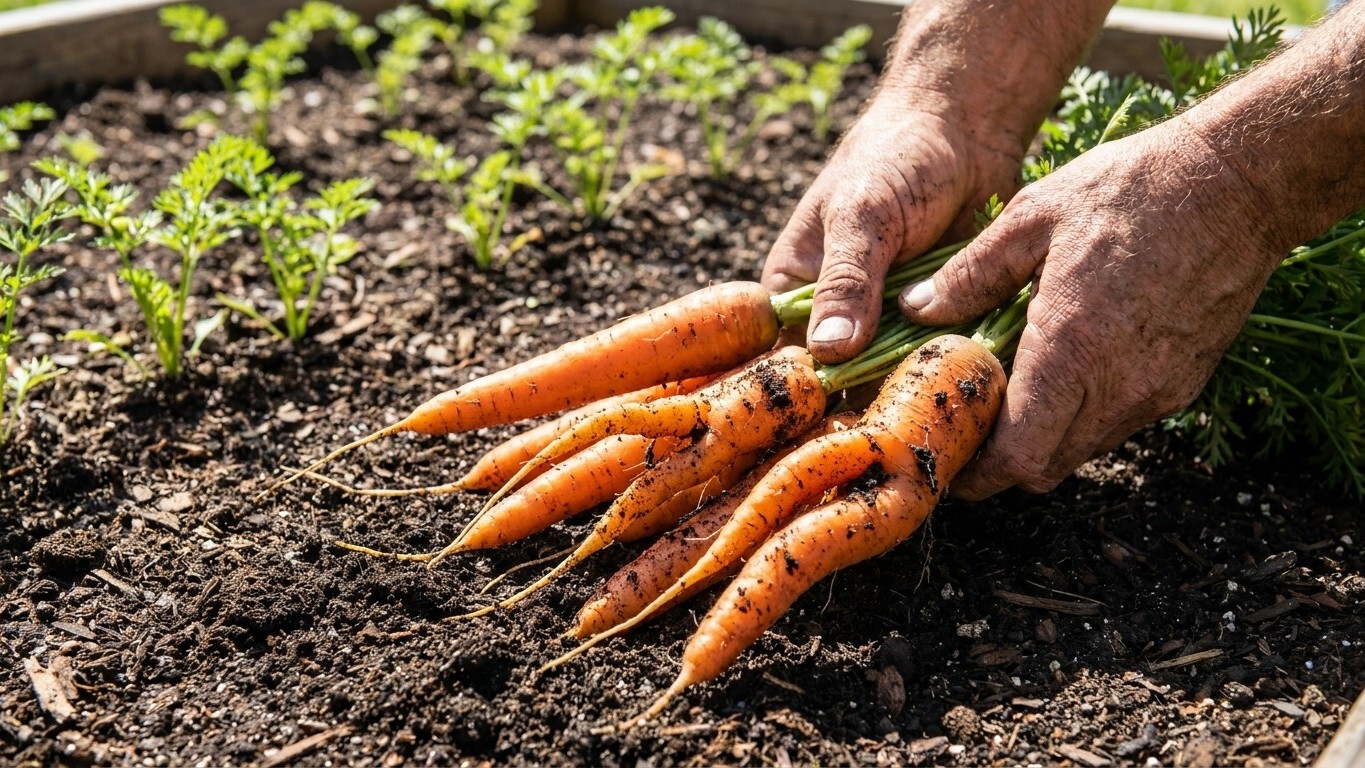
Set that against what a carrot actually wants. Utah State University Extension puts it plainly: carrots need deep, sandy, well-drained soil rich in organic matter to grow a straight root. Heavy or rocky ground makes the root fork instead of growing down. On paper, the territory’s low clay content and well-drained rating look promising, closer to what a carrot wants than the heavy clay soils that cause trouble in a lot of other places. The catch is depth, not texture. A carrot taproot wants to run straight down for six inches or more, and where the thawed layer above permafrost is shallow, that root hits cold, frozen ground before it’s finished growing. The result looks the same as forking in a clay soil, a stubby or split root, even though the cause is completely different.
The fix for a shallow thaw layer isn’t the same fix Extension gives for heavy clay, but the tools overlap. Building up a raised bed with compost worked into the top eight to twelve inches gives the taproot more depth to work with before it meets colder ground, and it warms faster in spring than the surrounding soil does, which matters when every week of growing season counts. Double digging helps too, loosening and mixing organic matter deeper into the profile where the survey data can’t tell you what’s actually there.
None of this replaces knowing your own yard. The Northwest Territories spans an enormous range of ground, from river bottoms to muskeg to gravel pads a builder graded flat, and the soil survey behind these numbers covers the territory’s agricultural areas, not every corner of it. Treat the Cryosol profile as a starting point that tells you what the region’s ground tends to do, then check what’s actually under your garden before you plant.
The test that settles it in your own garden
A soil survey number is an average pulled from dozens of sample sites. Your garden bed is one spot, and it might not look anything like the median. The only way to know what you’re actually working with is to dig, feel, and watch what the water does.
- Dig a test hole at least a foot deep. Note where the soil changes color or turns hard and cold. In much of the territory that’s where the thawed active layer ends and permafrost or deeply chilled ground begins. That depth is your real planting limit, whatever the survey average says.
- Check for stones and obstructions as you dig. Carrots fork around anything solid in their path, rocks, buried roots, or a hardpan layer. Pull out what you can reach and note whether the obstruction repeats at the same depth across the bed.
- Feel the texture between wet fingers. Grab a handful of moist soil and rub it into a ribbon. Sandy soil falls apart and feels gritty. Silty soil feels smooth and floury. Clay stretches into a long ribbon before breaking. This tells you more about your actual bed than any territory-wide percentage.
- Run a drainage check. Dig a hole, fill it with water, let it drain once, then fill it again and time how long the second fill takes to disappear. Water that lingers for hours points to a compacted layer or a high water table, either of which will sit a carrot root in soggy ground it doesn’t want.
- Compare what you found to the depth a carrot needs. If your test hole hit cold, hard ground, stone, or standing water within the top eight inches, that’s your answer regardless of what the regional average says. A raised bed solves all three problems at once by giving the root loose, workable depth above whatever’s underneath.
What goes wrong here
- Forking from a shallow root zone. When the taproot meets frozen or compacted ground before it’s finished growing, it splits or stops rather than running straight. Build a raised bed or double-dig the planting row with compost worked in deep, giving the root more workable soil above the cold layer.
- Poor germination during a warm, dry spell. Carrot seed is small and sits near the surface, and the well-drained, sandy-loam texture common across the territory sheds moisture fast once the sun is out. A dry crust on top can stop germination cold even when the seed underneath is viable. Keep the seedbed damp with light, frequent watering until seedlings are up, and consider covering the row with a thin layer of straw or damp burlap to slow surface drying.
- Splitting roots from uneven watering. The same fast-draining texture that helps avoid waterlogging also means the soil dries out quickly between waterings. A dry stretch followed by a heavy soak makes the root swell too fast and crack. Water on a steady schedule instead of letting the bed dry hard and then flooding it, and mulch to even out moisture between waterings.
- Stunted roots from thin topsoil over rocky or gravelly subsoil. Where the active layer is thin, gravel or coarse fill sometimes sits close to the surface. Rather than fighting it in place, build up rather than dig down, adding a raised frame filled with a loose, compost-rich mix so the root has depth that the native ground can’t provide.
Common questions
What’s the exact last frost date for my community?
That figure isn’t published in the soil data behind this page, and frost dates across a territory this size vary enormously between communities. Check with your local agricultural extension office or a regional gardening group for the date specific to where you live, then count back the 70 to 100 days your carrot variety needs to mature from seed.
Should I pick a specific carrot variety for this soil?
The available data doesn’t name a variety suited to the territory’s Cryosol soils, so no specific recommendation is made here. What matters more than variety choice is root depth: a shorter, stubbier carrot type may cope better with a shallow thawed layer than a long, tapering type that needs a foot of loose soil to grow straight.
What’s the soil pH like across the Northwest Territories?
No median pH is published for the mapped surface here. If pH matters for your planting plan, a home soil test is the only way to get a real number for your bed.
Do I count the 70 to 100 days from planting or from when seedlings appear?
From seeding. Carrots are sown directly in place and never transplanted, so there’s no transplant date to count from. The full 70 to 100 days runs from the moment seed goes into the ground.