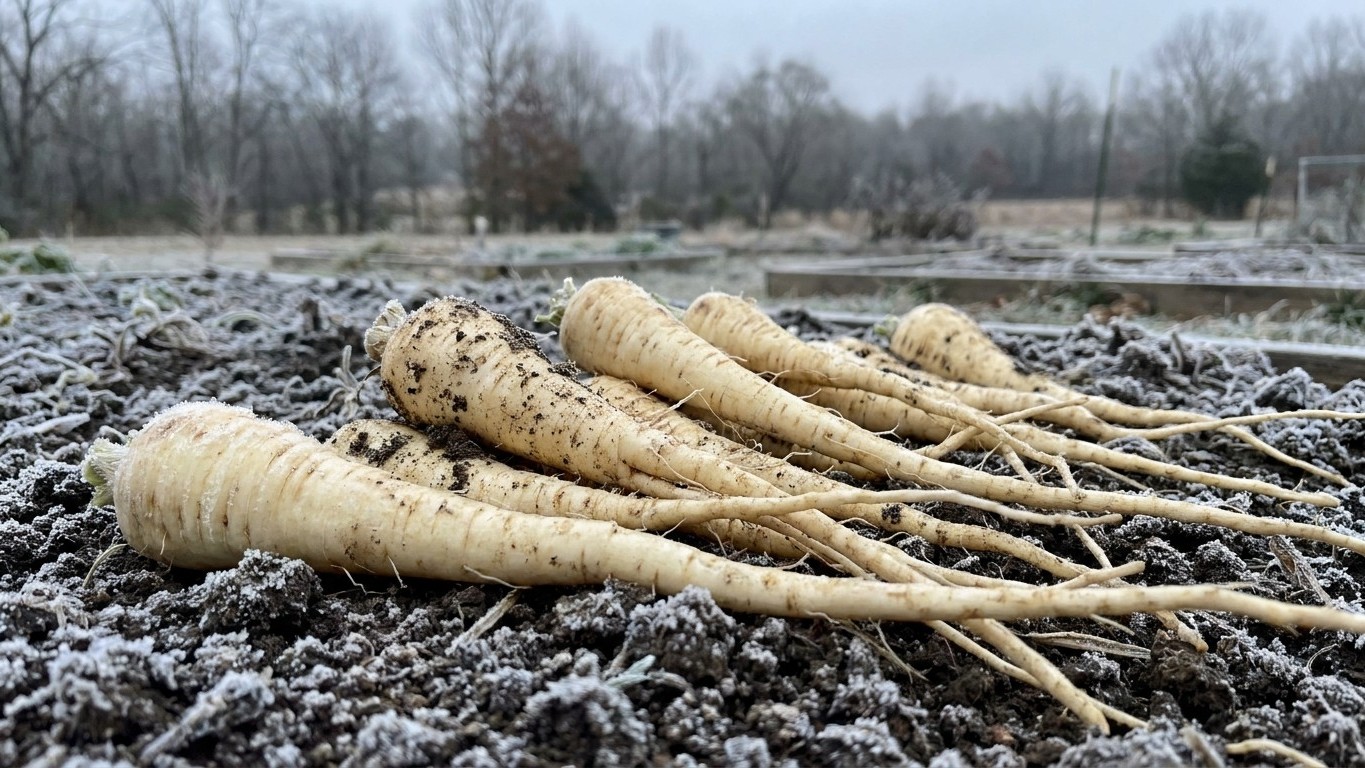

Oklahoma City’s coldest month averages a nightly low of 27°F, and that number alone answers the sweetening question: this state delivers real, sustained frost, not just a token freeze or two. A parsnip left in Oklahoma ground after that cold arrives will convert its stored starch to sugar the way the crop is supposed to. The harder question is timing the planting so the roots are mature and waiting when that cold shows up.
The short answer
Frost exposure, not the hardiness zone, is what decides whether a parsnip sweetens or just grows fat and starchy in the ground. A hardiness zone tells you what survives winter. It says nothing about how many weeks of genuine cold a crop actually sits through, and sweetening is a cold-exposure process, not a survival threshold. That distinction matters here because Oklahoma’s zone map alone would tell you almost nothing useful about parsnip flavor.
The number that does the work is the mean daily minimum for the coldest month, and for the Oklahoma City reference station that figure is 27°F. That is not a record low and not a monthly average temperature. It is the typical overnight low across the coldest stretch of the year, and it sits comfortably below freezing for weeks at a time. A single overnight dip to 32°F converts a little starch. A string of nights in the high 20s, repeated across December, January, and often into February, is what actually builds sweetness in the root.
Given that pattern, the answer for most of Oklahoma is straightforward: yes, this climate will sweeten parsnips, provided the gardener leaves the roots in the ground long enough to catch that cold. The mistake to avoid is harvesting on the calendar instead of on the thermometer. A parsnip pulled the week it reaches size, before the first hard frosts of late fall and early winter have had their say, will taste like a bland, fibrous carrot cousin. The same root, left alone through several more weeks of 27°F nights, becomes noticeably sweeter and nuttier.
Worth noting: 27°F is a state average built from a single reference station, and Oklahoma spans a lot of ground, from the humid southeast to the drier panhandle. Elevation and local microclimate shift that number around, sometimes by several degrees. But the broad pattern holds almost everywhere in the state: winters here are cold enough, and long enough, to sweeten a parsnip crop that was planted with enough lead time to mature before the cold sets in. The planting math, not the winter cold, is where things get tight.
Does the season fit?
Utah State University Extension puts parsnip maturity at 100 to 120 days from seeding, with sowing recommended 2 to 3 weeks before the last spring frost. Lay that timeline against Oklahoma’s frost dates and the arithmetic works out generously in this state’s favor.
- Find the local last spring frost. At the Oklahoma City reference station, that window runs March 28 to April 10, based on NOAA’s 1991-2020 climate normals.
- Back up 2 to 3 weeks for sowing. That puts seeding somewhere between roughly March 7 and March 27, depending on how the local frost date lands within that window.
- Add the germination lag. Parsnip seed is slow, typically 14 to 21 days before shoots break the surface. A gardener who sows in mid-March should not expect to see green rows until early to mid-April, and shouldn’t assume a bare bed means failed seed.
- Count 100 to 120 days from the sowing date, not from germination. Starting from early to late March, that lands maturity somewhere between mid-June and late July.
- Compare that to the first fall frost. The Oklahoma City reference station sees its first fall frost between October 29 and November 8.
- Measure the gap. Roots reaching maturity in June or July, sitting untouched until frost arrives in late October or early November, leaves months of margin, not weeks.
That gap is the real story here. In short-season states, the arithmetic between sowing, maturity, and first frost is tight enough to worry about. In Oklahoma, it isn’t. The season fits comfortably, and the surplus time works in the crop’s favor: the roots simply hold in the ground through summer and into fall, waiting for the cold that triggers sweetening, with no risk of the season running out before that cold arrives.
What goes wrong here
- Forked roots in heavy or stony ground. Much of Oklahoma carries clay-heavy or rocky soil that a straight taproot can’t push through cleanly, so it splits around obstructions instead. Utah State Extension’s remedy is direct: double dig heavy soil before sowing, or build a raised bed of deep, loose, sandy loam so the root has nothing to deflect off of.
- Forked roots from overwatering. This is a separate cause from heavy soil, not the same problem in different clothes. Inconsistent or excessive watering, especially heavy soaking after dry spells, encourages the root to branch rather than run straight down. Even, moderate moisture through the growing season keeps the taproot committed to one direction.
- A crusted seedbed that hides a germination failure. Because parsnip seed takes 14 to 21 days to sprout, a hard-crusted or dried-out surface during that window can look like failed seed when it’s really just slow seed. Keep the top inch of soil consistently damp until shoots appear, and resist the urge to re-sow at week two.
- A mild winter that never delivers enough cold. Oklahoma’s average is cold enough for sweetening, but averages hide variation, and a warmer-than-typical winter can shortchange the flavor payoff. The fix is patience rather than a calendar date: wait for several hard frosts, not just the first light one, before pulling roots meant for eating fresh.
North Carolina Extension’s Gardener Plant Toolbox states it plainly: “All parts of this plant contain furocoumarins which can make skin sensitive to light causing burns so be sure to wear gloves, long sleeves and long pants when dealing with it.” That means the roots, the leaves, and the stems all carry this compound, not just the leafy tops that most gardeners assume are the only risky part.
The mechanism is what makes this catch people off guard. Furocoumarins don’t burn skin on contact alone. The reaction needs sap on the skin and sunlight hitting that same skin, together. That combination is exactly what a fall harvest day delivers: bright sun overhead, bare forearms brushing against foliage while pulling tops, sap transferring to skin without anyone noticing. The burn itself often doesn’t show up until hours later, which is part of why so few gardeners connect it back to the parsnip patch at all. Because sunlight is the second ingredient, washing hands after the fact does little good once skin has already been exposed in daylight. The real protection is preventing contact in the first place: gloves, long sleeves, and long pants, worn before the digging starts, not applied as cleanup afterward.
Checking this against your own county
Every figure here comes from a single reference station near Oklahoma City, and Oklahoma’s frost timing shifts meaningfully across the state, arriving later in spring and earlier in fall as you move toward higher ground or further from that reference point, sometimes by a week or two. Before locking in a sowing date, check those numbers against your own county rather than treating a state capital reading as a statewide guarantee.
Oklahoma State University Extension maintains local offices across the state built for exactly this kind of question, and their staff can confirm frost dates, soil conditions, and planting windows specific to your county. Their statewide extension portal is the fastest way to translate these general figures into something reliable for your own garden.
Common questions
Can parsnips be left in the ground all winter in Oklahoma?
The facts here don’t publish a specific overwinter storage recommendation for Oklahoma ground, so that call depends on local soil freeze depth, which varies by county. Checking with a local extension office is the reliable way to confirm whether ground freezes hard enough locally to complicate digging through winter.
Does a light frost sweeten parsnips as well as a hard freeze does?
The available research points to several weeks of frosty weather, not a single light frost, as what converts starch to sugar. One cold night starts the process; repeated cold nights are what actually build noticeable sweetness.
Why did my parsnip seeds seem to fail before finally sprouting?
Parsnip seed germinates slowly, typically 14 to 21 days, which is longer than most garden vegetables. A bare-looking bed at the two-week mark is normal, not a sign of failed seed, provided the soil surface has stayed consistently moist.
Is it safe to compost parsnip tops after harvest?
The safety concern here is about skin contact during handling, specifically sap combined with sunlight, not about composting itself. Wearing gloves, long sleeves, and long pants while pulling and handling the tops addresses the actual risk regardless of what happens to the foliage afterward.