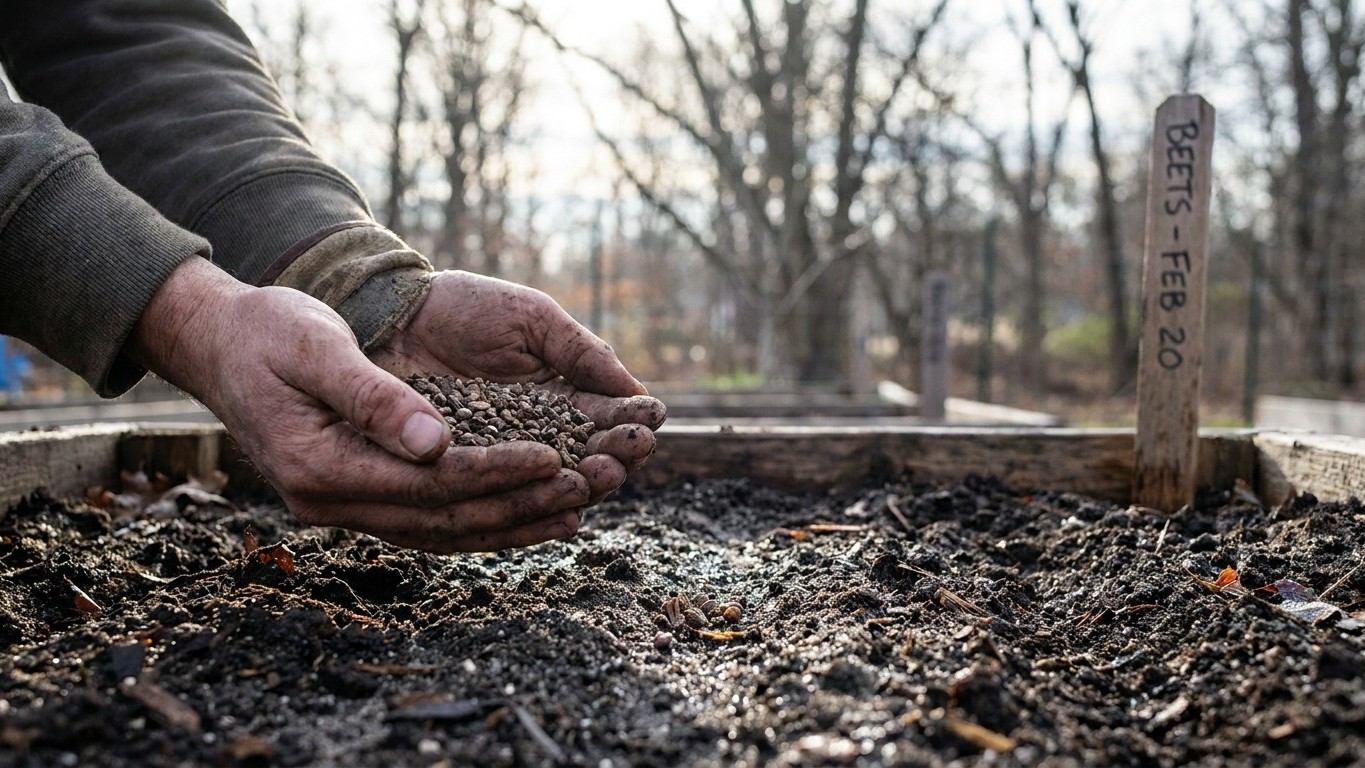

In central Oklahoma, the last spring frost typically falls between March 28 and April 10, so the safest sowing window for beets runs from roughly the first week of March to the last week of that month, about two to three weeks ahead of frost. That timing matters more than the calendar date itself, because what happens in the six weeks right after seeding decides whether the crop bolts, cracks, or turns woody before it ever reaches the table.
The short answer
Oklahoma’s official state soil is the Port series, a Mollisol, the same family of deep, dark prairie soils that built the Corn Belt. Where it’s mapped, the surface horizon runs close to neutral, about pH 7.0, with a texture that leans silty: 12 percent sand, 19 percent clay, and 69 percent silt, carrying roughly 2.0 percent organic matter and draining well. That’s the picture USDA’s own soil survey data gives for the Port series specifically, named the state soil by Oklahoma law back in 1987.
Set that next to what a beet actually wants. Utah State University Extension describes the ideal bed as deep, sandy, and well-drained, rich in organic matter, amended with no more than 1 inch of composted material per 100 square feet. The Port series checks the drainage box and comes close on organic matter, but its sand content is a fraction of what beets prefer, and that much silt means a crust can form over the seedbed after a hard rain, right when a beet seed is trying to push through. Sandy loam ground handles that far better than a silt-heavy one.
Heat is the other half of the equation, and here the picture is qualitative rather than a specific figure: the annual count of days above 90°F for the reference weather station isn’t part of the dataset behind this page. What is documented is the mechanism. Utah State’s research flags 85°F combined with water stress as the point where a beet root starts turning woody and fibrous. Oklahoma summers reach and hold past that threshold for weeks at a stretch every year, arriving earlier than in most northern states. A beet sown late enough that its root-bulking stage lands in June rather than May is gambling against that heat, regardless of the exact day count.
One more thing worth saying plainly: Oklahoma spans hundreds of distinct soil series, and a home garden in Tulsa’s river bottoms, in the Panhandle’s sandier ground, or on a lot a builder graded and filled a decade ago can look nothing like the Port series described above. Treat these numbers as a starting point for what the region’s ground tends to do, then confirm your own bed with a soil test rather than assuming the state soil’s pH and texture apply to your yard.
The six weeks that decide it here
Sowing two to three weeks ahead of that March 28 to April 10 frost window puts a beet’s earliest, most vulnerable growth stage squarely into an Oklahoma spring, and that season has a reputation for a reason. It swings. Weeks of dry, windy stretches can alternate with sudden heavy rain, and a bed that was bone-dry on Tuesday can be waterlogged by Friday. For a beet seedling, that instability lands directly on the failure Utah State names first: water stress in the first six weeks after sowing triggers premature flowering, known as bolting, and once a beet bolts, the root stops bulking up and the plant channels its energy into a flower stalk instead.
This is a different problem from the heat-driven woodiness that shows up later, and the two shouldn’t be folded into one vague instruction to “keep it watered.” Bolting is a response to inconsistent moisture early in the plant’s life, often triggered by a dry snap right after germination. Woodiness is a response to heat stress later, once the root is already forming, and it shows up even in beds that were watered adequately the whole way through if the thermometer runs hot enough during bulking. Oklahoma’s early spring dryness threatens the first outcome; its early summer heat threatens the second. A gardener managing only for one risks losing the crop to the other.
Practically, that means the six weeks after a March sowing need steady, even moisture, not a flood-and-drought pattern. On the silt-heavy Port-type ground, that also means watching for surface crusting after a downpour, since a crust can trap a germinating seed underneath it as effectively as drought can stress the seedling above it. A light layer of mulch or a gentle raking of the crust once it forms helps keep both risks in check without swinging the bed toward waterlogging.
What goes wrong here
- Bolting from an early dry spell. A week or two without rain right after germination is enough to push a beet toward flowering instead of root growth. Water on a consistent schedule through the first six weeks rather than relying on rainfall, and check soil moisture at seedling depth, not just the surface, before assuming the bed is fine.
- Woody roots from a late sowing meeting early heat. Beets sown in place typically need somewhere between 60 and 80 days from seeding to reach harvest size, and if that window stretches into weeks of 85°F-plus days, the root turns fibrous and tough. Sow as close to that March window as the county’s own frost history allows, and pull roots as soon as they hit usable size rather than letting them sit in the ground through the first heat wave.
- Surface crusting on silt-heavy ground. The Port series’ 69 percent silt content means a hard rain can seal the surface into a crust that a fine beet seedling struggles to break. Keep the top inch of the seedbed loose and slightly moist rather than letting it dry to a hard cap, and consider a thin mulch layer over the row until seedlings emerge.
- Thin organic matter limiting root development. At roughly 2.0 percent organic matter, the mapped Port series surface sits below what beets do best in. Work in composted organic matter ahead of sowing, capped at 1 inch per 100 square feet per Utah State’s guidance, rather than adding it heavily all at once.
- Compaction on ground that isn’t actually Port-series-like. Plenty of Oklahoma yards sit on clay-heavier or disturbed soil that drains far worse than the well-drained Port series this page describes. If water pools on the bed after rain, raised beds or deep tilling before sowing solve a problem that no amount of watering discipline will fix on its own.
Common questions
Can I plant beets in the fall in Oklahoma instead?
The frost data behind this page covers only the spring window, the March 28 to April 10 last-frost range for the reference weather station. A fall planting schedule depends on the first fall frost date for a given county, which isn’t part of the dataset used here, so check that date locally before planning a second sowing.
How long until beets are ready to harvest after sowing?
Beets sown directly in the ground generally reach harvest size somewhere between 60 and 80 days after seeding, not from a transplant date, since beets aren’t typically started indoors and moved. That range varies by variety and by how much heat and water stress the roots face along the way.
Should I trust the state soil’s pH for my own garden bed?
No. The pH 7.0 figure describes the mapped surface horizon of the Port series specifically, one soil series among hundreds across Oklahoma. A worked garden bed, especially one that’s been amended, tilled, or built on fill dirt, can run noticeably more acidic or alkaline. A soil test is the only way to know your own number.
Does adding compost fix Oklahoma’s silt-heavy soil for beets?
It helps but doesn’t fully substitute for the sandy texture beets prefer. Utah State’s recommendation caps composted organic matter at 1 inch per 100 square feet worked into the bed, which improves structure and drainage over time without overloading the soil with nutrients or creating its own compaction problem.