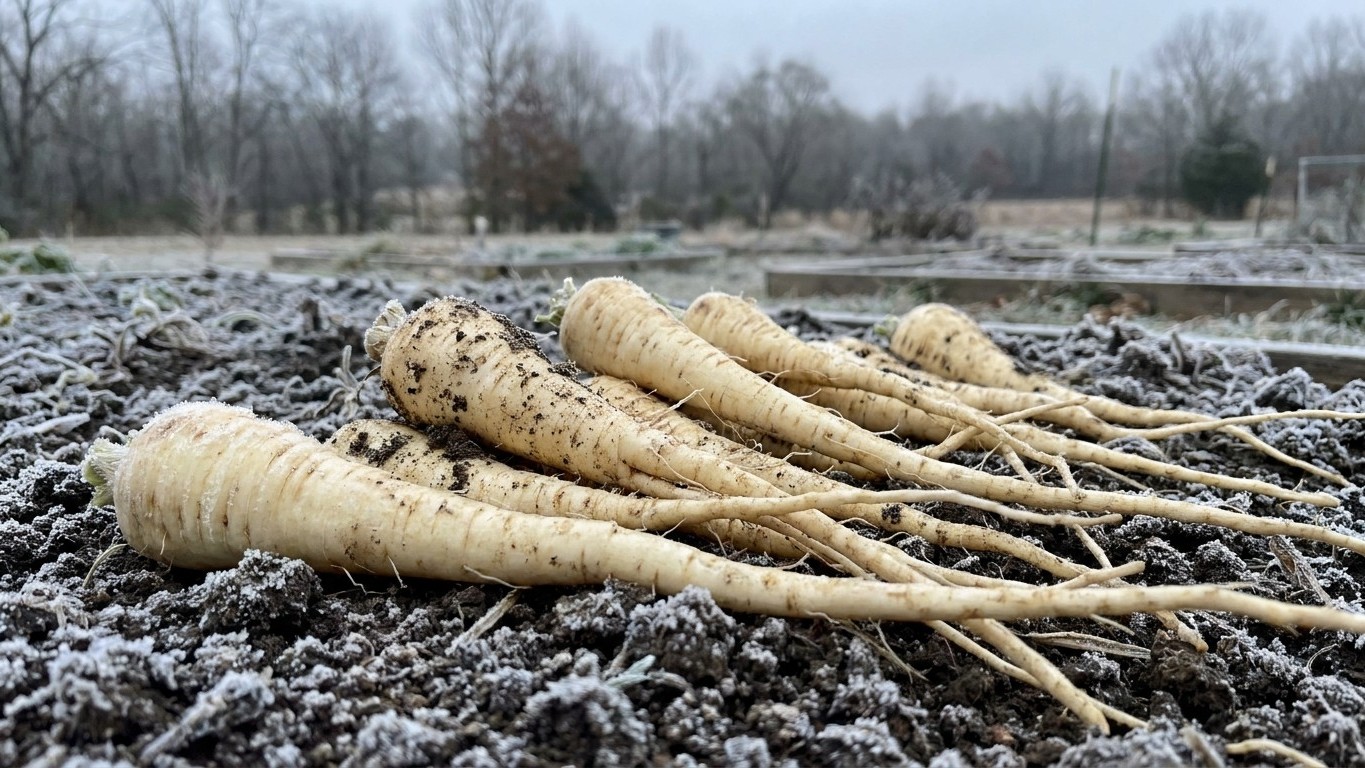

Yes, parsnips grown on Prince Edward Island will sweeten, and the reason has nothing to do with the province’s hardiness zone. It comes down to exposure: PEI’s coldest month averages a mean minimum of 10.3°F, which is more than enough frost to convert the root’s stored starch into sugar. The season length is tighter, but it still works if you sow at the right moment.
The short answer
The question that actually decides this isn’t “how cold does it get once in a while” but “does this place deliver several sustained frosty weeks.” On Prince Edward Island, using the Charlottetown reference station, the coldest month has a mean daily minimum of 10.3°F. That’s not a record low pulled from one brutal night; it’s the average low across the coldest weeks of the year, which tells you frost here isn’t a fluke, it’s routine.
That distinction matters because parsnips don’t sweeten from surviving winter in some technical sense. They sweeten from sitting in ground that’s repeatedly chilled below freezing, which triggers the root to break down starch into sugar as a kind of internal antifreeze. A garden in a mild coastal pocket with a comfortable hardiness rating can grow a perfectly healthy parsnip that never gets much sweeter than a carrot, simply because it never sees enough cold. Prince Edward Island doesn’t have that problem. A mean minimum of 10.3°F in the coldest month means the ground gets hit with real, sustained cold, week after week, not just an occasional light frost.
So the answer for growers here is straightforward: leave the roots in the ground after they mature, let them ride out several weeks of frosty fall and early-winter weather, and the sweetening will happen on its own. You don’t need to force it or guess at it. The climate does the work, provided the roots are already sized up before that cold sets in, which is where timing starts to matter more than temperature.
Where this could go wrong isn’t the cold, it’s the calendar. If parsnips are sown too late, they might still be small, thin roots by the time the ground freezes solid enough to stop growth. A sweet parsnip and a stunted parsnip can come from the same cold snap. The frost exposure here is not in question; the growing window leading up to it is what needs checking, and that’s the next thing to work out.
Does the season fit?
Parsnips are sown directly in the ground, not transplanted, and the standard guidance from Utah State University Extension calls for 100 to 120 days from seeding to harvest, with sowing done 2 to 3 weeks before the last spring frost. Here’s how that lines up against Prince Edward Island’s frost window, using the Charlottetown average dates.
- Sowing window: The average last spring frost at Charlottetown falls on May 16, so seeding 2 to 3 weeks earlier lands roughly between late April and early May. That’s the target start date, weather and soil conditions allowing.
- Germination lag: Parsnip seed is notoriously slow, taking 14 to 21 days just to sprout. Seedlings sown in late April likely won’t show above ground until mid-to-late May, which is normal, not a sign of failed seed.
- Maturity clock: The 100 to 120 days run from the seeding date, not from germination. A late-April sowing puts harvest-ready roots somewhere between mid-August and early September.
- Frost margin for sweetening: The average first fall frost at Charlottetown is October 17. That leaves roughly six to eight weeks of cooling weather and early frosts between a September root and the point where the ground gets seriously hard, which is exactly the stretch that builds sugar.
- Total arithmetic: From a late-April sowing to the mid-October frost date is around 175 days. Against a 120-day requirement, that’s a comfortable margin, roughly eight weeks of slack, even accounting for slow germination and a slightly delayed spring.
The takeaway: the season fits comfortably here, not tightly. The risk isn’t running out of days, it’s starting too late in a wet or cold spring and eating into that margin unnecessarily.
What goes wrong here
- Forked roots from heavy or stony ground: Parsnips push a single long taproot, and any rock, clump, or compacted layer splits it into forks. Utah State Extension recommends deep, sandy soil, and where the native ground is heavier, double digging to break up compaction before sowing is the fix, not fertilizer or variety choice.
- Forked roots from overwatering: This is a separate cause from soil texture. Excess moisture, especially inconsistent watering that swings from soggy to dry, can also cause the root to split or branch. Even in loose, sandy soil, uneven watering undoes the benefit. Steady, moderate moisture through the growing season is the remedy here.
- Season running out before roots size up: On PEI this is more about a late start than a short season, since the frost window itself is generous. Sowing promptly in the 2-to-3-week stretch before the average May 16 last frost, rather than waiting for a “safe” date well past it, protects the margin calculated above.
- Winter too mild to sweeten: This is the failure that defines a lot of southern and coastal gardens, but it isn’t the risk on Prince Edward Island. A coldest-month mean minimum of 10.3°F is well within the range that reliably triggers the starch-to-sugar conversion, so growers here don’t need to worry about a “flat” parsnip from insufficient cold. The remedy, if anything, is simply patience: leave roots in the ground through several frosty weeks rather than pulling them at the first light freeze.
Every part of a parsnip plant, not just the leafy tops, carries a compound that turns a sunny harvest afternoon into a skin hazard. North Carolina State Extension states it directly: “All parts of this plant contain furocoumarins which can make skin sensitive to light causing burns so be sure to wear gloves, long sleeves and long pants when dealing with it.”
What makes this catch people off guard is the mechanism. The sap alone doesn’t burn skin. It’s the combination of sap contact and sunlight, a reaction called phytophotodermatitis, that causes the damage. That’s why the injury doesn’t show up immediately at the sink where you’re washing dirt off your hands; it develops hours later, after skin that touched broken leaves, stems, or roots has spent time in direct sun. A bright day spent pulling tops or hauling up roots at harvest is exactly the kind of exposure that sets it off.
Because the trigger is sunlight, not the sap by itself, rinsing your hands afterward doesn’t undo the exposure the way it might with a simple irritant. The protection has to come before contact: gloves, long sleeves, and long pants while handling any part of the plant, whether you’re weeding around it, cutting the foliage back, or digging the roots on a clear afternoon.
Checking this against your own county
The figures here come from the Charlottetown A reference station, and Prince Edward Island isn’t one uniform climate. Northern coastal areas, low-lying valleys, and inland districts can each run their own version of frost timing, sometimes weeks apart from what Charlottetown records. Before locking in a sowing date based on the numbers above, it’s worth checking local conditions with Prince Edward Island’s provincial agriculture services, which can speak to microclimate variation and soil conditions specific to your part of the island. A backyard a few miles from the coast, or one sitting in a frost pocket, can easily run on a different calendar than the averages suggest.
Common questions
Do parsnips need to be dug up before winter on Prince Edward Island?
No. Given a coldest-month mean minimum of 10.3°F, roots can stay in the ground through multiple frosts, which is what drives the sweetening. Many gardeners leave them in place and harvest through fall and into early winter as needed.
What happens if parsnips are sown after the recommended late-April to early-May window?
The 100-to-120-day maturity window still has to run its course, so a later sowing pushes harvest later into fall. Given the roughly eight-week buffer before the average October 17 frost, a delay of a couple of weeks is unlikely to cause failure, but it does eat into the margin.
Why haven’t my parsnip seeds sprouted after a week?
Parsnip germination takes 14 to 21 days, which is slow compared to most garden vegetables. A week with no visible seedlings is normal, not a sign the seed failed.
Is it safe to compost parsnip tops after harvest?
The safety concern with furocoumarins is about skin contact combined with sunlight exposure while handling the plant, covered by wearing gloves and long sleeves during harvest. No treatment or handling guidance beyond that precaution is specified by the source used here.