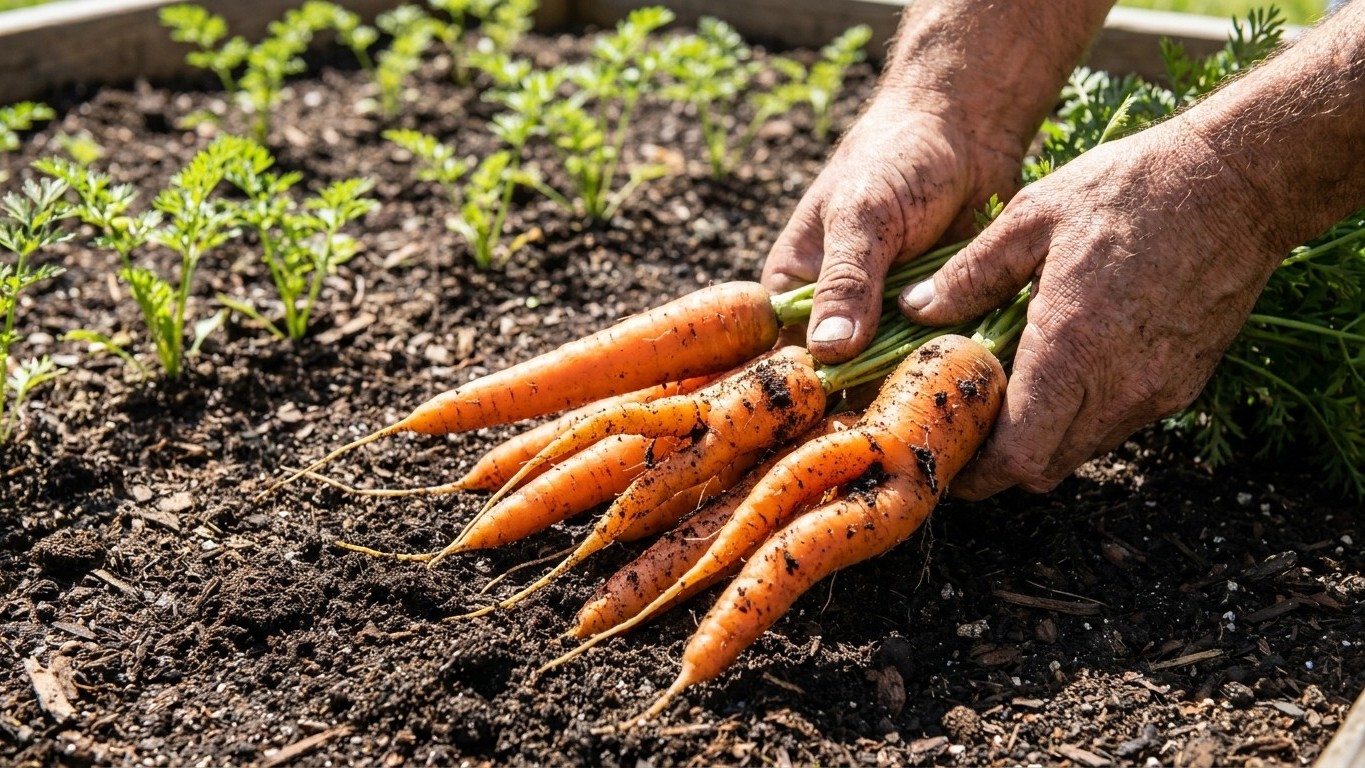

Carrots go into Saskatchewan ground as seed, not transplants, as soon as the soil can be worked in spring, since the crop tolerates cool soil and needs 70 to 100 days from sowing to reach full size. No specific last-frost date is published in the data behind this page, so check your own local frost record before you commit seed to the ground. What decides whether that seed grows into a straight root or a forked, stunted one is the soil itself, and Saskatchewan’s dominant ground type has traits worth knowing before you dig.
The short answer
The most common soil across Saskatchewan’s mapped agricultural land is a Chernozem, the deep, dark grassland soil the prairies are known for, rich in organic matter and naturally fertile. It covers 68 percent of the mapped surface, with Solonetzic soils as the next most frequent type. The median surface reading for this dominant profile sits at a pH of about 6.8, close to neutral. Texture runs loam to silt: 43 percent sand, 22 percent clay, 35 percent silt, with organic matter around 4.0 percent and drainage classed as well drained. That comes from Agriculture and Agri-Food Canada’s Canadian Soil Information Service, drawn from the surface horizons of 3,675 mapped soil components across the province.
What that soil means for carrots
Carrots want deep, sandy, well-drained ground rich in organic matter, according to Utah State University Extension. Heavy or rocky soil is what makes the taproot fork instead of growing straight down. Saskatchewan’s dominant profile is a reasonable middle ground: the sand share is decent, the drainage class is favorable, and the organic matter content is generous. But 22 percent clay is enough to cause forking in a bad pocket, especially where a Solonetzic soil sits underneath, since those layers tend to compact hard and resist a taproot pushing through. Where that’s the situation, the fix isn’t a different carrot variety. It’s plenty of compost worked in and a full double dig before sowing, or building a raised bed filled with loosened, amended soil so the root never meets the dense layer at all.
A starting point, not a diagnosis
None of this describes your backyard specifically. Saskatchewan spans hundreds of individual soil series, and the numbers above are a median across the agricultural regions the survey covers, not a reading from any one garden. The province’s far north, largely outside farmland, isn’t represented at all. River bottoms, low-lying muskeg, and any yard where a builder scraped, filled, or graded the topsoil can sit far from that median in either direction. Treat the Chernozem profile as a description of what the region’s ground tends to do, hold moisture reasonably well, run close to neutral, carry decent organic matter, and then find out what your own patch of dirt actually does.
The test that settles it in your own garden
A soil test lab will give you an exact pH and nutrient reading, but you can learn what matters most for carrots with nothing more than a shovel, a bucket of water, and twenty minutes.
Four checks before you sow
- Dig a hole at least a foot deep where you plan to sow. Note how far down you can go before hitting a hard, dense layer, a patch of rock, or heavy clay that resists the shovel. Carrots need that clear run of loose soil to grow straight.
- Look at what comes out. Stones and rubble in the spoil pile mean forked, split, or twisted roots later, no matter how good the surface looks. A stone-free profile down to at least eight inches is what you’re after.
- Feel the texture between your fingers. Squeeze a handful when it’s moist. Soil that holds a ribbon shape and feels slick is heavy in clay. Soil that falls apart and feels grainy leans sandy. Something in between, crumbly but able to hold a loose shape, is closer to the loam carrots prefer.
- Watch how water drains. Pour a bucket of water into the hole and time how long it takes to disappear. Water sitting for hours points to poor drainage and a real risk of rot and forking. Water gone within a reasonable stretch confirms the ground drains the way carrots need.
Run this on more than one spot in the garden if the beds are large. Soil can shift character within a few feet, especially near a foundation, a driveway, or anywhere fill dirt was brought in at some point.
What goes wrong here
Saskatchewan’s climate and dominant soil combine to produce a handful of repeat problems in carrot beds.
The three most common failures
- Forking in heavy ground. Wherever the clay share runs higher than the provincial median, or a dense Solonetzic layer sits close to the surface, the taproot splits around the obstruction instead of growing through it. The remedy is working in compost and double digging the bed before sowing, or switching to a raised bed filled with loosened soil so the root never reaches the dense layer.
- Poor germination during a hot, dry stretch. Carrot seed is small and sits shallow, so it dries out fast once the surface bakes. The remedy is keeping the seedbed consistently damp through germination, checking it daily if a warm spell hits right after sowing.
- Splitting from uneven watering. A root that grows through a dry stretch and then gets a heavy soak swells too fast and cracks. The remedy is a steady watering routine from sowing through harvest, rather than long gaps followed by a flood.
None of these three trace back to the seed or the variety. They trace back to what the ground does, and to how consistently the bed gets watered once the seed is in it.
Common questions
Do carrots need a raised bed in Saskatchewan?
Not everywhere. If your own dig test shows a clear, stone-free run of loose soil at least eight to twelve inches deep, in-ground sowing works fine. A raised bed becomes the practical answer once you hit heavy clay or a dense layer close to the surface, since it lets you control the soil the root actually grows through.
Can I sow carrot seed straight into Chernozem soil without amending it?
The median profile, loam to silt with well-drained conditions and generous organic matter, is workable soil for carrots as it stands. The main risk is the clay fraction, so working in compost before sowing still helps loosen the top layer and improve how straight the root grows, even in ground that tests close to the provincial median.
How do I know if my soil is more clay than the provincial average?
Run the squeeze test from the second section. Soil that ribbons and feels slick when moist carries more clay than the loam-to-silt median. Combine that with the dig test: a shovel that meets real resistance a few inches down is a strong sign the clay share runs higher than average in that spot.
Does Saskatchewan soil chemistry favor carrots?
The median surface pH for the province’s dominant soil sits close to neutral, which sits within the range most root vegetables tolerate reasonably well. That figure is a provincial median from mapped agricultural soils, though, not a reading from any single garden, so it’s worth treating as a general signal rather than your own number until you test the actual bed.