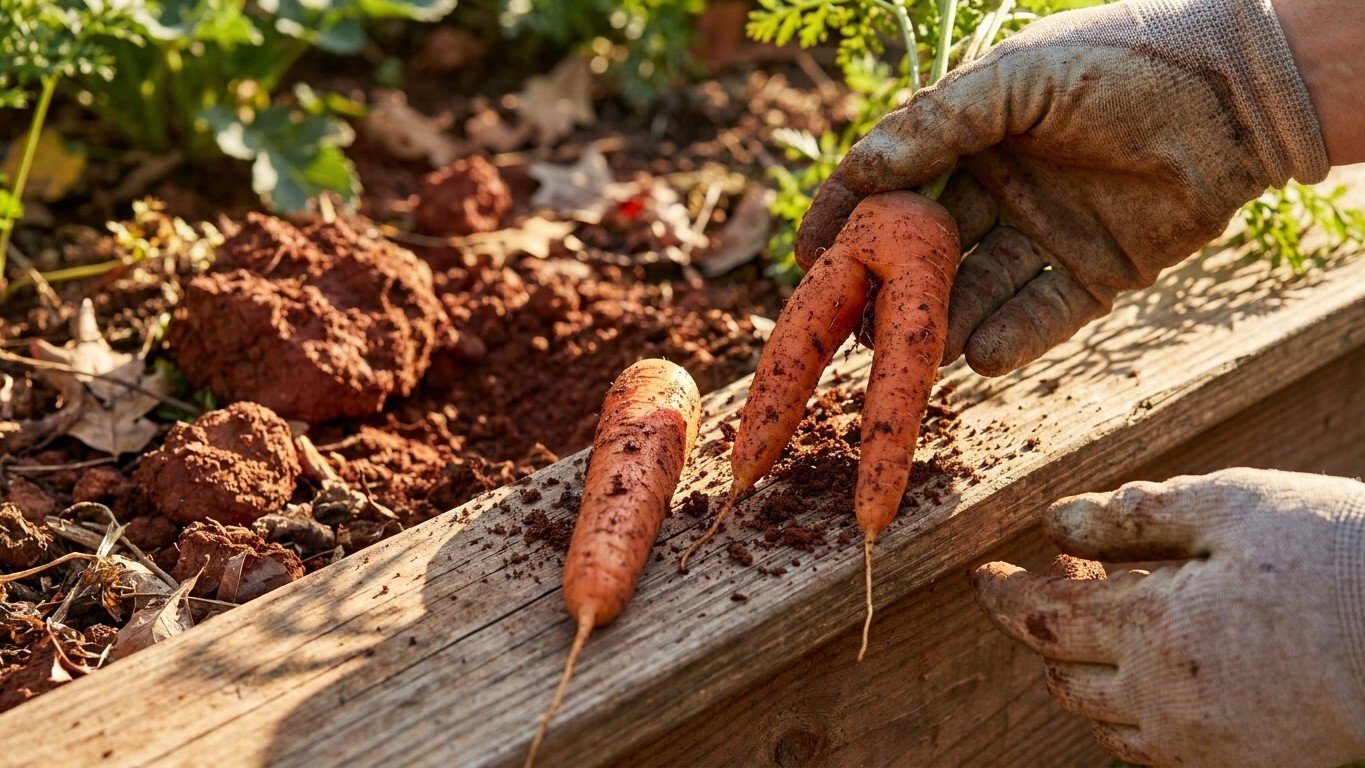

Mostly, no. Virginia’s benchmark soil, the Pamunkey series, runs mostly sand and silt with just 11 percent clay, well drained enough that carrot roots generally push straight down instead of splitting around an obstruction. That said, this one mapped series is not a promise about your yard. Virginia’s ground shifts from Tidewater sand to Piedmont clay to mountain rock in a matter of miles, and the only way to know your own answer is to dig where the carrots will actually grow.
The short answer
USDA NRCS lists the Pamunkey series as the soil representing Virginia in its State Soils program. It’s an Alfisol, a forest-derived soil with moderate fertility that holds onto nutrients reasonably well. The surface horizon runs 50 percent sand, 11 percent clay and 39 percent silt, a loam-to-silt mix, with organic matter around 1.2 percent and a surface pH near 6.2, slightly acid. The drainage class is well drained.
Forking happens when a carrot’s tip hits something it can’t push past: a dense clay layer, a buried rock, a compacted zone left behind by a tiller or a foundation crew. According to Utah State University Extension, carrots want deep, sandy, well-drained soil rich in organic matter, and heavy or rocky ground is what makes the root fork. Measured against that standard, the Pamunkey profile checks most of the boxes. Eleven percent clay is low enough that it shouldn’t build the kind of dense barrier that turns a taproot into a forked mess, and a well-drained rating means water isn’t sitting around the root and encouraging rot or uneven growth either.
The one place this soil falls short of the ideal is organic matter. At roughly 1.2 percent, it’s leaner than the “rich in organic matter” standard USU sets for a carrot bed. That doesn’t cause forking on its own, but it does mean a gardener working soil close to this profile still benefits from digging in compost before sowing, both for root straightness at the margins and for better overall size and flavor.
Here’s the catch, and it matters more than the number above: a state is not one soil. Virginia’s survey maps run to hundreds of distinct soil series, and the Pamunkey profile is a representative sample, not a site inspection of your raised bed or backyard row. Tidewater gardens often sit on sandier, looser ground than this. Piedmont clay, common through the middle of the state, carries far more than 11 percent clay and will fork carrots without help. Mountain soils frequently carry rock fragments the Pamunkey series doesn’t reflect at all. And any lot a builder has graded, filled or compacted during construction can behave nothing like the natural soil survey describes, regardless of what county it’s in.
If your own soil leans heavier or rockier than this benchmark, the fix USU points to is straightforward: work in plenty of compost and double dig the bed so the loosened, enriched layer runs deeper than the root will grow. Where the native ground is too far gone, shallow, full of rock, or compacted from years of foot traffic, building a raised bed filled with a loose, sandy, compost-rich mix sidesteps the problem instead of fighting it every season.
The test that settles it in your own garden
State averages tell you what to expect in general. Your own dirt tells you what will actually happen to a carrot planted this year. A short check before you sow beats guessing after the roots come up twisted.
- Dig where the row will go. Open a hole down to roughly the depth you expect the carrot to grow. Look for rocks, a hard clay layer, or a sudden change in color or density that would stop a root cold.
- Check for stones and hardpan. Run your fingers through the loosened soil. Gravel, buried construction debris, or a compacted band a few inches down are the most common causes of forking, and none of them show up on a state soil map.
- Feel the texture. Take a moist handful and squeeze it. Soil that ribbons between your fingers and holds its shape leans clay-heavy. Soil that crumbles and falls apart almost immediately leans sandy. Somewhere in between, with a soft, slightly gritty feel, is the loam carrots prefer.
- Watch how water moves through it. After a rain, or after watering the bed, come back and see whether the surface stays soggy or drains within a reasonable stretch of time. Standing water for long periods points to poor drainage, a separate problem from forking but one that affects root shape and rot just as much.
- Compare what you found to what carrots need. Deep, loose, well-drained, organic-rich ground is the target. Wherever your test comes up short, that’s the exact spot to amend, not the whole yard.
What goes wrong here
Virginia’s mix of clay-heavy inland soils, sandy coastal ground, and a long, humid growing season creates a specific set of carrot problems. None of them are mysterious once you know what’s causing them.
- Forking in heavy ground. Where native soil runs heavier in clay than the state’s benchmark Pamunkey profile, or where a compacted layer sits under the row, the root splits around the obstruction instead of growing straight. The remedy USU Extension gives is direct: work in generous compost and double dig the bed so the root has loose, workable soil well below where it needs to reach. In beds where the clay problem runs deep, a raised bed filled with a sandy, compost-amended mix removes the issue entirely.
- Poor germination during a hot stretch. Carrot seed is slow to sprout under the best conditions, and a hot, dry spell on the surface of the bed can stall germination further or dry the seed out before it ever gets going. Keeping the top inch of soil consistently moist during germination, through regular light watering or a thin mulch layer, keeps seedlings emerging on schedule instead of patchy.
- Splitting from uneven watering. A carrot that goes through a dry stretch followed by a heavy soak often cracks along the root as it swells back out unevenly. A steady watering routine, rather than occasional deep floods after neglect, keeps the root growing at a consistent rate and avoids that split.
Common questions
Does Virginia’s official state soil mean that’s what’s in my backyard?
No. The Pamunkey series is the soil USDA lists as representative of Virginia under its State Soils program, but the state’s survey maps hundreds of distinct series. Coastal, Piedmont and mountain gardens can all differ substantially from this benchmark, and graded or filled lots often differ from the natural soil survey entirely. Treat it as a starting point, then confirm with your own dig test.
What actually fixes clay soil that’s forking my carrots?
Utah State University Extension points to compost worked into the bed along with double digging, loosening the soil well beyond the depth the root will reach so nothing blocks its path. Where the clay problem is severe or the bed is shallow over hardpan, a raised bed filled with loose, sandy, organic-rich soil sidesteps the native ground rather than fighting it.
How rocky is too rocky for a carrot bed?
There’s no published threshold here, but the practical test is simple: if your dig-and-feel check turns up stones or gravel in the top layer where the root will grow, expect forking around each one. Sifting the bed by hand before sowing, or building a raised bed with clean fill, avoids the problem.
Should I skip soil testing and just build a raised bed?
A raised bed filled with a loose, well-drained, compost-rich mix removes most soil-related carrot problems regardless of what’s underneath, which makes it a reasonable shortcut if you’d rather not amend native ground. But if your native soil already tests out close to the state’s well-drained, moderate-clay benchmark, working compost into the existing bed may get you the same straight roots without the extra material and construction.