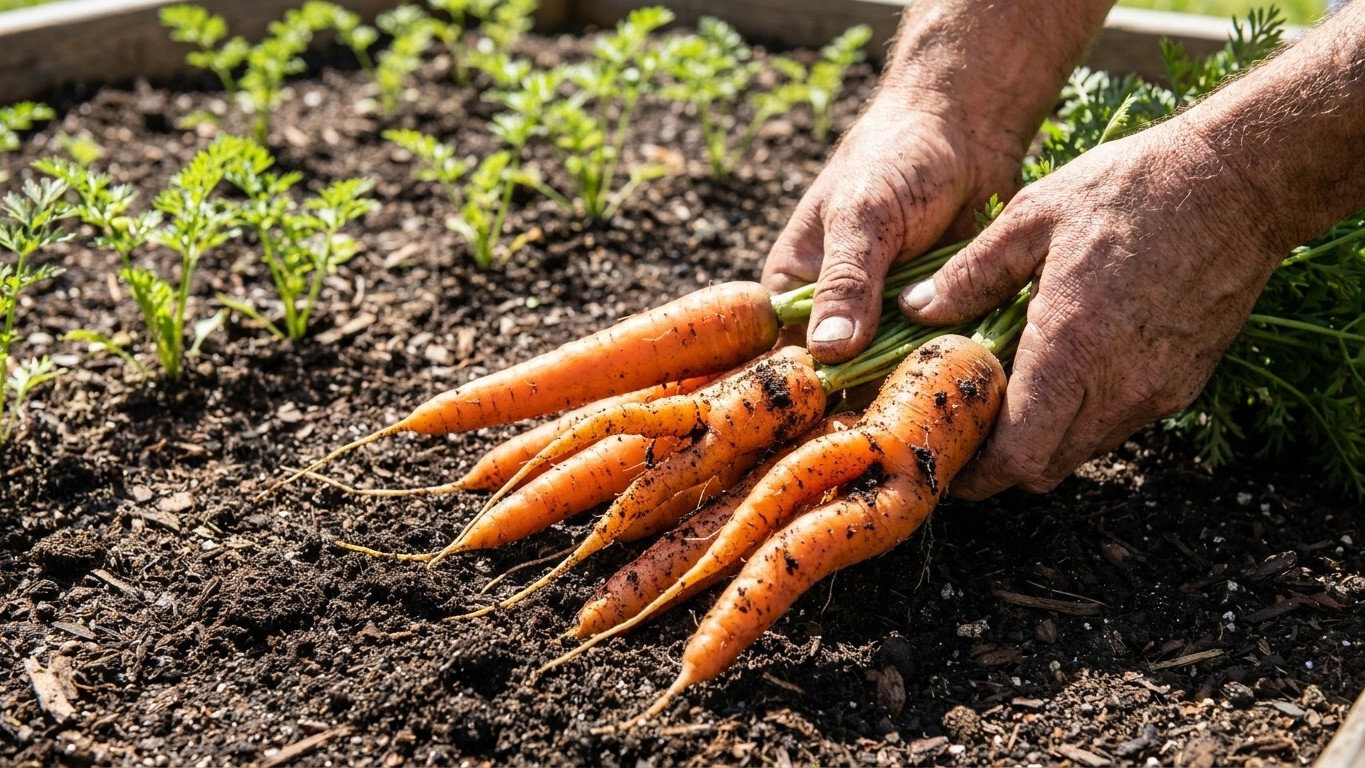

Carrots go into the ground directly, as seed, several weeks before your last spring frost, since the seed germinates in cool soil and the young plant shrugs off a light frost without harm. Count 70 to 100 days forward from that sowing date to harvest, since carrots are never transplanted. But across much of Virginia, the calendar matters less than what’s underfoot: the state’s representative ground tends toward a texture and fertility that can make or break a straight, unforked root long before the weather does.
The short answer
USDA’s Natural Resources Conservation Service names the Pamunkey series as representative of Virginia soils. It’s an Alfisol, a forest soil of moderate natural fertility that holds onto nutrients reasonably well once they’re applied. The surface horizon runs about 50 percent sand, 11 percent clay and 39 percent silt, a loam to silt loam texture, with a surface pH around 6.2, slightly on the acid side. Organic matter sits low, around 1.2 percent. Drainage is classed as well drained, which for a carrot grower is the single most useful word in that list.
Carrots want deep, sandy, well-drained soil rich in organic matter, according to Utah State University Extension. Heavy or rocky ground makes the taproot fork as it hits resistance and splits around it instead of pushing straight down. Measured against that standard, the Pamunkey series is a mixed report card. The sand-to-clay ratio and the well-drained classification lean in the carrot’s favor: 11 percent clay isn’t the dense, root-blocking clay that turns a carrot bed into a fork factory. But 1.2 percent organic matter is thin, and Utah State’s fix for heavy or nutrient-poor ground is the same either way: work in plenty of compost, and double dig the bed so the loosened, enriched layer runs at least a foot deep before you ever drop a seed.
A raised bed solves the same problem from a different angle. Building up six to twelve inches of loose, compost-rich soil above grade sidesteps whatever the native ground is doing underneath, which matters because the Pamunkey series is only a representative figure, not a guarantee. Virginia spans hundreds of mapped soil series, from tidewater silt to Blue Ridge clay to Piedmont ground scraped bare by a bulldozer during construction. The number above describes one soil that stands in for the state on a map. It says nothing certain about the dirt behind your own house.
The test that settles it in your own garden
A soil map can only get you so far. The ground a builder graded, filled or compacted twenty years ago rarely resembles the county’s textbook soil series, and the only way to know what you’re actually working with is to go dig.
- Dig a hole at least a foot deep where you plan to sow. Look at what changes as you go down: a sudden band of orange clay, a layer of gravel, or a hardpan that resists the shovel all signal a depth where a carrot root will hit resistance and fork.
- Check for stones and rubble. Even a modest scatter of pebbles in the top foot is enough to split a taproot around them. Sift a handful of soil through your fingers and note how much grit and stone comes with it.
- Feel the texture. Wet a small handful and try to roll it into a ribbon between your thumb and forefinger. A soil that ribbons long and stays slick is clay-heavy. One that won’t hold together at all is sandy. Something in between that forms a short, crumbly ribbon is closer to loam.
- Watch how water drains. Dig a hole roughly a foot deep and wide, fill it with water, and let it soak in once. Fill it a second time and watch how the water level changes over the following hours. Water that lingers for a long stretch points to poor drainage; water that vanishes almost immediately points to a soil so sandy it may need more organic matter to hold moisture for the crop.
None of this requires a lab, and none of it needs to match any number attached to a named soil series. It only needs to tell you, in your own bed, whether you’re dealing with something a carrot can push through or something that calls for compost, double digging, or a raised frame before seed goes in the ground.
What goes wrong here
- Forking in heavy or compacted ground. Even soil that tests as loam on paper can compact into something denser once foot traffic, tilling, or years of no organic matter have flattened its structure. The taproot meets resistance and splits into two or more legs. The remedy is the same one Utah State Extension gives for any heavy soil: work in generous compost and double dig the bed a foot or more deep before sowing, or build a raised bed filled with loose, enriched soil instead of fighting the native ground.
- Poor germination during a hot spell. Carrot seed is small and shallow-sown, and it needs steady surface moisture to sprout. A stretch of hot, dry days can crust the soil surface and dry out the seed before it germinates, leaving bare patches in the row. Keeping the seedbed consistently damp, with light, frequent watering rather than one heavy soak, carries the seed through germination.
- Splitting from uneven watering. A root that grows through a dry stretch and then gets hit with a heavy rain or a deep watering can swell too fast and crack. Steady, even moisture through the growing season, rather than feast-or-famine watering, keeps the root growing at one pace instead of lurching.
- Low fertility from thin organic matter. A surface horizon around 1.2 percent organic matter, which is what the state’s representative soil carries, doesn’t hold much reserve fertility on its own. Working compost into the bed before sowing addresses both the physical forking problem and the nutrient shortfall in one pass.
Common questions
Does Virginia’s clay content mean carrots will always fork?
Not necessarily. The state’s representative soil series carries only 11 percent clay in its surface horizon, paired with well-drained conditions, which is a far cry from a dense clay pan. Forking is more often a symptom of compaction, stones, or a hardpan layer at root depth than of clay percentage alone. The dig-and-feel test in your own bed will tell you more than a statewide average ever could.
How deep does a raised bed need to be for straight carrots?
The facts here don’t specify an exact depth for Virginia conditions, but the general principle from Utah State Extension is to loosen and enrich the soil to the depth the variety’s root will grow, which for most carrot types means well over a foot of loose, stone-free, compost-rich material.
Can I fix heavy soil without building a raised bed?
Yes. Double digging, working the bed a full spade’s depth and then loosening the layer beneath it, combined with a generous addition of compost, is the remedy Utah State Extension gives for heavy or rocky ground. A raised bed is simply a faster shortcut to the same loose, enriched profile.
Why does organic matter matter so much for carrots specifically?
Carrots grow a single taproot that has to push straight down through the soil profile without much help from surrounding roots or structure. Organic matter loosens soil structure and holds moisture evenly, both of which make it easier for that root to grow long and straight instead of meeting resistance or drying out partway down.