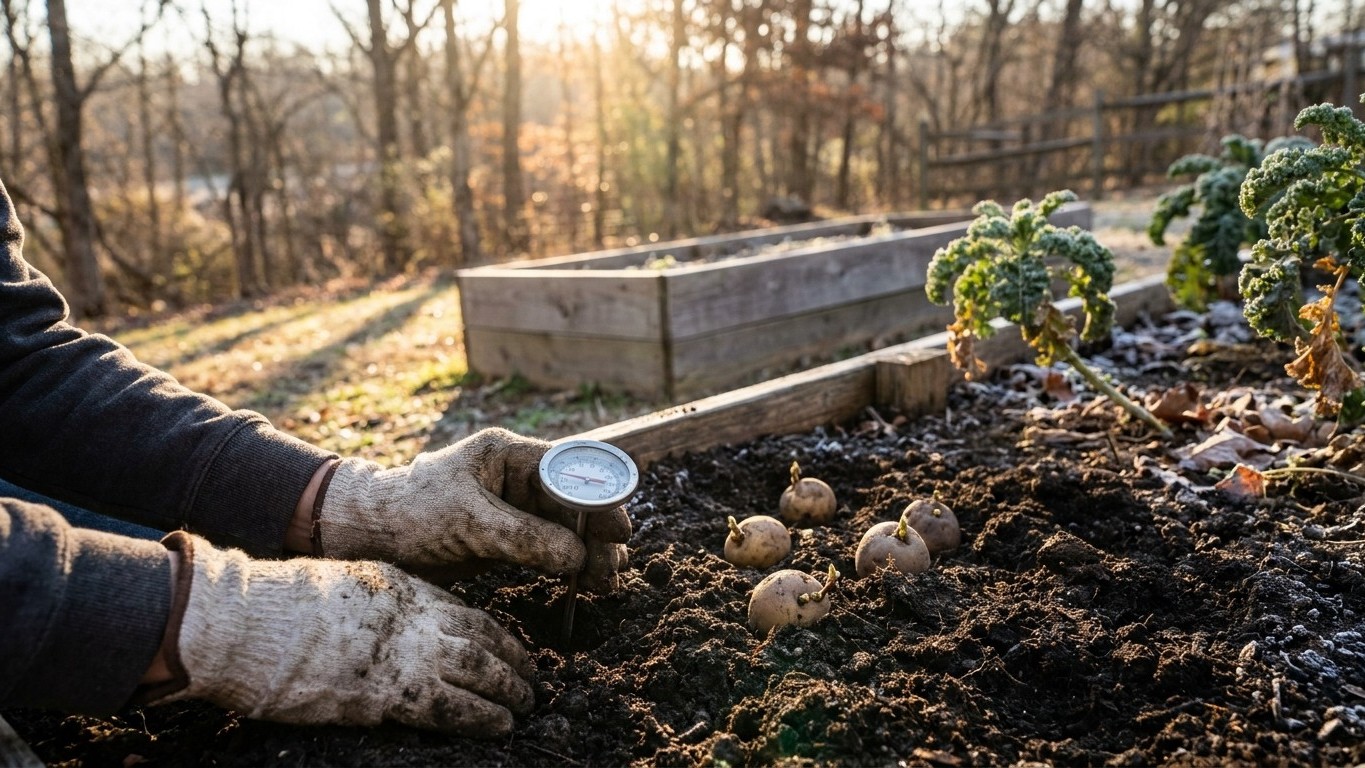

Count back 14 to 21 days from your last frost date, but let the soil thermometer settle the argument. In the Puget Sound lowlands, using the NOAA NCEI 1991-2020 Climate Normals for the Seattle-Tacoma reference station (USW00024233), that last frost falls between February 27 and March 18, which pushes the actual planting signal into late February through early March, and only once the ground itself reaches 50°F.
The short answer
For gardeners west of the Cascades, working from that same NOAA NCEI record, the last spring frost normally lands somewhere in the February 27 to March 18 span. That’s a three-week window, not a single date, and it’s specific to the maritime lowlands around Seattle-Tacoma. Count back 14 to 21 days from the earlier end of that range and you get a target stretch in mid to late February; count back from the later end and you land closer to the start of March. Either way, per Utah State University Extension’s potato fact sheet and the University of Maine Cooperative Extension’s Bulletin #2077, the real trigger is not a date at all. It’s soil temperature. Potatoes go into the ground as soon as the soil holds at 50°F, and that threshold is what the 14-to-21-day count-back is approximating.
This matters because a mild frost date does not mean an early planting date here. Western Washington’s frost window looks generous compared to colder regions, but cold, wet, slow-draining soil and weak late-winter light hold potatoes back regardless of what the thermometer says about air temperature overnight. A grower who plants the moment the frost-date math says “go” without checking the ground can end up with seed pieces sitting in cold mud for weeks, rotting before they ever sprout.
East of the Cascades, this window simply does not apply. That side of the state is high desert, with a shorter frost-free season and a different soil-warming pattern entirely. The NOAA figures cited here come from a single western Washington station, and stretching a Seattle-Tacoma frost date across the Cascades to Spokane or the Columbia Basin would be a mismatch, not a rough estimate. Gardeners in that region need their own local station’s Climate Normals, not this one.
What actually decides it
Soil temperature, not the calendar
The count-back method (14 to 21 days before the last frost date) is a shortcut for a physical event: the moment soil at planting depth holds steady near 50°F. Air temperature can swing ten degrees between a sunny afternoon and a cold night, but soil temperature moves slowly and evens out those swings, which is why Utah State University Extension and the University of Maine Cooperative Extension both anchor planting to soil, not sky. A gardener anywhere in the country can use this same logic: pull the local frost date, count back roughly two to three weeks, then confirm with a thermometer before committing seed potatoes to the ground.
The heat ceiling at the other end of the season
Tuber set and fill run into trouble once soil temperature climbs above 90°F, and no amount of extra watering reverses that stall once it starts. This is the mechanism that quietly decides whether a summer crop succeeds anywhere potatoes are grown, because it works independently of rainfall or irrigation. A region that reaches 90°F soil temperatures early and often needs to think in terms of a spring crop dug before that ceiling hits, not a summer crop nursed through it. A region where soil rarely gets that hot has more flexibility in timing the harvest.
Maritime lowlands versus high desert
Western Washington’s mild, wet maritime pattern and eastern Washington’s dry, wide-swing high desert pattern are not the same climate wearing different weather, they are two different sets of rules. A frost date, a soil-warming curve, and a heat-ceiling risk all shift together when you cross the Cascades. That’s the reasoning a gardener needs to carry into any county this page doesn’t name directly: identify which pattern you’re in before trusting any single number.
How to do it
- Pull the last-frost Climate Normals for the NOAA station nearest your own garden, not automatically the Seattle-Tacoma figures used here, if you garden outside the Puget Sound lowlands.
- Count back 14 to 21 days from that local last-frost window to identify a target planting stretch rather than a single day.
- Check soil temperature at planting depth with a soil thermometer, and wait for a steady 50°F reading before trusting the calendar math.
- Buy certified seed potatoes rather than grocery-store tubers or last season’s saved stock, since uncertified seed carries virus that no amount of good soil or fertilizer will fix later.
- Match the season class, early, mid-season, or late, to how quickly your local soil is likely to cross the 90°F heat ceiling later in the year.
- Plant once the 50°F soil signal holds, even if a run of cold, wet weather makes the date feel early, because western Washington’s weak late-winter light already slows early growth on its own.
- Recheck soil temperature in early summer, and plan the harvest window around pulling tubers before the ground climbs toward 90°F rather than trying to push additional size out of a crop that’s already stalled.
What goes wrong
- Planting by the frost date alone, ignoring the soil. Cold, waterlogged ground rots seed pieces before they sprout even when the calendar says the count-back window has arrived. Check a soil thermometer at planting depth and wait for a steady 50°F reading instead of trusting the date on its own.
- Using uncertified seed potatoes. Grocery-store tubers and saved seed from a previous crop can carry virus invisibly, and that virus quietly cuts yield with no visible cause. Buy certified seed potatoes every season.
- Applying the Seattle-Tacoma frost window east of the Cascades. The high desert climate there runs a shorter, harder season, and this station’s Climate Normals don’t describe it. Pull frost data from a NOAA station local to that region instead.
- Watering harder once soil passes 90°F, expecting it to save tuber sizing. Once that heat ceiling is crossed, tuber set and fill stall regardless of moisture. Plant early enough, and choose an early season class, so the crop is set before soil heat becomes the limiting factor.
- Mistaking a mild frost date for permission to plant very early. Western Washington’s frost window is comparatively gentle, but cold, wet soil and low light still slow potatoes down past the last freeze. Let the 50°F soil reading, not comfort with the air temperature, make the call.
Common questions
Does the February 27 to March 18 frost window apply to all of Washington?
No. That range comes from a single NOAA NCEI station near Seattle-Tacoma and describes the mild, maritime lowlands west of the Cascades. Eastern Washington’s high desert climate runs a different, shorter season, and gardeners there should pull Climate Normals from a station local to their own area.
What’s the actual difference between counting back from frost and checking soil temperature?
Counting back 14 to 21 days from the last frost date is an estimate of when soil is likely to hit 50°F. Checking soil temperature directly, with a thermometer at planting depth, confirms the real event the count-back is only approximating, and it accounts for local drainage and sun exposure that a regional frost date can’t capture.
Why does certified seed matter more than variety choice?
Uncertified seed potatoes, including grocery-store tubers, can carry virus that reduces yield with no obvious symptom until harvest. Certified seed is inspected specifically to avoid that risk, which makes it a bigger factor in a successful crop than which season class is chosen.
If my area gets hot summers, should I still plant a late season class?
Where soil regularly climbs above 90°F, an early season class planted as soon as soil hits 50°F, then dug before peak summer heat, avoids the point where tuber fill stalls. A late season class in that same location risks running straight into the heat ceiling before it finishes sizing.