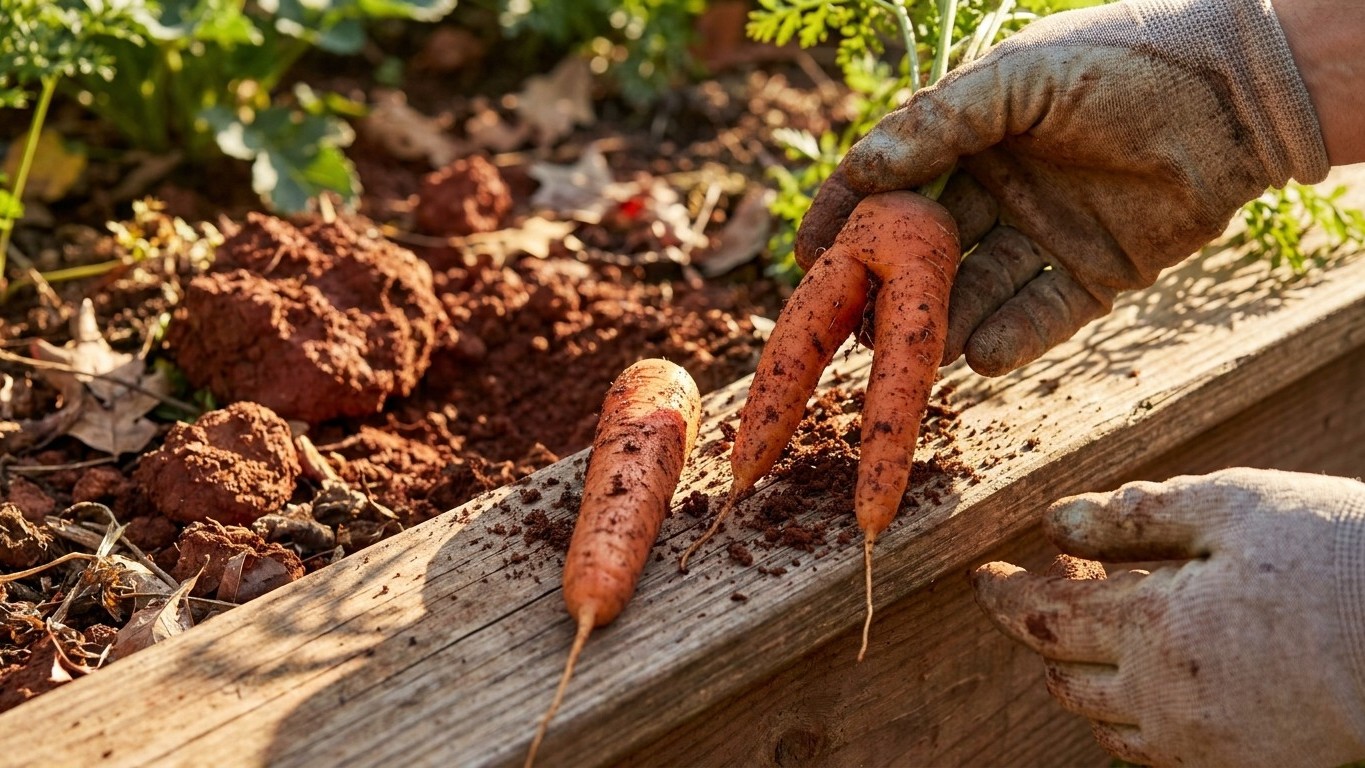

Short answer: probably not much. Wisconsin’s state soil, the Antigo series, is a well-drained silt loam with very little clay, and low-clay, well-drained ground is exactly what keeps a carrot root straight instead of splitting into two legs. But “the state soil” and “the dirt under your tomato cage” are two different things, and the only way to know which one you’ve got is to dig a hole and look.
The short answer
The Antigo series became Wisconsin’s official state soil by state law in 1983, part of the USDA NRCS State Soils programme, and it’s worth knowing what that soil actually looks like below the surface. Sampled across its major components, the surface horizon runs about 20 percent sand, 10 percent clay and 70 percent silt, which puts it firmly in the silt loam camp. It’s an Alfisol, a forest soil of moderate fertility that holds onto nutrients reasonably well, with a surface pH around 5.5 (slightly acid) and organic matter around 3.0 percent. Drainage class: well drained.
Carrots, according to Utah State University Extension, want deep, sandy, well-drained soil that’s rich in organic matter. Heavy or rocky ground is what makes the root fork, splitting into two or more legs as it hits resistance and grows around it instead of straight down. Measured against that standard, Antigo-type ground is a reasonably good match on paper. Ten percent clay is not heavy clay. Well drained means water isn’t sitting around the root collar inviting rot. The organic matter figure, close to that 3 percent mark, is roughly where a lot of extension programs like to see a vegetable bed sit.
The catch is texture, not chemistry. A soil that’s 70 percent silt can crust hard on top after a rain and compact into a dense layer a few inches down if it’s tilled while wet or walked on too often. That compacted layer does the same thing heavy clay does: it stops the taproot cold and forces it to fork or stub out. Utah State’s fix for heavy ground applies here just as well, working in plenty of compost and double digging the bed, loosening and enriching the soil a full spade’s depth or two, so there’s nothing hard for the root to hit. Where a hardpan or heavily worked, compacted subsoil is the real problem, a raised bed filled with loose, blended soil sidesteps the issue entirely.
None of this describes your actual backyard with any certainty. Wisconsin spans hundreds of mapped soil series, and Antigo is a statewide representative, not a survey of every lot. A river bottom nearby might run sandier and drain faster. Hill country a few miles off might carry more rock. Anywhere a builder graded, filled, or stripped topsoil for a foundation will read completely differently from the mapped series. Treat the numbers above as a general tendency for the region, not a stand-in for a soil test of your own dirt.
The test that settles it in your own garden
- Dig a hole where you plan to plant. Go down at least a foot if your shovel allows it, and look at the wall of the hole as you go. A sudden change in color, or a layer that suddenly resists the shovel and feels rock-hard, tells you there’s a barrier a carrot root will meet before it’s finished growing. That’s the layer that causes forking, not whatever’s on top of it.
- Sort through what you pulled out. Spread the soil on a tarp and look for stones and pebbles. A handful here and there is normal. A soil that’s constantly clattering with rock as you dig is a soil where roots will bend and split around every obstacle they meet.
- Squeeze a wet handful. Grab a fistful of moist (not soaked) soil and squeeze it into a ball, then poke it. If it holds together as a slick, ribbon-like shape, you’re dealing with clay-heavy ground. If it falls apart the moment you let go and feels grainy between your fingers, that’s sand-leaning soil. If it holds a loose shape but crumbles easily under a poke, that’s the loam texture carrots prefer.
- Watch how water moves through it. Dig a second hole nearby, fill it with water, and time how long it takes to drain. Water that sits for hours is telling you drainage is poor and roots are more likely to rot, stall, or fork trying to avoid saturated ground. Water that vanishes almost immediately is a soil that drains well but may need more frequent watering to keep carrots growing evenly.
Do this in more than one spot if the bed is large. Soil texture can shift within the same yard, especially near foundations, driveways, or anywhere fill dirt was brought in at some point.
What goes wrong here
- Forking in heavy or compacted ground. Any layer of dense clay, rock, or compacted subsoil stops the taproot and sends it splitting sideways. Utah State University Extension’s remedy for this is straightforward: work in generous amounts of compost and double dig the bed so the loosened, enriched layer runs deep enough for the whole root. Where compaction runs deep or a hardpan won’t break up, a raised bed filled with loose soil is the simpler fix.
- Poor germination during a stretch of hot, dry weather. Carrot seed is small and sits close to the surface, and a crusted, dried-out top layer, common on silt-heavy ground after it bakes in the sun, can keep seedlings from pushing through at all. Keeping the seedbed consistently moist until seedlings are up, and covering seed lightly rather than burying it deep, gives it a better shot at breaking the surface.
- Splitting from uneven watering. A root that grows steadily through a dry spell and then gets soaked all at once, or the reverse, tends to crack open along its length as it swells unevenly. A steady, even watering routine rather than feast-or-famine soaking is what keeps the root growing at one consistent rate from seeding to harvest.
Common questions
Does mixing in sand fix a soil that’s forking carrots?
Not by itself. Utah State University Extension points to organic matter and depth, through compost and double digging, as the fix for heavy or rocky ground, not sand added on its own. Sand mixed unevenly into clay can actually create a worse texture than either material alone.
Can carrots grow in clay soil without building a raised bed?
Yes, if the clay layer is broken up and enriched deeply enough. Double digging the bed and working in plenty of compost, as Utah State University Extension recommends for heavy ground, can open up enough loose, fertile depth for a straight root without resorting to a raised frame. A raised bed simply skips that labor by starting with loose soil from the outset.
How long does it take carrots to reach harvest?
Carrots are sown directly in the ground rather than transplanted, and the general window extension guidance points to runs from 70 to 100 days counted from the day the seed goes into the soil, not from any transplant date, since there isn’t one for this crop.
Does the state soil’s pH matter for the carrots in my own bed?
The pH figure recorded for the Antigo series, around 5.5, describes that specific mapped soil, not your garden. Wisconsin covers hundreds of distinct soil series, and pH can shift noticeably from one yard to the next depending on parent material, drainage, and years of amendments. A soil test of your own bed is the only way to know your actual number.