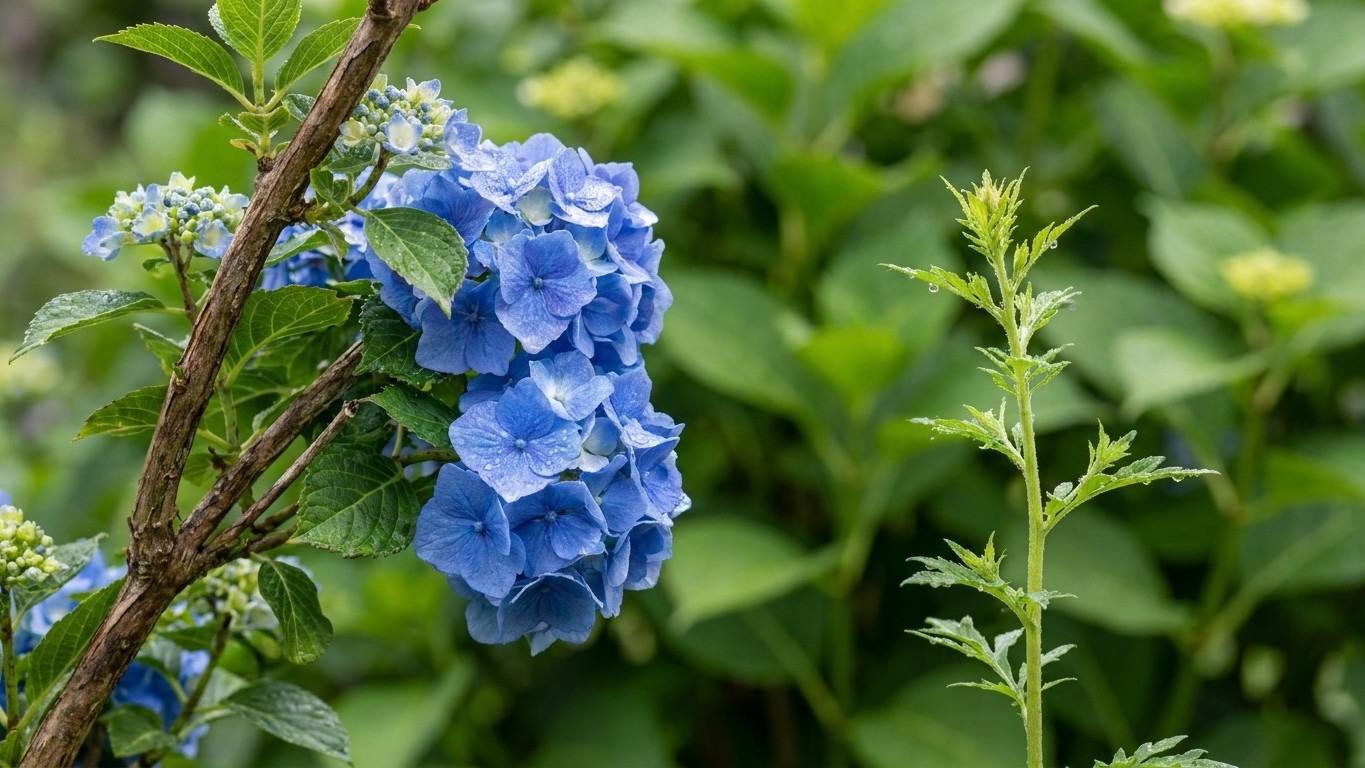

Hydrangeas that bloom on new wood, meaning smooth and panicle types, get pruned in late winter to early spring, before leaves open. Types that bloom on old wood, including most bigleaf and oakleaf hydrangeas, get only dead stems removed in late May. Any shaping happens right after the flowers fade and no later than the end of July. Which group your shrub belongs to decides everything, because a cut at the wrong time removes that year’s flower buds.
What this comes down to in Wisconsin

At Milwaukee, the reference station for the NOAA NCEI 1991-2020 Climate Normals (32 F freeze probabilities, 30 to 70 percent band), the last spring freeze falls between April 16 and April 29. The first fall freeze falls between October 17 and October 29. Those two ranges frame every pruning decision. Late-winter cuts come before the first range, old-wood cleanup comes after it, and the last shaping cut comes well ahead of the second.
The reason is where the flower buds sit. Smooth and panicle hydrangeas grow new stems each spring and form flower buds on that fresh growth, so a March cut removes nothing that was going to bloom. Bigleaf, mountain, oakleaf and climbing hydrangeas set their flower buds in late summer and fall on stems that must survive the winter. Cut those stems in April and you have cut the flowers.
Wisconsin winters add a second layer. Stems of bigleaf hydrangeas often die back to the snow line or to the ground, and which stems are alive can’t be judged in March. A stem that looks fine in a warm week may be dead at the core, and a stem that looks rough may leaf out by late May. That is why old-wood types are judged by leaves, and new-wood types by the calendar.
| Type | Example cultivar | Flowers on | When to prune in Wisconsin |
|---|---|---|---|
| Smooth (Hydrangea arborescens) | ‘Annabelle’ | New wood | Late winter to early spring, before leaves open |
| Panicle (Hydrangea paniculata) | ‘Limelight’ | New wood | Late winter to early spring, before leaves open |
| Reblooming bigleaf (Hydrangea macrophylla) | ‘Endless Summer’ | Old and new wood | Dead stems out in late May; light shaping after the first flush |
| Traditional bigleaf | ‘Nikko Blue’ | Old wood only | Dead stems out in late May; shaping right after bloom |
| Oakleaf (Hydrangea quercifolia) | ‘Alice’ | Old wood | Right after bloom, by the end of July |
Climbing hydrangea and mountain hydrangea (Hydrangea serrata) follow the old-wood rule. Both get dead wood removed after leaf-out and any shaping straight after flowering.
Working it out for your own garden
Start by sorting the shrub into new wood or old wood. Panicle hydrangeas have cone-shaped flower clusters and bloom from midsummer into fall. Smooth hydrangeas carry round white or pale green heads. Bigleaf types have glossy, rounded leaves and mophead or lacecap flowers, and oakleaf types have deeply lobed leaves like an oak. If the tag is long gone, bloom time is a decent clue: flowers in June usually mean old wood, and flowers from July on usually mean new wood.
Then count from the frost window. New-wood cuts work best before the Milwaukee last-freeze range of April 16 to April 29. That gives roughly the third week of March to mid-April, when the ground is workable and buds are still tight. Old-wood cleanup waits for leaves to emerge after that same range. That puts it in roughly the first week of May to the end of May.
For old-wood types, confirm life before you cut. Scratch a stem with a thumbnail: green and moist underneath means alive, tan and dry means dead. Cut dead stems back to the first live pair of buds, or to the ground if nothing is green. A stem that has leafed out in late May is alive, and one with bare buds in June is not.
Take ‘Limelight’, a panicle hydrangea. Cut in late March, it starts new shoots when buds break in late April. Those shoots carry flower buds by midsummer, and the heads color up long before the October 17 to October 29 freeze range. Even a cut made in mid-April still gives a full bloom. Removing last year’s growth keeps the shrub dense and the stems stiff enough to carry the heads.
Now take ‘Nikko Blue’, a traditional bigleaf. Its buds formed last August on stems that Wisconsin winters often kill to the snow line. Cut it back “to tidy up” in March and any surviving buds go in the brush pile. Even if you leave it alone, the new shoots from the base don’t flower that year. This type often gives leaves and no flowers, which is why a reblooming bigleaf like ‘Endless Summer’ is the safer bet. It also flowers on new growth, later in summer, but still ahead of the fall freeze range.
What changes across the state
The Milwaukee ranges describe a lakeshore city. Lake Michigan holds heat into fall, so the first fall freeze at the lakeshore comes later than it does inland, and spring there runs cooler and slower. Buds break a little later along the shore, which lowers the odds of a freeze catching new growth that has already opened. Inland southern Wisconsin typically freezes earlier than the lakeshore, so new-wood shrubs there have less time to bloom after a late start.
The USDA Plant Hardiness Zone Map spans zone 3b to 6a across the state. That zone system rests on one variable, the average annual extreme minimum temperature. Hydrangea stems are most at risk in the colder end of that range, so check with your local county extension office about your area. In the north the first fall freeze arrives earlier than at Milwaukee, and snow often lingers into April. Late-winter pruning there slides toward the point when the snow melts and the stems can be reached.
The practical effect is a shift in which types earn their space. In the north and in cold inland hollows, smooth and panicle hydrangeas are the dependable bloomers because they flower on stems that grew that same year. Bigleaf and oakleaf types do best in the milder south and along the lakeshore. Snow cover also matters: stems buried under a deep drift are insulated, and stems standing above it take the full cold, so leaving a foot or two of framework on a smooth hydrangea in an open yard costs little.
The mistakes this state punishes

A costly error is the spring tidy-up of an old-wood hydrangea. In March the shrub looks like a clump of gray sticks, and the urge to cut it back is strong. Wait for leaves. Remove only what is clearly dead, and do any shaping after the flowers fade.
The second is reacting to a warm spell. A run of mild days in late March or early April can start buds swelling on hydrangeas, and a freeze can follow inside the April 16 to April 29 range at Milwaukee, or later farther north. If frost blackens new growth, hold off for a couple of weeks before cutting. Many bigleafs push replacement buds from lower on the stem, and cutting too soon removes them.
The third is pruning too late in the season. Cutting an old-wood type in August or September removes buds already set for the next year. Late shaping or heavy feeding on any hydrangea also pushes soft growth that has no time to harden before the October 17 to October 29 freeze range, and the lakeshore’s later freeze is no reason to push it further. Finish old-wood shaping by the end of July, and don’t prune old-wood types in fall except to remove broken stems.
The fourth is cutting smooth hydrangeas to the ground every year. That gives taller, softer stems, and the big heads of ‘Annabelle’ then flop after a summer storm. Leaving a foot or two of framework gives sturdier stems. Panicles should be cut before leaves open.
Checking this against your county
The Milwaukee ranges are a starting point, since a farm in Door County, a backyard in Eau Claire and a hillside near Superior all reach spring on different schedules. Your county office of the University of Wisconsin-Madison Division of Extension can tell you how local frost dates and winter dieback differ from the lakeshore. For planting, soil and variety choice, the state guide to growing hydrangeas in Wisconsin covers what this article leaves out.
Common questions
Can I prune hydrangeas in fall in Wisconsin?
Smooth and panicle types tolerate a cut after leaf drop, but late winter is better because the dried stems and flower heads catch snow and protect the crown. Old-wood types should not be cut in fall at all, since the buds for next year are already on the stems.
How do I prune a hydrangea if I don’t know which type it is?
Remove only dead stems in late May, after leaves have opened. Then watch when it blooms. If flowers open in June, treat it as old wood and shape it right after bloom. If flowers open from July on, treat it as new wood and cut it in late winter.
Why did my bigleaf hydrangea leaf out but never bloom?
The flower buds were probably killed by winter cold or removed by a spring cut. Old-wood bloomers have to carry living stems through the winter, and in colder parts of the state they often don’t. A reblooming bigleaf that also flowers on new wood solves most of that problem.
When should I deadhead hydrangeas?
On old-wood types, cut spent flowers back to the first pair of healthy buds right after bloom, before August. On smooth and panicle types, deadheading is optional, because the dried heads stay attractive in winter and the late-winter cut removes them anyway.