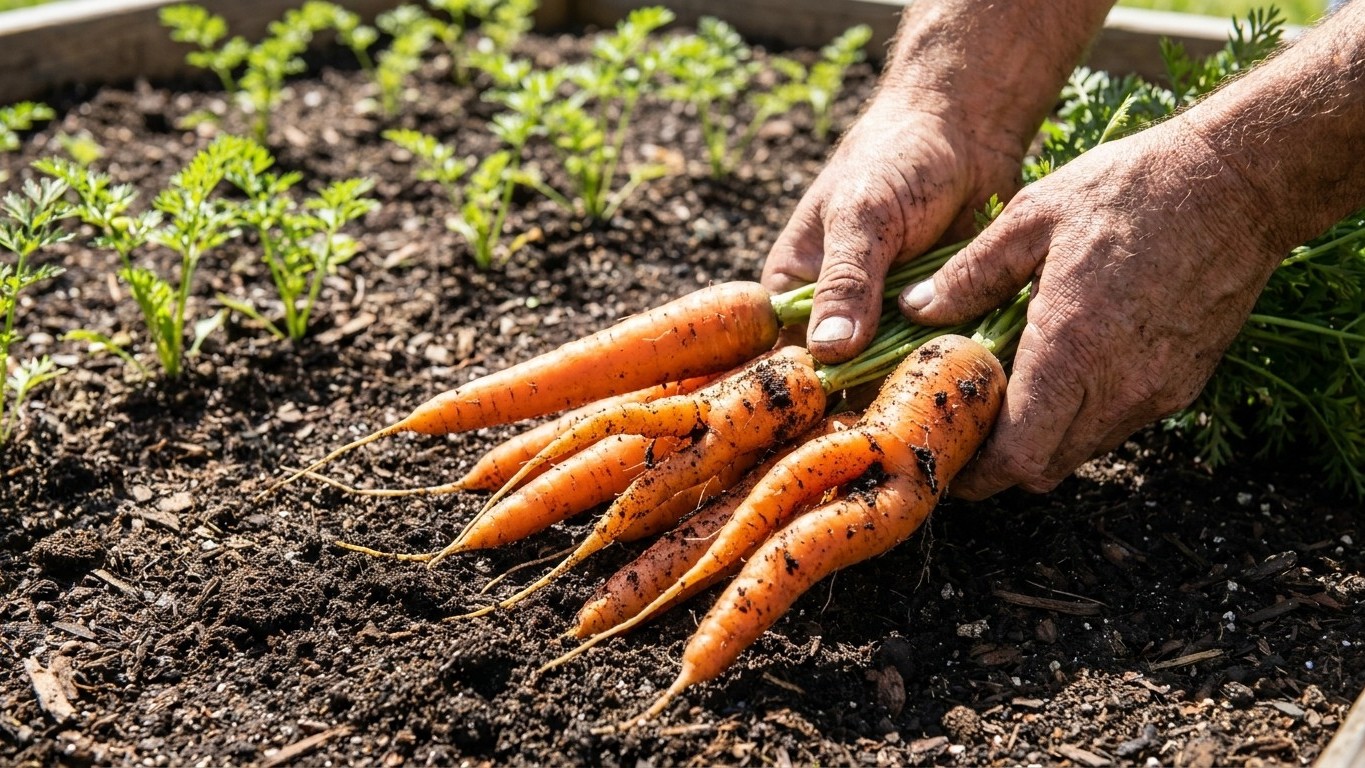

Wisconsin gardeners sow carrot seed directly in the ground once the soil can be worked in spring, weeks ahead of the last frost, because carrot seedlings shrug off a light chill better than the seed packet suggests. Harvest follows 70 to 100 days after that seeding date, never from a transplant, since carrots are never moved as seedlings. Whether the root grows straight or forks depends less on the calendar than on what’s under your boots.
The short answer
Wisconsin’s official state soil, named by state law, is the Antigo series, an Alfisol formed under forest cover. It’s a moderately fertile soil that holds nutrients reasonably well, and the surface horizon runs slightly acid, with a pH around 5.5. Texture-wise it leans loam to silt: 20 percent sand, 10 percent clay, and a hefty 70 percent silt, according to USDA soil survey data. Drainage is classed as well drained, and organic matter sits around 3.0 percent in that surface layer.
Put those numbers next to what carrots actually need. Utah State University Extension is blunt about it: carrots want deep, sandy, well-drained soil rich in organic matter, and heavy or rocky ground makes the root fork instead of running straight. Antigo’s low clay content and good drainage put it on the friendlier end of that spectrum. It’s not a sand-box loam built for carrots the way a coastal dune soil might be, but a silt-heavy, well-drained profile with modest clay doesn’t set up the compaction and standing water that twist a taproot into a fork. A gardener working true Antigo soil is less likely to need a raised bed just to get a straight carrot, though a shovelful of compost worked into the top foot never hurts, since carrots still prefer more organic matter than 3.0 percent typically supplies on its own.
That’s the state-level picture, and it’s worth saying plainly: it’s a starting point, not a diagnosis. Wisconsin spans hundreds of mapped soil series, from sandy outwash plains in the central part of the state to heavy clay flats near old glacial lake beds. A yard that’s been graded, filled, or scraped by a builder can bear no resemblance to any published soil survey at all. If your garden sits on heavier ground than Antigo, the fix Utah State names directly is compost worked in generously, double digging to break up compaction below the topsoil, or building a raised bed so the carrot never has to fight its way through native clay at all.
The test that settles it in your own garden
- Dig a hole about a foot deep in the bed where you plan to sow. Note how easily the spade goes in, whether you hit a hardpan layer partway down, and how many stones or rocks come up with the soil. A carrot root needs a clear, stone-free run of at least that depth to grow straight.
- Pull a handful of soil from the sides of the hole and rub it between your fingers. Gritty and loose means sand; sticky, smooth, and slow to fall apart means clay; a soil that feels silky but still holds together lightly is closer to silt or loam.
- Squeeze a moist handful into a ball. If it holds a tight, dense shape and resists breaking apart, expect the same resistance a young carrot root will meet as it tries to push down through it.
- Fill the hole with water and time how long it takes to drain away completely. Water still sitting after several hours points to poor drainage, the kind of condition that stunts and forks roots even in soil that otherwise looks fine on top.
- Repeat the dig in more than one spot in the bed. Soil can change character within a few feet, especially near foundations, old driveways, or wherever fill dirt was brought in.
What goes wrong here
- Forking in heavy ground. Clay-heavy or compacted soil splits the taproot as it hits resistance below the surface. The remedy, per Utah State University Extension, is compost worked in deeply and double digging to loosen the profile, or a raised bed filled with a lighter mix if the native ground can’t be reasonably amended.
- Poor germination during a hot, dry spell. Carrot seed is small and sits shallow, so a bed that dries out and crusts over during a warm stretch keeps seedlings from pushing through. Keeping the top inch of soil consistently damp until seedlings appear, with light, frequent watering rather than one heavy soak, solves most of this.
- Splitting from uneven watering. Roots that go from dry to suddenly soaked swell unevenly and crack along the length of the carrot. A steady watering rhythm, rather than a drought followed by a deluge, keeps growth even from seed to harvest.
- Stunted roots in stony or rocky beds. Even soil with reasonable texture can hold buried stones that deflect a growing root sideways or split its tip. Sifting the top foot of a bed before sowing, or building up a raised bed above the rocky layer entirely, removes the obstacle rather than fighting it every season.
Common questions
Does Wisconsin’s state soil mean my garden will grow good carrots?
Not automatically. The Antigo series describes a representative surface soil mapped across parts of the state, not the ground under any one backyard. Use it as a general sense of what the region’s soil tends to do, then dig your own test hole to know what you’re actually working with.
How many days does it take carrots to mature after sowing?
Somewhere between 70 and 100 days, counted from the day the seed goes into the ground. Carrots are direct-sown and never transplanted, so there’s no seedling stage to subtract from that count.
What if my soil test shows heavy clay?
Work in a generous layer of compost and double dig the bed to loosen compaction below the surface, following the approach Utah State University Extension recommends for heavy ground. If the clay runs deep or the bed is small, a raised bed filled with a lighter soil mix sidesteps the problem entirely.
Is Wisconsin’s soil naturally acidic for growing carrots?
The Antigo series, the state’s official soil, runs slightly acid at a surface pH around 5.5. That’s a mapped average for one representative series, not a number to apply to your own bed without testing, since acidity varies widely across the hundreds of soil series found statewide.