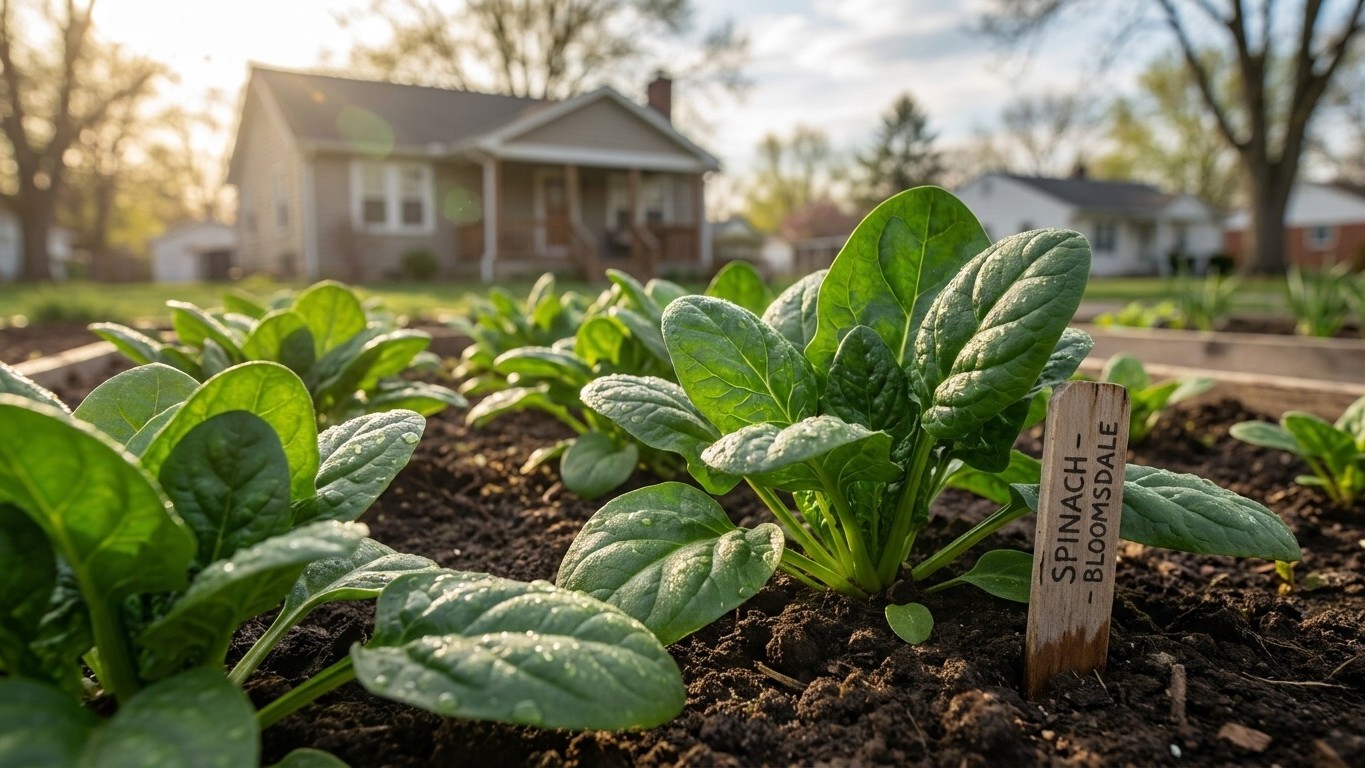

Will Spinach Bolt Early in Connecticut? Spinach sown in the state in spring typically bolts by late May or early June, pushed by the lengthening days as much as by warm weather. A fall crop, timed to soil temperature rather than frost, avoids the problem almost entirely because it grows into shortening days instead of toward the solstice. The window for either planting is narrower than most seed packets suggest, and the day-length clock, not just the thermometer, decides when it closes.
The short answer
Bridgeport, the reference station behind these climate figures, gets 14 hours and 58 minutes of daylight on the longest day of the year. That’s not extreme compared to the far north, and it’s nowhere near the near-16-hour summers of Canada. But for spinach it doesn’t matter that Connecticut’s day length is only moderate by national standards. Flowering in spinach is triggered by long days themselves, and Connecticut’s early summer already supplies enough of them to set the process in motion whether or not the weather cooperates.
That’s the part gardeners misjudge most often. A cool, cloudy June doesn’t buy extra weeks the way it might for a crop that’s limited purely by heat. Spinach shifts from making leaves to making a seed stalk once day length crosses its trigger point, and that shift runs largely on its own clock, independent of the thermometer.
Heat matters too, just later. Bridgeport’s climate normal shows only 6.2 days a year reaching 90F or higher, a fairly modest heat load for the Northeast. On paper that looks like friendly territory for a crop that grows best below 75F. But bolting rarely waits for real summer heat to show up in July. By the time those hot days arrive, day length has usually already pushed spring-sown spinach into flowering, and the heat that follows just finishes the job, turning the stems bitter and tough on top of the bolting itself.
So the limit in Connecticut is both day length and heat, but day length closes the door first each spring, chronologically speaking. Heat becomes the bigger obstacle later in the year, for anyone trying to get a second, fall crop started, because the soil has to cool down before spinach seed will germinate at all. The two constraints hit the crop at different points in the season, which is exactly why the spring and fall plantings need to be reasoned through separately, and When to Sow Autumn Spinach in Connecticut deserves its own look.
How long the spring window really is
Laid out step by step, the spring window in Connecticut looks like this:
- Sowing date: Spinach seed goes in the ground 2 to 3 weeks before the last spring frost. With Bridgeport’s last frost normally falling between April 2 and April 12, that puts sowing somewhere in mid-to-late March for most of the state’s milder ground.
- Early growth: Spinach germinates and grows well in cool early-spring soil, when air temperatures aren’t anywhere near the 75F ceiling. This is the easiest stretch of the whole season for the crop, with none of the constraints that show up later.
- Day length climbs: Through April and May the days lengthen steadily toward the state’s peak of 14 hours and 58 minutes at the summer solstice. Spinach doesn’t need to reach that peak to react, it starts shifting toward flowering once day length crosses its trigger point, which in practice lands most sowings in bolt sometime in the back half of May or into early June.
- Heat arrives late: Bridgeport averages only 6.2 days a year at or above 90F, and nearly all of them land in July and August. The spring spinach crop is usually finished, one way or another, before real summer heat shows up. Bolting ends the spring window, not heat.
- Net window: Counting from a mid-to-late March sowing to a late-May or early-June bolt, Connecticut gardeners get somewhere in the range of eight to ten weeks of usable spring spinach growing, depending on how early the ground can be worked and how quickly a given sowing reaches its trigger.
Several spinach varieties turn up in extension material for the region, including Bloomsdale, Melody, Teton, and Olympia. None of them come with published days-to-maturity or bolt-resistance figures in the data behind this article, so variety choice is better treated as a matter of local trial than a guaranteed way to stretch that eight-to-ten-week window.
The autumn crop, and when the soil lets you sow
Because spinach isn’t bothered by shortening days, the fall planting trades the day-length problem for a different one entirely, then finally runs into frost at the far end. Two separate hurdles, each worth handling on its own.
Warm soil delays germination
Utah State University Extension notes that spinach seed germination drops once soil temperature rises above 80F. Connecticut’s August ground, especially inland, routinely sits above that line, since soil holds onto summer’s accumulated heat even after most of the year’s few 90-plus days have passed. Sowing straight into August soil often means poor, patchy germination, not because the air is too warm on any given day but because the ground itself hasn’t caught up with the calendar yet. The practical fix is to check soil temperature directly with a thermometer and sow once it drops, rather than sowing by a fixed date.
Frost closes the season
Bridgeport’s climate normals put the first fall frost between October 28 and November 10, the mildest range anywhere in the state given the station’s location on Long Island Sound. Utah State’s guidance for a fall crop is to sow 50 to 75 days before the date you want to harvest. Counting back 75 days from October 28 lands sowing around August 14. Counting back just 50 days from November 10 lands sowing around September 21. In practice, the warm-soil hurdle above tends to push most Connecticut plantings toward the later end of that range, early-to-mid September, which still leaves roughly 50 days to reach harvest before frost, tighter than the full 75-day version but workable in the state’s milder pockets.
Checking this against your own county
Every date in this article comes from a Bridgeport station on Long Island Sound, the mildest corner of Connecticut. Inland towns and the northwest corner of the state see frost earlier in fall and later in spring than these numbers suggest, which shrinks both the spring window and the fall sowing math above, sometimes by a couple of weeks in either direction.
For frost dates and soil conditions specific to your own county, the University of Connecticut Extension is the right place to check before locking in a sowing date, especially for anyone gardening away from the coast.
Common questions
Does a cool Connecticut summer delay spinach bolting?
No. Flowering is triggered by day length itself, and Connecticut’s early-summer days get long enough to set that off whether or not the weather stays cool.
Can spinach be planted in Connecticut in mid-summer?
Not reliably. Soil temperatures above 80F, common through much of the summer, reduce germination sharply. The fall sowing window opens once soil cools, generally not until late August or September.
Which spinach variety resists bolting best in Connecticut?
No published bolt-resistance data exists for the varieties commonly mentioned in the region, including Bloomsdale, Melody, Teton, and Olympia. Treat variety selection as a matter of local trial rather than a fixed answer.
Is heat or day length the bigger threat to spring spinach in Connecticut?
Both play a role, but day length acts first. Most spring-sown spinach bolts before the year’s small handful of 90-degree days ever arrive.