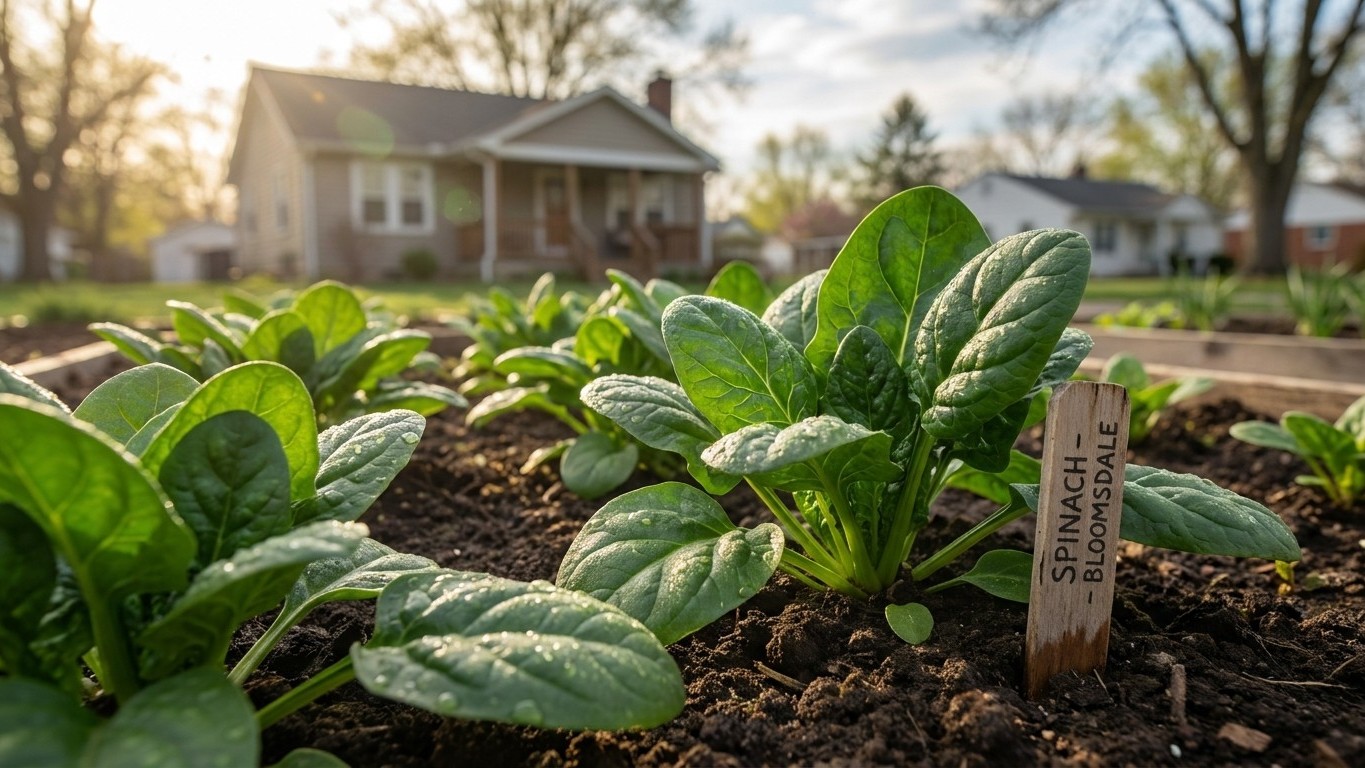

Wyoming spinach bolts because of long summer daylight, not because the state’s cool nights are too gentle. Will Spinach Bolt Early in Wyoming? With 14 hours and 58 minutes of daylight on the longest day of the year, spring-sown plants are pushed toward flowering well before the hottest part of summer arrives. Plant in the first three weeks after the ground can be worked, plan to pull the crop by early June, and start the fall round in mid-to-late July — for specific timing, see When to Sow Autumn Spinach in Wyoming.
The short answer
Fourteen hours and 58 minutes of daylight on the summer solstice is a lot of light for a leaf crop that flowers in response to long days. Spinach doesn’t care whether the afternoon feels comfortable or scorching; once day length crosses a certain point, the plant shifts into reproductive mode and sends up a seed stalk. That means a mild Wyoming summer at elevation, one that never gets brutally hot, does not buy extra weeks of harvest. The clock that matters most here is the sun’s position, not the thermometer.
That said, heat is not irrelevant. Spinach grows best where temperatures stay below 75 F, and that ceiling is also the point past which the leaves start turning bitter. Wyoming’s reference station near Cheyenne averages 10.4 days a year at 90 F or hotter, which is a moderate heat load compared to lower-elevation states, but those hot days tend to cluster in July and August, right when day length is already doing most of the damage to a spring crop. So the honest answer is both factors are at work, but they arrive on different schedules. Day length ends the spring crop in late May or early June, while summer heat is what keeps a gardener from simply resowing spinach all through July.
The practical result: treat spinach in Wyoming as a two-season crop, not a summer-long one. Get it in early, harvest it fast, then wait for the calendar to turn before trying again in the fall. Trying to stretch a planting through the entire summer, hoping cooler mountain air will hold off bolting, runs against how the plant actually responds to sunlight.
Four varieties commonly show up in seed catalogs for this kind of climate: Bloomsdale, Melody, Teton, and Olympia. No days-to-maturity or bolt-resistance figures for these varieties are published in the sources behind this article, so nothing more specific can be said about how they compare here. Choosing among them is a matter of local trial, not a documented shortcut around the day-length problem.
How long the spring window really is
- The last spring frost at the reference station falls somewhere between May 7 and May 18. Since spinach seed should go in the ground two to three weeks before that date, sowing typically lands in the second half of April, sometimes stretching into the very start of May depending on how the soil is thawing that particular spring.
- Spinach germinates and grows quickly in cool soil, so seedlings that go in during late April are usually up and growing within a week or two, well ahead of the last frost date itself. Frost rarely bothers young spinach; it’s built for cool starts.
- Day length climbs fast through May. By the time the calendar reaches late May, daylight is already closing in on the long-day threshold that triggers flowering, months before the June solstice actually delivers the full 14 hours and 58 minutes.
- That leaves roughly four to six weeks of good leaf production, from a late-April sowing to a harvest that should wrap up by late May or the first week or two of June, before the lengthening days push the plants to bolt.
- Wyoming’s early-summer temperatures are usually still comfortably under the 75 F growth ceiling during that window, which is the one piece of good news: heat is not the reason the spring crop ends here. Day length closes it out on its own schedule, regardless of how mild the mornings still feel.
The autumn crop, and when the soil lets you sow
A fall planting flips the problem. Instead of racing daylight, the gardener is racing warm soil first, and then the arrival of hard frost at the back end of the season.
Soil still too warm to germinate
Spinach seed germination drops sharply once soil temperatures climb above 80 F, and Wyoming’s warmest stretch, the same window that produces those 10.4 days a year above 90 F air temperature, tends to keep soil hot well into July at lower elevations. Sowing directly into that heat is a common way to get a spotty, disappointing stand. The practical fix is patience: wait until soil has started cooling from its midsummer peak, water the seedbed to bring the temperature down a few degrees if needed, or start seed in a shaded spot and transplant once soil conditions ease. There isn’t a published soil-temperature date for this to point to here, only the 80 F threshold itself, so watching the ground rather than the calendar is the more reliable approach.
The frost that ends the season
The first fall frost at the reference station arrives somewhere between September 24 and October 5. Working backward from that window using the standard guidance of sowing 50 to 75 days before the target harvest date puts the fall sowing window at roughly mid-July through mid-to-late August, depending on how early or late frost actually shows up that year and how mature a harvest the gardener is aiming for. A sowing on the earlier end, around mid-July, aligns with the 75-day mark counted back from the early-October frost estimate; a later sowing in mid-August aligns closer to the 50-day mark counted back from the earliest possible late-September frost. Given Wyoming’s roughly 130 frost-free days at 6,000 feet, and the fact that frost is possible in any month at higher elevations, treating late August as the practical cutoff for fall spinach sowing is the safer read of these numbers, rather than pushing toward the latest date the math technically allows.
Checking this against your own county
Every figure above comes from a single reference station and applies most directly to that location. Elevation swings of a few thousand feet across Wyoming shift both frost dates and summer heat load enough to matter, so a garden at 7,500 feet is going to see a shorter frost-free stretch than one at 5,000 feet, even within the same county.
The University of Wyoming Extension is the right place to confirm local frost dates, soil temperature trends, and planting timing for a specific county before locking in a sowing date. County-level extension offices typically track conditions more closely than any statewide average can, and they’re free to contact directly.
Common questions
Can shade cloth delay bolting in a Wyoming garden?
Shade cloth can lower leaf and soil temperature, which helps with the heat side of the equation, but it does nothing to shorten the actual hours of daylight reaching the plant. Since day length is the primary trigger for bolting here, shade cloth is a partial fix at best, more useful for keeping soil cooler ahead of a fall sowing than for stopping a spring crop from flowering.
Does elevation change when spinach bolts in Wyoming?
Elevation shifts frost dates and heat load, both of which matter to spinach, but day length at a given date is the same regardless of elevation within the state. A higher garden may have cooler air, which helps with the 75 F ceiling, but it won’t push back the point at which long days trigger flowering.
Is bolted spinach still edible?
Once a plant sends up a flower stalk, energy shifts away from leaf production and the remaining leaves tend to turn bitter and tough, tracking the same 75 F threshold tied to flavor decline. It’s technically edible but generally not worth harvesting for fresh eating at that point.
Can I plant spinach again mid-summer if I miss the spring window?
Sowing spinach in the middle of a Wyoming summer runs into both problems at once: day length is already long enough to push bolting, and soil is likely warm enough to hurt germination. Waiting for the fall window, once soil starts cooling, is the more reliable path rather than trying to squeeze in a summer planting.