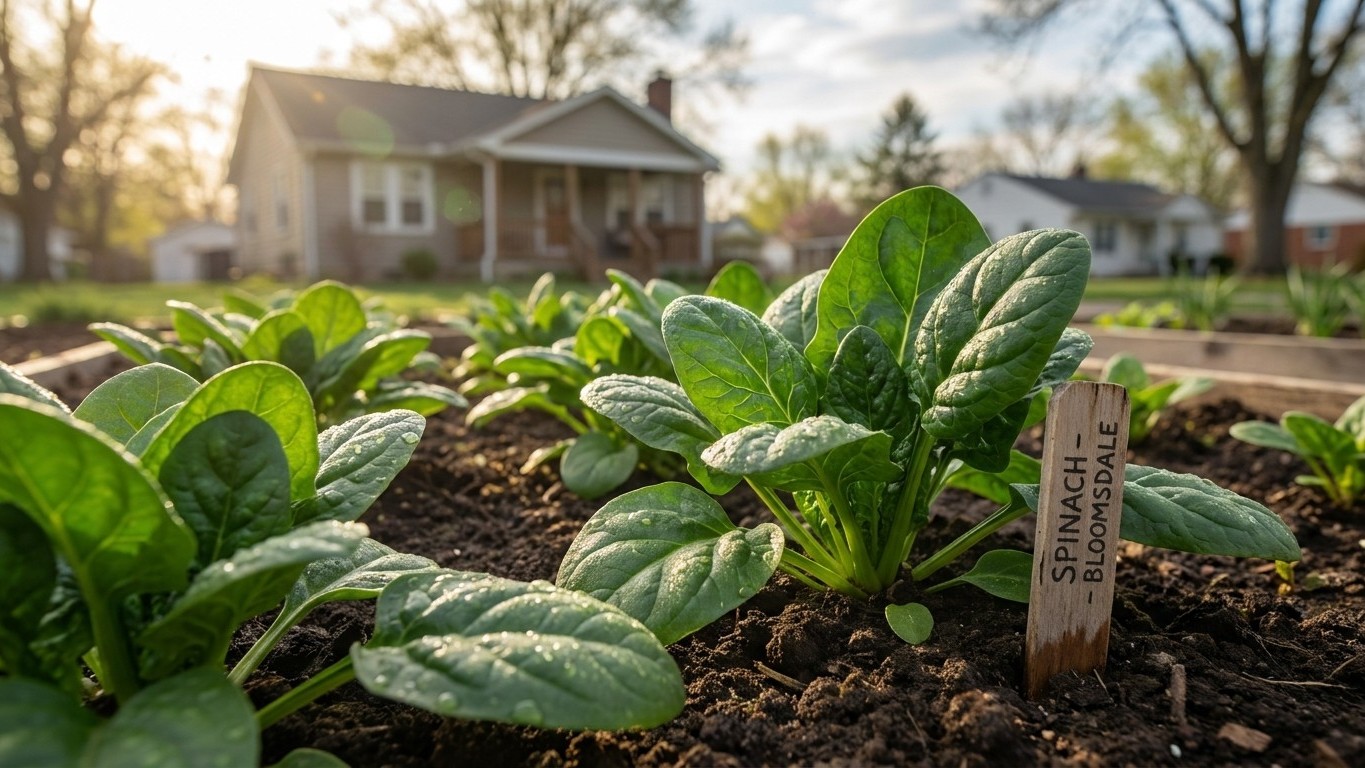

Spinach in Prince Edward Island bolts because of long summer days working together with warmth, not because the Island gets hot. With about 15 hours and 36 minutes of daylight on the longest day, PEI gardens hit the day-length trigger for flowering well before the thermometer becomes the bigger problem. The practical result: two short windows, spring and fall, bracket a summer stretch spinach simply cannot use, which is why knowing When to Sow Autumn Spinach in Prince Edward Island matters just as much as timing the spring crop.
The short answer
Spinach flowers, or “bolts,” in response to two forces acting together: day length and heat. Long days push the plant toward seed production, and the Utah State University Extension notes that spinach grows best where temperatures stay under 75 F, with germination itself dropping once soil passes 80 F. On Prince Edward Island, the day-length side of that equation arrives fast. By the summer solstice the Island is receiving 15 hours and 36 minutes of daylight, a figure calculated from the latitude of the Charlottetown reference station. That is nowhere near the 12-hour mark that triggers short-day onions to bulb, but it is squarely in the range that pushes spinach toward flowering regardless of how mild the air feels.
Here is the part that surprises a lot of gardeners moving to the Island from farther south: PEI’s summer heat is not the main enemy. The Charlottetown climate record shows an average of 0.0 days a year reaching 90 F. That is not a typo. Summers here are genuinely mild, without the sustained heat load that fries spinach outright in warmer states. If heat were the only trigger, PEI gardeners would have a long, comfortable spinach season. It does not work that way, because the day-length trigger fires on its own schedule, tied to the calendar and the latitude, not to the thermometer.
So the limit in Prince Edward Island is day length first, with heat playing a secondary role that mostly matters once the plant is already stressed by long days. A cool summer here does not buy extra weeks of leaf production, because the long days keep arriving whether the air is 65 F or 85 F. This is the opposite of what happens with a long-day onion variety, which actually needs those same long hours to form a bulb. For spinach, the identical daylight number that helps one crop ends another. Will Spinach Bolt Early in Prince Edward Island? Understanding that distinction is the whole key to timing a planting here.
The takeaway for planning purposes: treat the approach of the solstice, not a heat wave, as the signal that your spring spinach crop is entering its final stretch.
How long the spring window really is
- Work backward from the mean last frost. Environment and Climate Change Canada’s Canadian Climate Normals, based on the 1981-2010 period at the Charlottetown A station, put the average last spring frost at May 16. Spinach seed tolerates cold soil well, and the general guidance is to sow two to three weeks before that date, which lands sowing somewhere around the last days of April into the first days of May.
- Expect a wide margin around that date. A mean frost date is a midpoint, not a guarantee. In roughly half of all years the last frost falls later than May 16, so gardeners sowing at the earliest edge of that window should have row cover or cloches ready for a late cold snap.
- Count the cool weeks you actually get. From late April sowing to the summer solstice is roughly seven to eight weeks. Because PEI averages zero days a year above 90 F, nearly all of that stretch sits comfortably under the 75 F growth ceiling, which is unusually generous compared to warmer parts of the spinach-growing map.
- Watch the calendar, not the forecast, for the finish line. As daylight climbs toward 15 hours and 36 minutes through May and June, the bolting trigger builds regardless of temperature. Most PEI gardeners can expect roughly six to eight usable weeks of leaf harvest from a spring sowing before the plants start sending up flower stalks.
The autumn crop, and when the soil lets you sow
A fall planting flips the two obstacles from spring. Instead of racing daylight, the challenge becomes waiting out summer soil temperatures, then working backward from the season’s end before frost shuts things down.
Soil that starts out too warm to germinate
Utah State University Extension’s guidance is specific: spinach germination drops once soil temperature passes 80 F. In many warmer states that creates a real bottleneck, forcing gardeners to wait deep into late summer for soil to cool enough for seed to sprout reliably. Prince Edward Island’s climate works in the gardener’s favor here. With an average of 0.0 days a year reaching 90 F, the Island’s soil rarely spends much time anywhere near that 80 F germination ceiling in the first place. Fall sowing windows tend to open earlier here than in hotter regions, since there is no long stretch of baked, overheated ground to wait out.
The frost that ends the season
The other boundary is fixed and comes from the other end of the calendar. The same ECCC Canadian Climate Normals record puts the mean first fall frost at October 17, again measured at the Charlottetown A station over the 1981-2010 period. Since the source guidance for a fall spinach crop is to sow 50 to 75 days before the date you want to harvest, and spinach itself tolerates a light frost without much complaint, October 17 makes a reasonable target harvest date to count back from. Counting back 50 to 75 days from October 17 lands the sowing window between roughly early August and late August. Sowing earlier in that range gives a bigger, more forgiving harvest; sowing later trims the margin but still usually beats the frost.
Four spinach varieties commonly come up in extension guidance: Bloomsdale, Melody, Teton, and Olympia. The Utah State University Extension source used for the figures on this page does not publish days-to-maturity or performance data for any of them, so no comparison or recommendation can be made here beyond naming them.
Checking this against your own county
Every figure above comes from a single station, Charlottetown A, and Prince Edward Island is not one uniform climate. Gardeners in Prince County, Queens County, and Kings County can each see meaningfully different frost timing depending on proximity to the coast and elevation, and a mean frost date already means the real date shifts year to year even at the reference station itself. Before locking in a sowing date, check current conditions and local advice through Prince Edward Island’s own agriculture resources at princeedwardisland.ca/en/topic/agriculture. Local extension staff can speak to soil conditions and microclimate patterns in your specific part of the Island in a way a single provincial station average cannot.
Common questions
Does a cooler PEI summer mean spinach can be grown all season without bolting?
No. Bolting in spinach is triggered by long days as much as by heat, and Prince Edward Island still reaches 15 hours and 36 minutes of daylight around the solstice. That day length alone pushes plants toward flowering even in a mild, low-heat summer.
Is heat ever a factor in PEI spinach bolting?
It plays a secondary role. With an average of 0.0 days a year above 90 F, sustained heat stress is rare on the Island, which is why day length, not temperature, is the main driver of bolting here.
When is the safest time to sow a fall spinach crop in PEI?
Counting back 50 to 75 days from the mean first fall frost of October 17 puts sowing somewhere between early and late August, with earlier sowing giving a larger harvest before frost.
Should I trust May 16 and October 17 as exact frost dates for my garden?
Treat both as long-term averages from the Charlottetown A station, not guarantees. In roughly half of all years the actual frost falls later than the mean date, so building in a margin on either end of the season is worth it.