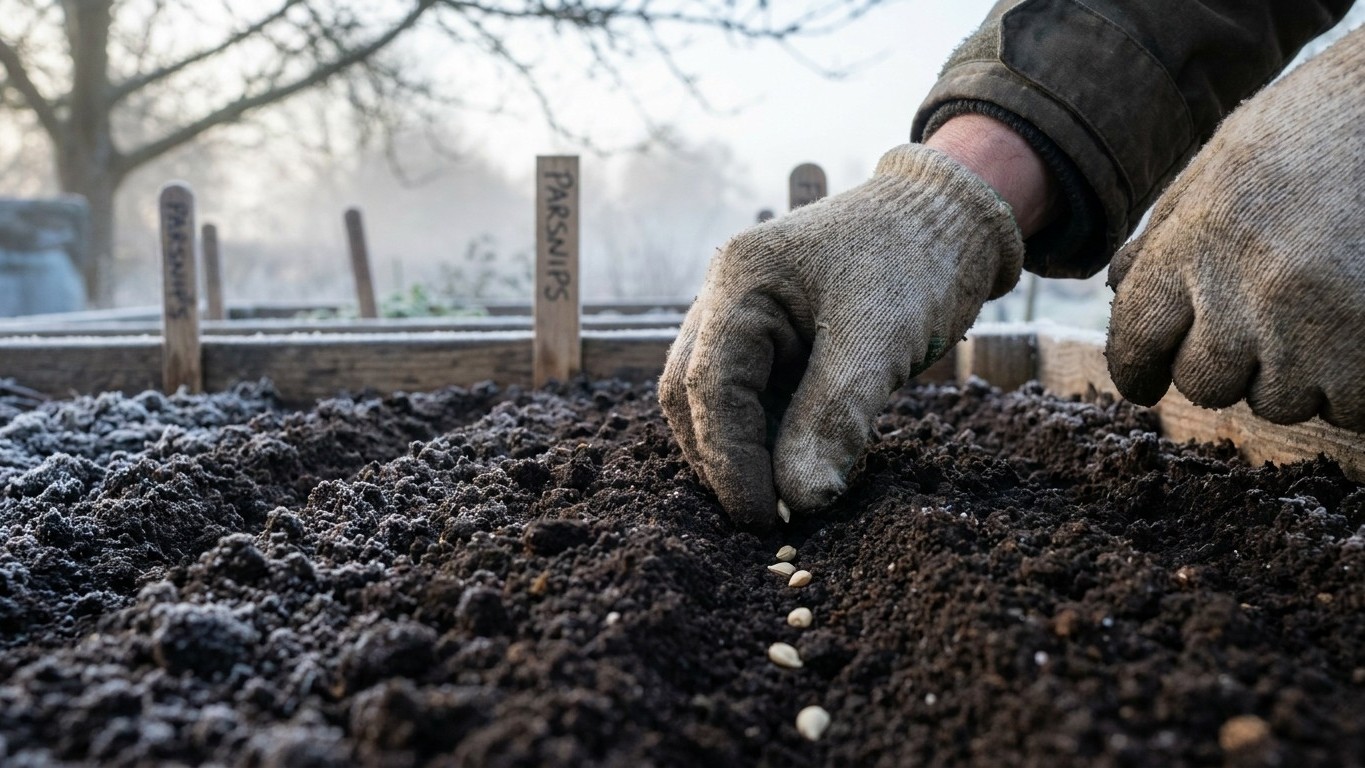

Sow parsnips in Delaware from mid-to-late March, about two to three weeks before the last spring frost near Wilmington (April 3-14). Direct-seed into loosened soil, since parsnips don’t transplant. Germination is slow, 14 to 21 days, so patience matters before anything shows above ground. Left in place through fall, the roots meet Delaware’s frosty weeks and sweeten before harvest.
The short answer
The number that actually decides this isn’t the state’s hardiness zone, it’s how cold the ground gets in the dead of winter. At the Wilmington reference station, the mean daily minimum for the coldest month sits at 25.6°F, according to NOAA NCEI Climate Normals for 1991-2020. That’s not a record low pulled from one brutal night. It’s the average low across the coldest stretch of the year, which tells you something more useful: Delaware winters routinely dip into the mid-20s, not just once but repeatedly, over weeks at a time.
That repetition is the whole point for parsnips. The crop doesn’t sweeten because a calendar says “winter” or because a map shades a state into a particular growing zone. It sweetens through direct exposure to freezing temperatures, which triggers the root to convert stored starch into sugar. A single light frost barely nudges that process. Several weeks of nights in the mid-to-upper 20s does the job thoroughly, and that’s exactly what a 25.6°F coldest-month average implies for a Delaware garden.
So the short answer holds up on two fronts. First, the sowing window: mid-to-late March gives seeds enough lead time ahead of the April 3-14 last-frost window to get established while the soil is still cool and workable. Second, the payoff: a Delaware winter delivers the kind of sustained cold that turns a merely edible parsnip into a genuinely sweet one, provided the roots stay in the ground through several hard frosts rather than coming out at the first cool snap.
Where a warmer coastal state might grow a fine-looking parsnip that never develops much sugar, Delaware’s winter minimums put it solidly in the category of climates that finish the job. That’s a real advantage over gardeners further south, and it’s worth building the whole planting plan around, rather than treating frost as an inconvenience to dodge.
Does the season fit?
Parsnips need 100 to 120 days from seeding to reach a usable size, according to Utah State University Extension, and that clock starts the moment seed goes into the ground, not when it germinates. Matching that requirement against Delaware’s frost dates shows how much room there actually is.
- Set the sowing window. Counting back two to three weeks from the April 3-14 last-frost range near Wilmington puts sowing at roughly mid-to-late March, weather and soil workability allowing.
- Account for slow germination. Seeds take 14 to 21 days to emerge, so a mid-March sowing typically shows first seedlings in late March to early April, right around or just after the last frost date itself.
- Run the 100 to 120 days forward. From a mid-to-late March sowing, the minimum 100-day mark lands in late June to early July, and the full 120-day mark in mid-to-late July. That’s when roots have reached a workable size, though not yet their best flavor.
- Compare against the first fall frost. Wilmington’s first fall frost falls October 26 to November 7. Counting from a mid-to-late March sowing to that window is roughly 215 to 235 days, far beyond the 120-day minimum.
- Read the gap. The difference between the 120-day maturity mark and the first fall frost leaves a cushion of roughly three months. That’s not wasted time. It’s the stretch during which fully grown roots sit in the ground, waiting for the cold that sweetens them, before digging begins after several hard frosts.
That arithmetic points to a comfortable fit, not a tight one. Delaware gardeners aren’t racing the calendar the way growers in short-season northern states sometimes are. The bigger risk here isn’t running out of season, it’s pulling the roots too early, before the cold has had time to do its work.
What goes wrong here
- Forked roots from heavy or stony ground. Much of Delaware, especially away from the sandy coastal plain, carries clay-heavy or compacted soil that splits a taproot as it pushes down. Utah State University Extension recommends deep, sandy soil for parsnips, and where that’s not the native condition, double digging the bed to break up compaction and remove stones before sowing is the fix, not something to address after the roots are already forked.
- Forked roots from overwatering. This is a separate cause from soil texture, and it catches gardeners with otherwise decent beds off guard. Excess moisture, especially in irregular bursts, encourages the taproot to branch instead of driving straight down. Steady, moderate watering through the germination and early growth stages avoids the swings that cause it.
- Sowing pushed past the window. Delaware’s season has real margin, but delaying sowing well into April eats into that cushion. Since germination alone takes up to three weeks, a late start compresses the time roots have to size up before the frosty weeks that matter for flavor arrive.
- Harvesting before the frost has done its work. The most Delaware-specific mistake isn’t a lack of cold, it’s impatience. Roots dug right after reaching the 100 to 120-day mark in midsummer will be starchy and bland. Leaving them in the ground through several hard frosts in the 25.6°F range that defines the region’s coldest month is what converts that starch to sugar, so the fix is simply timing the harvest to follow the cold, not the calendar.
Common questions
Can I start parsnip seeds indoors in Delaware and transplant them later?
No. Parsnips form a single taproot that resents disturbance, so seed goes directly into the garden bed. Starting indoors and transplanting tends to produce stunted or forked roots.
How long after sowing should I wait before harvesting?
Expect 100 to 120 days from seeding to reach usable size, but hold off digging until after the ground has seen several hard frosts, which is when the roots actually sweeten.
What kind of soil bed works best for parsnips in Delaware gardens?
Deep, loose, sandy soil is ideal. Where the native ground is heavier, as it can be away from the coastal plain, double digging the bed before sowing helps prevent forked roots.
Can parsnips stay in the ground over a Delaware winter?
Yes. With a coldest-month mean minimum of 25.6°F, Delaware winters provide the sustained frost exposure parsnips need, and roots can typically be left in place, mulched, and dug as needed through the cold months.