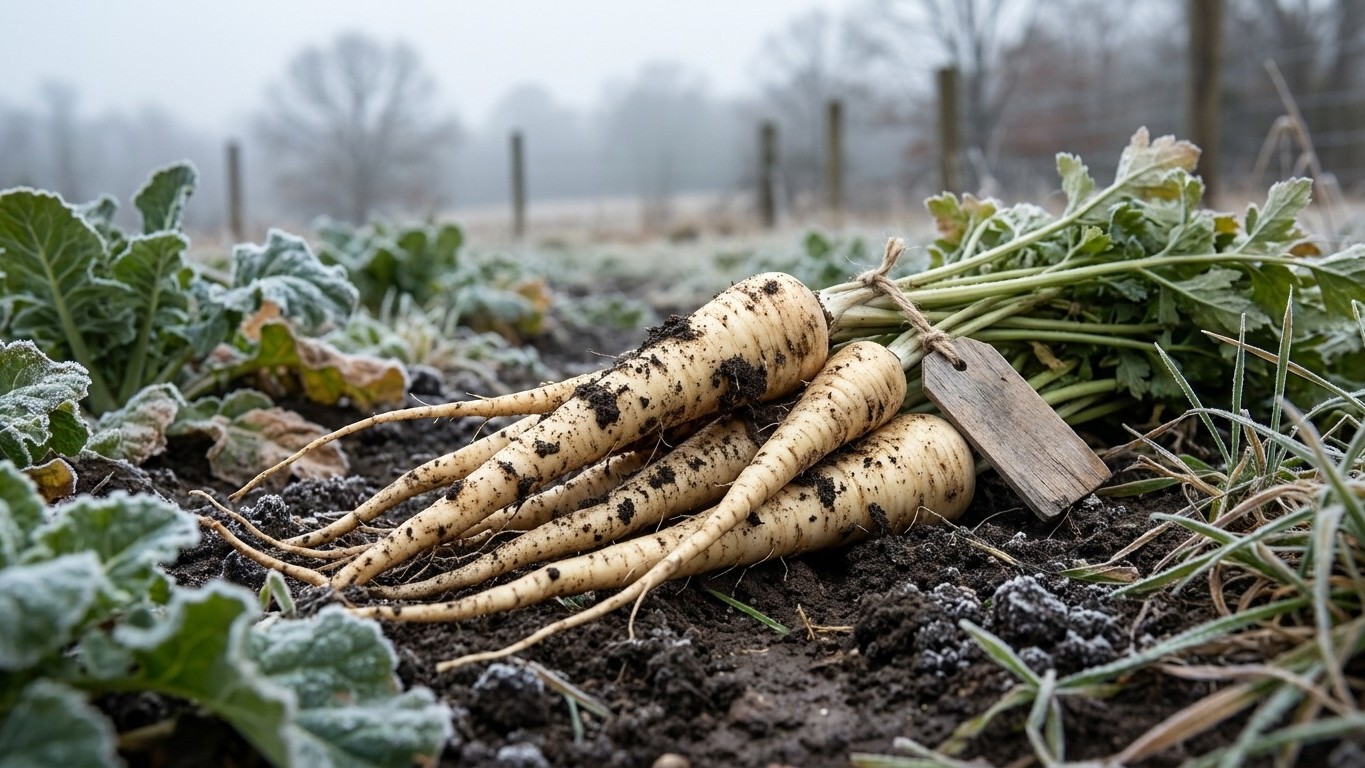

Yes, Kentucky delivers what a parsnip needs. Louisville’s coldest month averages a nightly low of 27.8°F, well below freezing, and that cold arrives on schedule most autumns. Sown at the right time and grown in the right soil, a parsnip planted here won’t just survive. It will convert its stored starch into sugar and come out of the ground tasting like it should.
The short answer
The number that settles this is 27.8°F. That’s the mean daily minimum for the coldest month at the Louisville reference station, drawn from NOAA NCEI’s 1991-2020 Climate Normals. It’s not a record low and it’s not a seasonal average. It’s the typical overnight temperature during the coldest stretch of the year, and it tells you something a hardiness zone map never will: how often the ground actually drops below freezing here.
That distinction matters more than most gardeners realize. A hardiness zone rating describes the coldest extreme a perennial plant might survive over years. It says nothing about how many frosty nights a root vegetable gets to sit through before harvest. Parsnips don’t care what zone they’re in. They care whether cold has actually touched them, repeatedly, for weeks. A mild winter with one or two light frosts produces a parsnip that grew fine but never sweetened. A winter with a mean minimum of 27.8°F, several degrees below the freezing point, produces the opposite.
Kentucky’s winters clear that bar without much drama. A coldest-month average minimum in the high 20s means frost isn’t an occasional visitor here, it’s the norm for weeks at a stretch from late fall into winter. According to Utah State University Extension, parsnips need exactly that kind of exposure, several weeks of cool, frosty weather, to trigger the chemical shift that turns starch into sugar in the root. Kentucky’s climate supplies that condition reliably, which separates it from warmer states where gardeners have to work around a winter that simply doesn’t get cold enough.
None of this means every parsnip pulled from Kentucky soil will taste sweet. Soil texture, sowing date, and harvest timing all still matter, and a rushed harvest right after the first frost skips most of the sweetening window entirely. But the climate itself isn’t the obstacle. The frost is there. What a gardener does with that frost decides the rest.
Does the season fit?
Parsnips need 100 to 120 days from seeding to reach a mature root, and that count starts the day seed goes into the ground, not the day a seedling appears. They’re also sown directly in place rather than transplanted, since the taproot doesn’t tolerate disturbance well. Lining that requirement up against Kentucky’s frost dates shows exactly how much room there is to work with.
- Sow 2 to 3 weeks before the last spring frost. With Louisville’s last-frost window running March 24 to April 4, that puts a reasonable sowing date somewhere around early to mid-March.
- Expect germination to take 14 to 21 days. Parsnip seed is notoriously slow and uneven to sprout, so seedlings won’t show above ground until early to late April in most years. Digging up the row before that window closes is the single most common way gardeners give up on a bed that was never actually dead.
- Count 100 to 120 days forward from the seeding date, not the germination date. That puts root maturity somewhere around mid-June to mid-July for an early-March sowing.
- Compare that maturity date against the first fall frost, which arrives November 2 to November 12 here. That leaves roughly four additional months of cool soil time between a mature root and the first hard frost of autumn.
- Use that gap. Parsnips can stay in the ground well past maturity, and the weeks of cold that follow the first fall frost are exactly what converts the stored starch into sugar before digging.
Run the arithmetic and Kentucky’s season doesn’t just fit, it fits with slack to spare. A 100-to-120-day crop sown in early March and left in the ground until after several fall frosts have a season roughly twice as long as the minimum requirement demands. That margin is what makes this a comfortable growing state for parsnips rather than a marginal one.
What goes wrong here
- Forked roots in heavy or stony ground. Kentucky’s clay-heavy soils are common, and a taproot hitting compacted clay or buried rock splits into two or three legs instead of growing straight. Utah State University Extension recommends deep, sandy soil for straight roots, and where the native ground is heavy, double digging the bed before sowing gives the root a clear path down.
- Forked roots from overwatering. This is a separate cause from soil texture, not a variation of it. Too much moisture, especially in already-loose soil, encourages the root to branch rather than push straight down. Watering deeply but less frequently, rather than keeping the bed constantly damp, keeps the taproot growing in one direction.
- A season that runs out. Kentucky’s frost window leaves plenty of margin, but sowing late, waiting too long to confirm germination, or miscounting from transplant date instead of seeding date can still eat into that margin. Sow on schedule in early to mid-March and give the seed its full 14 to 21 days before assuming a failed row.
- A winter too mild to sweeten. This isn’t the state’s typical problem, given a 27.8°F mean minimum in the coldest month. But microclimates matter. Urban plantings, particularly in and around Louisville, tend to run warmer and see frost arrive later and end earlier than surrounding rural ground. A garden in that kind of pocket may get fewer effective frosty weeks than the countywide numbers suggest, and harvesting immediately after the first light frost, rather than waiting several weeks into the cold stretch, cuts the sweetening process short regardless of where the garden sits.
Common questions
When should parsnips be sown in Kentucky?
Sow 2 to 3 weeks before the last spring frost. With a last-frost window of March 24 to April 4 at the Louisville reference station, that generally means seeding in the ground by early to mid-March.
How long does it take for parsnip seeds to sprout?
Germination takes 14 to 21 days. Parsnip seed is slow and can look like nothing is happening for two to three weeks after sowing, which is normal rather than a sign of failure.
Can parsnips be left in the ground through the cold season in Kentucky?
The state’s coldest-month mean minimum of 27.8°F puts winter temperatures reliably below freezing without extreme deep freezes, which is the condition parsnips need to sit in the ground and sweeten over several weeks rather than being dug immediately at first frost.
Does soil type change how sweet a parsnip turns out?
Soil texture affects the shape of the root more than its sugar content, but it still matters. Utah State University Extension calls for deep, sandy soil for straight growth, and notes that heavy soil needs to be double dug before sowing to give the taproot room to grow without forking.