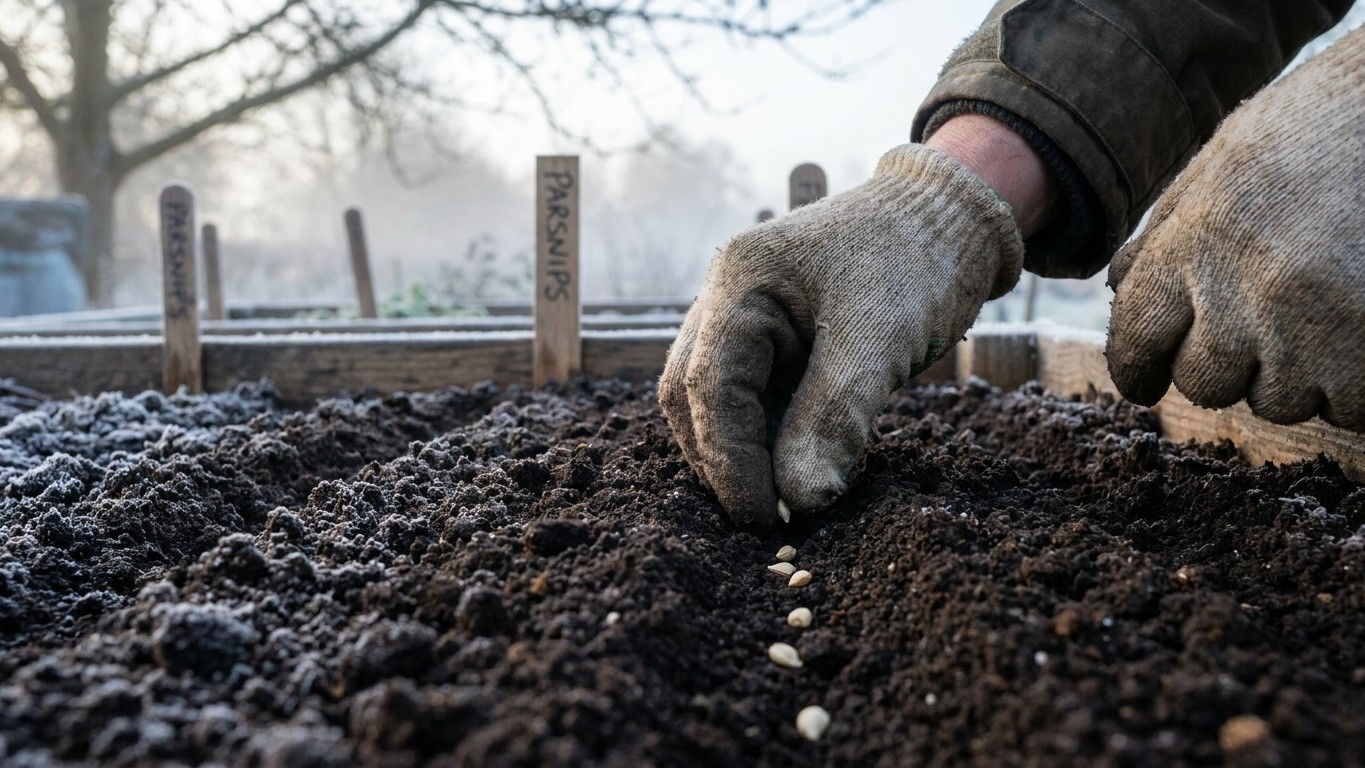

Sow parsnip seed directly in the garden between roughly March 3 and March 21, two to three weeks ahead of Kentucky’s last spring frost. That frost typically falls between March 24 and April 4 near Louisville, though rural gardens often see a tighter window than the city station suggests. Skip transplants: parsnip taproots resent disturbance, so seed goes straight into the bed it will grow in for the whole season, and patience is required before the first true leaves show.
The short answer
Does Kentucky actually deliver enough frosty weather to sweeten a parsnip, not just grow one? The mean minimum temperature during the coldest month, measured at the Louisville reference station, sits at 27.8°F, according to NOAA’s 1991-2020 Climate Normals. That’s several degrees below freezing on an average night during the coldest stretch of winter, and that cold holds for weeks at a time, not just an isolated night here and there.
That number matters more than it looks at first glance. A parsnip pulled straight out of warm soil tastes fine, but flat: starchy, mild, a little one-note. What turns it into the sweet, nutty root gardeners talk about is repeated exposure to cold, which triggers the plant to convert stored starch into sugar as a kind of natural antifreeze. Kentucky’s frost season stretches from early November through late March or early April, based on that same NOAA dataset, which means roughly five months where nighttime temperatures regularly drop below freezing, with the deepest cold arriving in January.
Put those two facts side by side and the answer is straightforward. Parsnips grown in Kentucky soil will sweeten, provided they’re left in the ground through at least a few hard frosts before harvest. Pulling them in early October, right after they reach size, skips the entire point of growing this crop. The roots need to sit through repeated cold snaps, ideally several weeks’ worth, before a spade ever touches them.
None of this hinges on which side of a hardiness zone line Kentucky falls on. Hardiness zones describe the coldest temperature a perennial might survive over winter, and parsnips here are grown as an annual root crop, dug and eaten rather than left to overwinter as a living plant. What actually decides flavor is frost exposure itself, meaning the number of genuinely cold nights the root experiences while still sitting in the ground. Louisville’s 27.8°F average minimum for the coldest month, paired with a frost season running from early November into April, gives Kentucky gardeners plenty of that exposure. Gardeners in states with only a handful of light frosts each winter simply don’t get the same result, no matter how carefully they grow the crop or how rich the soil.
Does the season fit?
Parsnips need 100 to 120 days from seeding to reach full size, and that clock starts the day seed goes into the soil, not the day it germinates. Because this is a direct-seeded crop with a long, slow taproot, there’s no shortcut through indoor starts or transplants. Lay that requirement next to Kentucky’s frost calendar and the numbers line up with room to spare, though it’s worth walking through the arithmetic step by step.
- Sowing window: Seed goes in two to three weeks before the last spring frost. With that frost landing between March 24 and April 4 in the Louisville reference data, the sowing window falls between roughly March 3 and March 21. Rural gardens, which tend to run a touch cooler and later than the urban station, may want to lean toward the back half of that window rather than the front.
- Germination lag: Parsnip seed is famously slow and uneven, needing 14 to 21 days just to break the surface. Seed sown on March 3 might not show green until March 17 to 24; seed sown March 21 could take until early April to emerge. Nothing is wrong if the row looks bare for three straight weeks.
- Growth to maturity: Counting the full 100 to 120 days from the original seeding date, not from germination, roots sown at the start of the window mature around June 11, and roots sown at the end of the window mature around July 19.
- Cushion before frost: The first fall frost arrives between November 2 and November 12. That leaves anywhere from three and a half to five months between a mature root and the first freeze, far more time than the crop needs to simply sit in the ground and continue thickening slightly through late summer and fall.
- Verdict: The fit is comfortable, not tight. Even a late sowing reaches maturity by midsummer, and the long gap before the first frost means there’s no pressure to rush harvest in September. The real scheduling question in Kentucky isn’t whether the crop matures in time; it’s how long to leave mature roots in the ground afterward so they catch enough frosty weeks to taste sweet.
What goes wrong here
- Forked, stubby roots from heavy or stony ground: Kentucky’s clay-heavy soils resist a straight taproot, and any rock or dense clump the root meets gets forked around instead of pushed through cleanly. Double dig the bed to at least 12 to 15 inches, breaking up clay and pulling out stones, or build a raised bed filled with deep, loose, sandy loam before seeding.
- Forked roots from overwatering: This is a separate cause from soil texture, and it’s easy to blame the wrong one. Too much water, especially in a feast-or-famine pattern, encourages the taproot to split into two or three branches instead of driving straight down. Water deeply but infrequently, aiming for even, moderate soil moisture rather than a soaked-then-bone-dry cycle over the growing season.
- Running the clock too close by sowing late: Because germination alone eats 14 to 21 days before anything visible happens, delaying past the sowing window shrinks the cushion between maturity and the first fall frost. Sow at the start of the window rather than the end if the goal is a wide margin for roots to sit and sweeten before digging.
- Pulling roots before the frost has done its work: A mature parsnip dug straight off summer growth, before any hard frost, is edible but bland and starchy rather than sweet. Kentucky’s frost season, running from early November into late March, gives ample opportunity for that exposure, so the fix is simple patience: leave mature roots in the ground through at least several cold nights, ideally spanning weeks near or below the coldest-month average minimum, before digging them.
Common questions
Can I start parsnip seeds indoors and transplant them in Kentucky?
No. Parsnips grow a single long taproot that doesn’t tolerate being moved or bent. Any disturbance at the seedling stage tends to produce forked, stubby roots later on. Seed goes directly into the bed where it will grow for the full 100 to 120 days, with no indoor head start.
Why hasn’t my parsnip seed sprouted after two weeks?
That’s normal, not a failed planting. Parsnip seed germinates slowly and unevenly, often taking a full 14 to 21 days to break the surface. Keep the row consistently moist during that stretch and resist the urge to re-sow before three full weeks have passed.
Should I leave parsnips in the ground over a Kentucky winter?
Yes, that’s actually when the flavor develops. With a coldest-month average minimum of 27.8°F and a frost season stretching from early November into late March or early April, roots left in place get plenty of cold exposure to convert stored starch into sugar. A layer of mulch over the row makes it easier to dig roots once the topsoil firms up in deep winter.
What kind of soil do parsnips need in Kentucky gardens?
Deep, sandy soil is the starting point, since it lets the long taproot push straight down without resistance. Kentucky’s heavier clay soils aren’t a dealbreaker, but they need to be double dug, loosened, and cleared of stones to a depth of at least 12 to 15 inches, before seed goes into the row.