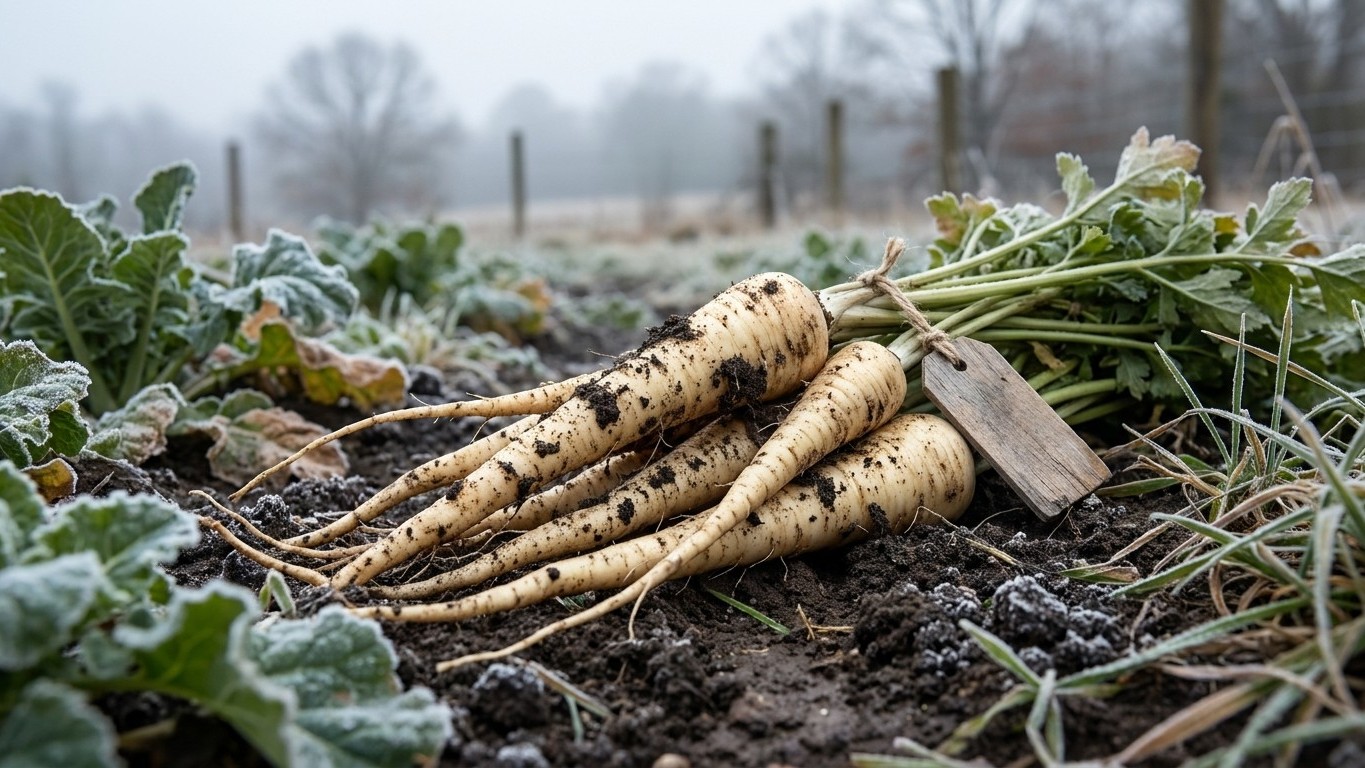

Yes, parsnips sweeten reliably in Michigan. The state’s winters bring long stretches of freezing temperatures, exactly the kind of frost exposure that turns a parsnip’s stored starch into sugar. Unlike warmer states where a parsnip grows fine but never sweetens, Michigan’s cold season does that conversion work for you. The growing season is also long enough that a crop sown from seed in spring reaches full size with time to spare before the ground locks up. The details of timing and soil still matter, but the climate itself is not the limiting factor here.
The short answer
Does Michigan deliver the several frosty weeks a parsnip needs to turn sweet? Yes, and by a wide margin. In the Detroit area, the coldest month of the year averages a nightly low of 19.2°F, according to NOAA NCEI Climate Normals covering 1991 to 2020. That’s not a record low or a one-night dip, it’s the average minimum temperature repeated night after night through the coldest weeks of winter. A parsnip left in that kind of cold for an extended stretch has more than enough exposure to convert its stored starch into sugar.
Frost exposure vs. hardiness zone
It helps to separate two things that get confused constantly: the hardiness zone and frost exposure. A hardiness zone rating tells you the average extreme minimum temperature a perennial plant can survive over winter. It says nothing about how many weeks of frost a garden actually gets, or how deep and how often that cold sets in. Parsnip sweetening isn’t a zone question at all, it’s a duration question. The crop needs sustained cool, frosty weather, not just a single freeze event or a technically cold zone rating, per Utah State University Extension.
Michigan answers that duration question with real numbers. A coldest-month average low of 19.2°F means the ground, and any parsnip roots left in it, sits well under 32°F for a large share of the winter, not just brushing against freezing on isolated nights. That prolonged cold is the mechanism doing the actual work: it triggers an enzyme response in the root that breaks down starch molecules into simpler sugars, which is why a parsnip dug in the dead of winter tastes noticeably sweeter than one pulled in early fall.
So the climate side of the equation is settled. A parsnip grown in Michigan soil, left in the ground through a real stretch of the state’s cold winter weather, will sweeten. The open question isn’t whether the state’s climate cooperates, it clearly does, but whether the growing season gives the root enough time to size up before that cold sets in, and whether the soil lets the root grow straight instead of forking. Those are the two questions the rest of this page answers.
Does the season fit?
Parsnips are sown directly in place, not started indoors and transplanted, so every day of the 100 to 120 days to maturity counts from the moment seed goes into the ground. Utah State University Extension recommends sowing 2 to 3 weeks before the last expected spring frost. Lay Michigan’s frost calendar against that formula and the season fits with real breathing room, though the arithmetic shifts a little depending on where in the state you’re gardening.
The timeline
- Sowing date. In the Detroit area, the last spring frost falls around April 30, so seed goes in the ground roughly mid-April, 2 to 3 weeks earlier. Across most of the Lower Peninsula, where the last frost lands in early to mid-May, sowing shifts to late April.
- Germination. Parsnip seed is notoriously slow, taking 14 to 21 days to sprout. That’s nearly three weeks of bare-looking soil before anything is visible above ground, and it’s the point where impatient gardeners dig up the row and re-sow, assuming the seed failed. It hasn’t. That’s just how parsnip seed behaves.
- Maturity window. Counting 100 to 120 days from that mid-to-late April sowing date lands the crop at full size sometime between late July and mid-September, depending on the exact sowing date and how warm the season runs.
- First fall frost. Michigan’s zone 6a areas see their first fall frost between October 6 and October 21. That leaves anywhere from roughly three to twelve weeks between a mature parsnip crop and the season’s first freeze, depending on how early the seed went in the ground.
- The verdict. With that much buffer between maturity and the first frost, Michigan’s season fits comfortably. There’s room to sow on the later end of the window, room for a slow, cool spring to push germination back a bit, and still time for the root to size up before frost starts doing its sweetening work.
That comfortable fit matters because a tight season forces a trade-off between root size and sweetness. A gardener who sows late and finds frost arriving before the root has bulked up ends up with a parsnip that’s technically sweetened but too thin to be worth digging. Michigan’s frost-free stretch is long enough that this isn’t the usual failure point here. The failures that do show up tend to start in the soil, not the calendar.
What goes wrong here
Michigan’s climate handles the sweetening and the season length without much drama. What trips gardeners up tends to be the soil underfoot and a couple of habits that come with a long, cool growing window.
Common failures
- Forked roots from heavy or stony ground. Michigan’s clay-heavy soils in many regions force a parsnip’s taproot to split around obstructions instead of growing straight down. Utah State University Extension points to deep sandy soil as the ideal and recommends double digging heavy ground to at least the depth of a mature root before sowing, working out stones as you go.
- Forked roots from overwatering. This is a separate cause from heavy soil, not the same problem wearing different clothes. Inconsistent or excessive watering, especially heavy rain followed by more heavy watering, encourages the root to branch instead of plunging straight down. A steady, moderate watering schedule, rather than soaking the bed and then letting it dry out hard, keeps the root growing in one direction.
- Digging before the frost has done its job. A parsnip pulled in early fall, before the state’s cold has had weeks to work on it, comes out starchy and bland instead of sweet. Given how far Michigan’s first frost sits after typical maturity dates, the fix is patience: leave the root in the ground through several hard frosts, mulch it if you plan to keep digging into winter, and hold off judging the flavor until after that exposure.
- Slow, soggy spring soil delaying germination. Michigan springs can stay cold and wet well into April, which slows already-slow parsnip germination even further past the normal 14 to 21 days. Waiting for the soil to warm and drain a little before sowing, rather than rushing seed into cold mud, cuts down on rot and uneven stands.
Common questions
Do I need to wait for frost before harvesting parsnips in Michigan?
Yes, if sweetness is the goal. The root reaches full size once it hits maturity around 100 to 120 days after sowing, but the sugar conversion happens afterward, once the root sits through cool, frosty weather. Digging early gives you a fully grown but starchy root. Waiting through Michigan’s fall frosts, which arrive between October 6 and October 21 in zone 6a areas, gives the same root time to sweeten.
Can I leave parsnips in the ground all winter in Michigan?
Many gardeners do, digging as needed through the cold months and pulling the last of the crop before the ground is too frozen to work. A layer of mulch over the row makes digging easier once the topsoil hardens. Given the Detroit area’s coldest-month average low of 19.2°F, roots left in the ground get plenty of sustained cold exposure, which is exactly what drives the sweetening.
What if my parsnip seed hasn’t sprouted after two weeks?
Don’t assume it failed. Parsnip germination normally takes 14 to 21 days, longer than most root vegetables, and cool or wet spring soil in Michigan can push that even further. Give it the full three weeks before deciding to re-sow, and keep the seed row consistently moist in the meantime rather than letting it dry out and then soaking it.
Does Michigan soil need special preparation for parsnips?
Often, yes. Deep sandy soil is the ideal growing medium according to Utah State University Extension, and much of Michigan’s ground runs heavier than that. Where the soil is dense or full of stones, double digging the bed to at least the depth a mature root will reach clears the path for a straight taproot instead of a forked one, and it’s worth doing before seed ever goes in the ground.