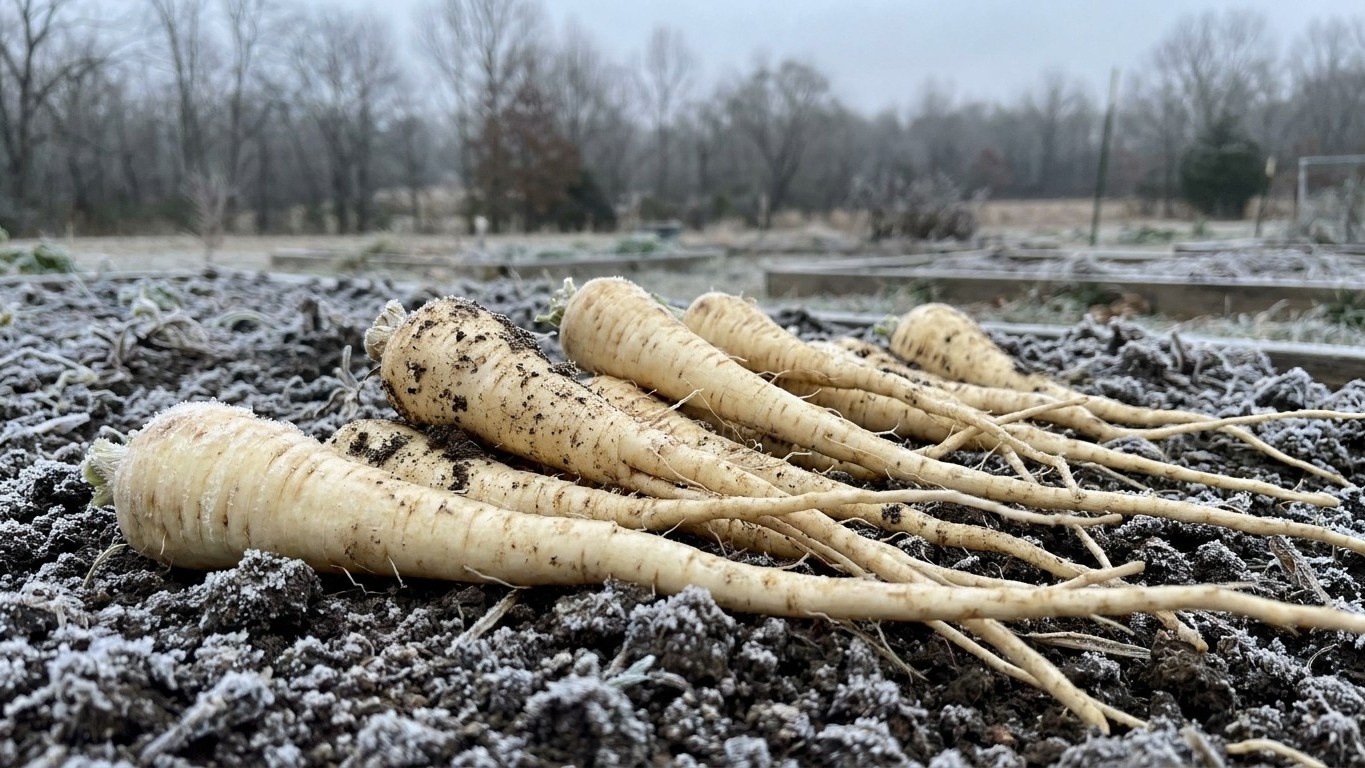

Yes, parsnips grown in Michigan will sweeten, and the reason has nothing to do with the state’s hardiness zone rating. It comes down to how many weeks of frost the roots sit through before you dig them, how you time the sowing against local frost dates, and how you handle the plant’s sap once harvest day arrives. Here’s what actually decides the outcome.
The short answer
Start with the number that matters most: the mean daily minimum temperature during Michigan’s coldest month sits at 19.2°F, based on the Detroit-area reference station in the NOAA NCEI Climate Normals for 1991-2020. That’s not a record low, and it’s not a monthly average, it’s the typical overnight low across the coldest stretch of winter. Nineteen degrees below freezing, night after night, for weeks at a time.
That figure is the whole story for parsnips. Sweetening in this root crop happens through a specific mechanism: cold temperatures trigger the plant to convert stored starch into sugar, a survival response that keeps the cell fluid from freezing solid. A parsnip that never experiences sustained cold grows into a perfectly edible root, but a starchy, flat-tasting one. A parsnip that sits through several weeks of freezing nights turns noticeably sweeter, almost candy-like at the core.
Michigan’s winter delivers exactly that. A mean minimum of 19.2°F in the coldest month isn’t a marginal, occasional dip below freezing, it’s a sustained cold season with weeks of consistent frost exposure. That’s the condition parsnips need, and it’s present here in abundance.
One warning worth repeating because it trips people up: the hardiness zone number you see on seed packets and plant tags describes whether a perennial plant survives winter in a given region. It says nothing about how many frosty nights a garden actually gets, and it isn’t interchangeable with the mean minimum temperature figure above. A gardener in a comfortable, moderate hardiness zone can still get plenty of frost exposure, and a gardener in a colder zone doesn’t automatically get more sweetening than one in a milder zone next door, because zone maps average out winter severity across broad regions. What decides parsnip flavor is the actual, measured pattern of cold nights in a specific location, which is what the 19.2°F figure captures. In Michigan, that pattern is strong enough that sweetening isn’t a maybe, it’s close to guaranteed, provided the roots are left in the ground long enough to feel that cold.
So the short answer holds: grow parsnips in Michigan, leave them in the soil past the point where they’re just “mature,” and let a handful of frosty weeks do the rest of the work before you harvest.
Does the season fit?
Parsnips take 100 to 120 days from seeding, according to Utah State University Extension, and that clock starts the day seed goes into the ground, not the day you transplant a start, because parsnips are sown directly in place and don’t tolerate transplanting well. Germination itself is slow, 14 to 21 days, so a gardener who doesn’t see green after a week shouldn’t assume the sowing failed and dig up perfectly good seed.
- Sowing window: Parsnips go in the ground 2-3 weeks before the last spring frost. In the Detroit area, where the last spring frost lands around April 30, that puts sowing in mid-April. Across most of the Lower Peninsula, where the last frost runs early to mid May, sowing shifts to late April.
- Germination lag: Add the 14 to 21 days it takes seed to emerge, and a mid-to-late April sowing doesn’t show visible seedlings until early to mid May. That’s a normal, expected wait, not a sign of trouble.
- Maturity: Counting 100 to 120 days forward from that April sowing, roots reach usable size somewhere between late July and mid August, well ahead of any fall frost concern.
- Frost exposure window: The first fall frost in Michigan’s zone 6a areas arrives between October 6 and October 21. That leaves roughly two months between “mature enough to eat” and “first frost hits,” and then additional weeks after that first frost before the ground locks up hard, all of which the roots can spend underground soaking up cold.
- Verdict: The season fits comfortably. There’s enough calendar room for full maturity by late summer and for several weeks of post-frost sweetening in the ground before winter forces a final harvest.
That comfortable fit is worth noting because it’s not universal. Warmer states routinely run short on frost weeks, forcing gardeners to harvest before real sweetening kicks in. Michigan doesn’t have that problem, the arithmetic works in the grower’s favor from sowing straight through to a frost-sweetened harvest.
What goes wrong here
- Forked, twisted roots from heavy or stony ground. Parsnips push a single long taproot straight down, and anything that deflects it, a rock, a clay lens, compacted soil, splits the root into forks. Utah State University Extension recommends deep, sandy soil for this reason; where the ground runs heavy, double dig the bed to at least 12 to 15 inches before sowing so the root has a clear, loose path downward.
- Forked roots from overwatering, a separate cause entirely. Even in loose soil, roots that sit in consistently soggy ground can also fork or branch, because excess moisture disrupts the taproot’s growth pattern in a different way than physical obstruction does. Water deeply but let the top inch or two dry between waterings rather than keeping the bed constantly wet.
- A season that runs out before maturity. This is rare in Michigan given the arithmetic above, but a late sowing, anything pushed past the recommended 2-3 weeks before last frost, eats into the margin. Sow on schedule rather than waiting for warmer soil; parsnip seed germinates fine in cool spring ground.
- A mild winter that never delivers real cold. This isn’t Michigan’s typical risk, but an unusually mild winter, or roots grown under heavy mulch that insulates them from the cold, can leave them starchy instead of sweet. If mulching to prevent the ground from freezing too hard to dig, pull the mulch back for a few weeks once several frosts have already passed, so the roots still feel that cold before you protect them for digging.
Handling parsnips at harvest carries a risk that most garden guides skip entirely. According to the North Carolina Extension Gardener Plant Toolbox, “All parts of this plant contain furocoumarins which can make skin sensitive to light causing burns so be sure to wear gloves, long sleeves and long pants when dealing with it.” That’s the whole warning, and it applies to the roots, the foliage, the stems, every part of the plant, not just the leafy tops.
The mechanism is what makes this surprising. Furocoumarins don’t burn skin on contact by themselves. The reaction needs two things together: plant sap on the skin, and sunlight hitting that same skin. That combination is exactly what a harvest day produces, bright sun, bare forearms pulling tops and brushing soil off roots, sap transferring onto skin during the process. The burn doesn’t show up immediately either. It typically appears hours after the exposure, once the skin has had time to react to the sap-plus-light combination, which is part of why people don’t connect it back to the parsnips they pulled that morning.
Because the reaction depends on sunlight, not just contact, washing the skin after the fact doesn’t undo the exposure the way it might with a simple irritant. The real protection is preventing the sap from reaching skin in the first place: gloves, long sleeves, and long pants while harvesting, especially on a clear, sunny day.
Checking this against your own county
The figures here are drawn from a Detroit-area reference station and from statewide frost-date ranges, which means your own county could run a little earlier or later than either. Soil texture also varies block to block, let alone county to county, and that affects how deep you’ll need to work a bed before sowing.
Michigan State University Extension keeps county-level guidance on frost dates, soil conditions, and planting calendars through its outreach network. You can find your local office through MSU Extension’s outreach directory, and a quick call or visit will tell you whether your specific location tracks close to the Detroit numbers above or runs on its own local pattern.
Common questions
Can I harvest parsnips before the first fall frost in Michigan?
You can, and the roots will still be edible, but they’ll taste starchier and less sweet. The flavor payoff comes specifically from leaving roots in the ground through several frosty weeks, so an early harvest trades sweetness for convenience.
How long can parsnips stay in the ground over a Michigan winter?
The frost sweetening happens over the first several cold weeks after the first fall frost, which in zone 6a areas of Michigan falls between October 6 and October 21. Beyond that, the limiting factor becomes whether the ground freezes hard enough to make digging impossible, which mulch can delay but not prevent indefinitely.
Does soil type matter more than climate for Michigan parsnips?
Both matter, but they solve different problems. Climate, specifically frost exposure, determines whether the roots turn sweet. Soil texture, ideally deep and sandy, determines whether the roots grow straight or fork. Michigan gardeners with heavy or stony ground need to double dig regardless of how favorable the frost pattern is.
Is the furocoumarin risk worse on certain days?
Based on the mechanism described by NC State Extension, the reaction requires both sap contact and sunlight, so exposure on a bright, sunny day handling the plant carries more risk than handling it under overcast skies or after dark. The source doesn’t quantify the difference, but the two-factor mechanism makes the connection to sun exposure clear.