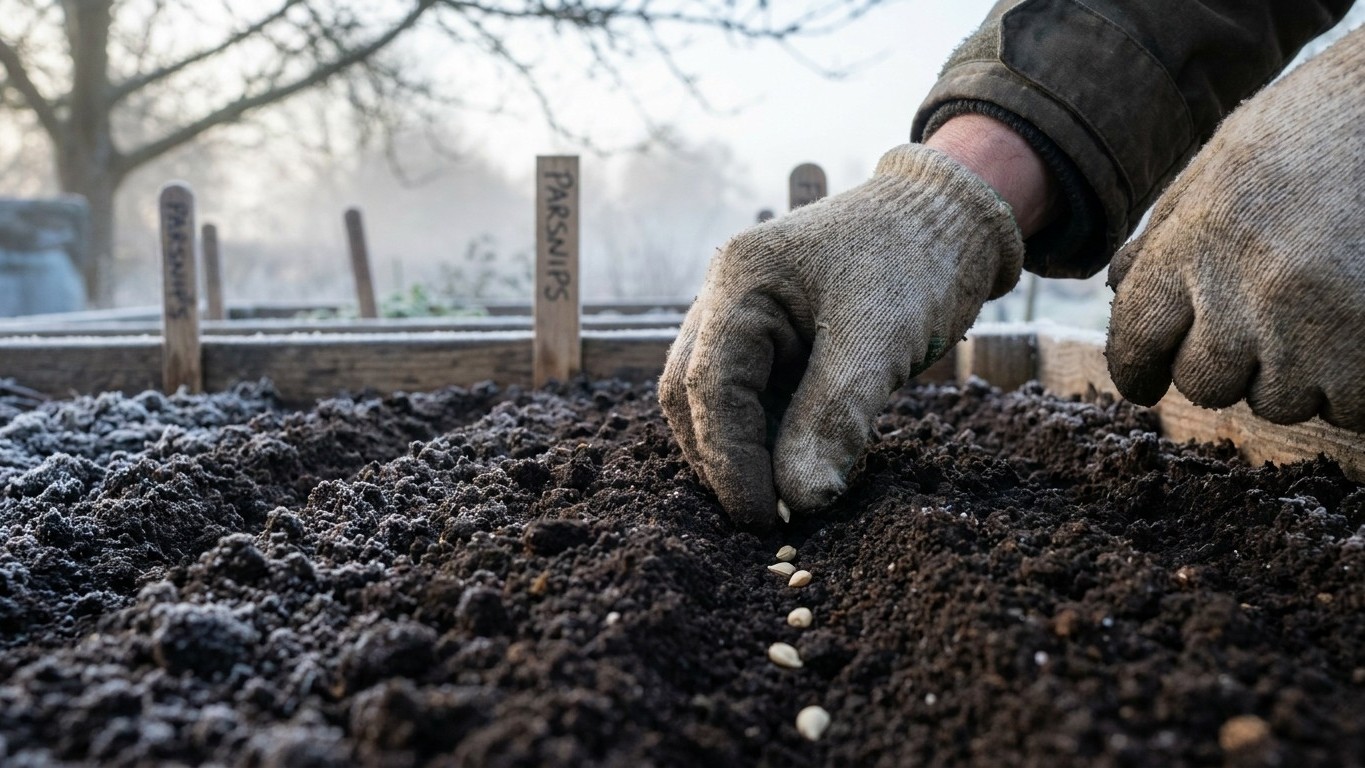

In most of Michigan, parsnip seed goes into the ground two to three weeks before the last spring frost, which lands around April 30 near Detroit and stretches into early or mid-May across much of the rest of the Lower Peninsula. That window gives the crop its full 100 to 120 days before the first fall frost shows up, somewhere between October 6 and October 21 in zone 6a. Time it right, and Michigan’s cold autumns do the rest.
The short answer
Before picking a sowing date, ask a different question first: does this part of Michigan actually deliver several weeks of frosty weather, or does it just get chilly? That distinction matters more than most gardeners realize, because a parsnip’s sweetness doesn’t come from surviving winter in general. It comes from sitting in cold soil, repeatedly exposed to frost, long enough for stored starch to convert into sugar. A mild, forgiving winter grows a perfectly fine root that never develops that signature sweetness.
Michigan doesn’t have that problem. Using Detroit as the reference station, NOAA’s 1991-2020 climate normals put the mean minimum temperature for the coldest month at 19.2°F. That’s not a record low or a fluke cold snap. It’s the average low, night after night, through the heart of winter. A number that far below freezing means frost isn’t an occasional visitor here. It’s a season-long presence, and it’s exactly the kind of prolonged cold exposure the sweetening process depends on.
So the plain answer: parsnips grown in Michigan don’t just grow here, they sweeten here. That’s a real distinction, because plenty of states can grow a technically edible parsnip that stays starchy and bland because the frost exposure never lasts. Michigan’s fall frost arriving in early-to-mid October, followed by that 19.2°F coldest-month average, gives roots left in the ground weeks of the cold conditions they need.
None of this has anything to do with hardiness zone maps. Hardiness zones describe the coldest temperature a perennial plant can survive over winter, which is a different question entirely from how many frosty weeks an annual root crop sits through before harvest. A gardener could look at a zone map, see a relatively mild number, and wrongly assume that means less frost exposure. The coldest-month minimum is the number that actually answers the sweetening question, and for Michigan, it answers it clearly: yes, there’s enough frost here, and the sowing decision now becomes a matter of timing the season correctly rather than worrying whether winter will cooperate.
Does the season fit?
Knowing the climate supports sweet parsnips is only half the job. The other half is arithmetic: does Michigan’s frost-free window actually leave room for a 100- to 120-day crop, sown directly in place, to mature before winter shuts things down? Here’s how that math plays out, step by step.
- Start with the sowing date. Parsnip seed goes into the ground 2 to 3 weeks before the last spring frost. Near Detroit, with a last frost around April 30, that puts sowing in mid-to-late April. Farther north and inland, where last frost slides into early or mid-May, sowing shifts later to match.
- Add the germination lag. Parsnip seed is notoriously slow, taking 14 to 21 days to germinate. That’s not a delay you can shortcut, and gardeners who don’t account for it often assume the seed failed and re-sow into bare, still-germinating soil. Build those three weeks into the calendar before expecting to see rows of seedlings.
- Count forward 100 to 120 days from seeding, not from germination. That’s the crop’s own timeline, straight from Utah State University Extension. Sown in mid-to-late April, a 120-day root reaches maturity sometime in mid-to-late August.
- Compare that maturity date against the first fall frost. Michigan’s first fall frost falls between October 6 and October 21 in zone 6a. A root that’s mature by late August has roughly six to eight weeks of extra time before that first frost even arrives, and those weeks matter because they’re what allow the roots to sit through the season’s early cold snaps before harvest.
- Judge the fit. Between an April sowing and an October frost, Michigan’s growing season runs somewhere in the neighborhood of five to six months. A 100- to 120-day crop, plus its slow germination, fits into that window with real margin to spare. This isn’t a tight squeeze the way it can be in short-season northern climates. It’s a comfortable fit, with enough slack that a late or wet spring won’t necessarily wreck the harvest.
That margin is worth banking, because Michigan springs aren’t always cooperative. A cold, soggy April that delays sowing by a week or two still leaves enough runway for the root to mature and catch its frost exposure before the ground freezes hard.
What goes wrong here
- Forked or split roots from heavy or stony ground. Parsnips want deep, loose, sandy soil. Michigan’s clay-heavy pockets, common across parts of the Lower Peninsula, can deflect a taproot around rocks and compacted layers, splitting it into forked, misshapen roots. Utah State University Extension’s fix is straightforward: double dig heavy soil before sowing, breaking it up well past the depth the root will eventually reach.
- Forked roots from a second, unrelated cause: overwatering. This isn’t the same problem as heavy soil, even though the result looks identical. Too much water, especially inconsistent watering that swings between soggy and dry, can also cause the taproot to fork or branch. Even a raised bed with perfect, loose soil will produce ugly roots if it’s kept waterlogged. Even watering, not heavy watering, is the goal.
- Sowing too late and running the season short. Michigan’s window is comfortable, but it isn’t infinite. A gardener who sows in early June, well past the recommended 2-to-3-weeks-before-last-frost mark, is gambling that a 120-day root can still mature and catch enough frost before the October freeze. In a normal year it might work; in a year with an early fall frost, it won’t.
- Skipping the frost exposure by harvesting too early. Michigan’s climate delivers the frosty weeks a parsnip needs, but only if the roots are left in the ground to receive them. Pulling the crop the moment it looks mature, before the season’s first frosts have had a chance to work on it, skips the sweetening step entirely and leaves a starchy, underwhelming root despite living in a climate perfectly capable of producing a good one.
Common questions
Can parsnips be started indoors and transplanted in Michigan?
No. Parsnips are a direct-seeded, in-place crop. The taproot doesn’t tolerate transplanting well, which is why the 100- to 120-day clock in the season math above starts at seeding, not at any indoor head start.
How long does parsnip seed take to sprout in Michigan’s cool spring soil?
Expect 14 to 21 days. That’s a normal, expected lag for parsnip seed regardless of soil temperature within the recommended sowing window, and it’s the reason patience matters more than a quick re-sow at the first sign of bare soil.
Does Michigan get cold enough for parsnips to sweeten every year?
The 1991-2020 climate normal puts Detroit’s coldest-month mean minimum at 19.2°F, well below freezing and consistent with the sustained frost exposure the sweetening process requires. That’s a long-term average, not a year-by-year guarantee, but it reflects a climate that reliably delivers the frosty weeks parsnips depend on.
Is Michigan’s soil naturally suited to parsnips, or does it need amending?
It depends on the specific site. Parsnips need deep, sandy, loose soil, and heavy or clay-heavy ground needs to be double dug before sowing to avoid forked roots. There’s no single answer for the whole state; the soil at a given garden is a starting point to check, not something to assume either way.