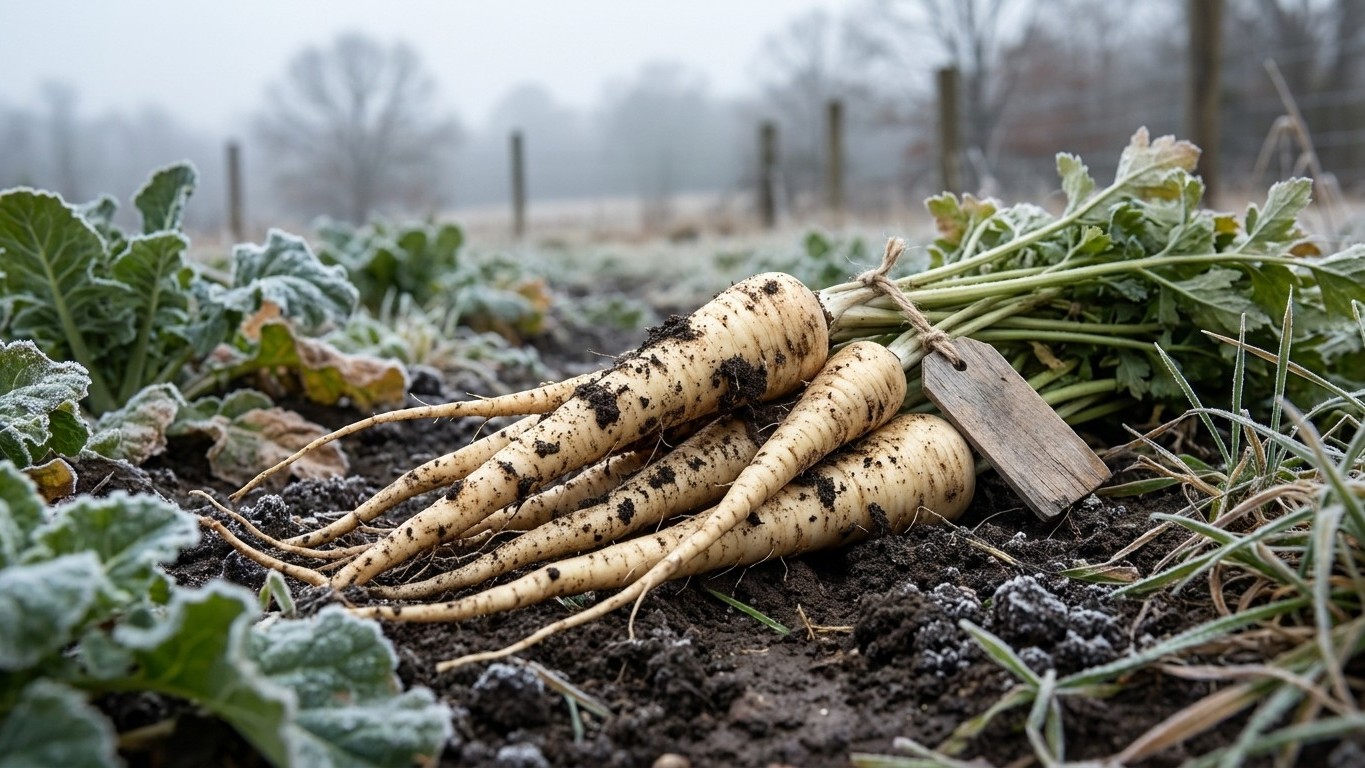

New Hampshire’s winters run cold enough, and long enough, that parsnips left in the ground here don’t just survive frost. They convert to sugar because of it. The state’s coldest month averages a nightly low of 17.1°F, and that kind of sustained cold is exactly what turns a starchy root into a sweet one. The season length works too, if you sow at the right time. Here’s the arithmetic behind that answer, and where New Hampshire gardeners still trip up.
The short answer
Sweetening isn’t about hardiness zone. It’s about frost exposure, plain and simple, and those are two different measurements that get confused constantly. A hardiness zone tells you the coldest temperature a perennial plant might survive over winter. It says nothing about how many frosty weeks a root vegetable sits through before you dig it up. For parsnips, what matters is the second number: how cold, how often, and for how long.
New Hampshire answers that question decisively. The mean minimum temperature for the coldest month, drawn from NOAA NCEI Climate Normals for 1991-2020 at the Manchester reference station, sits at 17.1°F. That’s not a record low or a fluke cold snap. It’s the average nightly low across the coldest month of the year, which means repeated, reliable freezing is the norm here, not the exception.
Parsnips need exactly that kind of repetition. According to Utah State University Extension, the roots taste best after several weeks of cool, frosty weather, which converts stored starch into sugar. One light frost does almost nothing. It takes a sustained run of freezing nights, night after night, to trigger the chemical shift that separates a bland parsnip from a genuinely sweet one. A single mild frost followed by a warm spell won’t do it. New Hampshire’s coldest month, averaging well below freezing on a nightly basis, delivers that sustained exposure without much doubt.
Compare that to a milder coastal or southern climate, where the coldest month might average a nightly low in the high 30s or low 40s. That kind of winter grows a perfectly fine parsnip. It just never gets cold enough, long enough, for the starch-to-sugar conversion to finish. The root stays starchy no matter how long it sits in the ground. New Hampshire doesn’t have that problem. The state’s winters are cold enough that the risk runs the other direction: getting the timing right so the roots are still workable when you want to harvest, not whether the cold will show up at all.
So the short answer holds up under scrutiny. New Hampshire parsnips will sweeten, not just grow, because the coldest month here delivers real, sustained frost exposure rather than the occasional light dip that a hardiness zone rating might suggest on its own.
Does the season fit?
Frost exposure answers the sweetening question. Season length answers a different one: will the root even reach a harvestable size before the ground locks up? Parsnips are sown directly in place, not transplanted, and Utah State University Extension puts the timeline at 100 to 120 days from seeding to maturity. That clock starts the day you drop seed in the ground, not the day green shows up. Here’s how New Hampshire’s calendar lines up against that requirement.
- Sowing window: Parsnip seed goes in 2 to 3 weeks before the last spring frost. In the Manchester reference area, that last frost falls between April 16 and April 27, which puts sowing somewhere around late March to mid-April, depending on how the season is running that year.
- Germination lag: Parsnip seed is notoriously slow to sprout, taking 14 to 21 days to germinate. A gardener who sows in late March or early April shouldn’t expect to see rows until mid to late April, and shouldn’t assume a failed planting and re-sow too early. Bare soil for three weeks is normal, not a warning sign.
- Maturity clock: Counting 100 to 120 days from that seeding date lands the crop’s earliest maturity somewhere in mid to late July, and the later end in August.
- First fall frost: The reference station shows the first fall frost arriving between October 13 and October 26 (NOAA NCEI U.S. Climate Normals 1991-2020). That leaves roughly two to three months of margin after the crop technically matures, and before the ground starts freezing hard.
- The verdict: The math works comfortably here. Even sowing on the later side of the window and hitting the long end of the maturity range, New Hampshire’s frost-free stretch runs long enough to mature the root and still leave weeks of cold weather afterward for the sweetening process to do its work.
That comfortable fit is worth noting because it’s not universal. In shorter-season northern climates, gardeners sometimes have to choose between letting the root mature fully and getting enough frost exposure afterward. New Hampshire rarely forces that trade-off, provided the seed goes in on schedule rather than delayed into late spring.
What goes wrong here
A fitting season and cold enough winters don’t guarantee a good harvest on their own. Most parsnip trouble in New Hampshire gardens comes down to soil and timing mistakes rather than climate limits.
- Forked roots from heavy or stony ground. New Hampshire’s glacial soils run rocky and often compacted in unimproved beds, and a parsnip root pushing through rocks or clay will split into forks rather than growing straight. Utah State University Extension recommends deep, sandy soil for this crop, and says heavy soil needs to be double dug before sowing. Clearing stones and loosening the bed a full 12 to 18 inches down before planting solves this at the source.
- Forked roots from overwatering. This is a separate cause from soil texture, and it’s easy to mix the two up. Even in loose, well-prepared soil, roots that get inconsistent heavy watering, soaked one week and dry the next, tend to fork or crack as they grow. Even, moderate watering through the season keeps the root growing in one straight line.
- A season that runs out. This risk is low in New Hampshire given how the calendar lines up, but it still shows up when sowing gets pushed late, whether from a wet spring or a delayed start. Sowing as soon as the soil is workable, within that 2 to 3 week window before last frost, keeps the full 100 to 120 day clock from bumping against hard ground in late fall.
- Harvesting before enough frosty weeks pass. A root that’s technically mature in August but dug up right away skips the sweetening step entirely. Leaving the crop in the ground through several hard frosts, and mulching over it to keep the soil workable as temperatures drop, lets the starch-to-sugar conversion finish before harvest.
One caution worth repeating: the state’s general soil reputation for being rocky and glacial is a starting point, not a diagnosis. Individual gardens vary a lot, especially between old farmland with decades of amendment and a new suburban lot with builder’s fill underneath the topsoil. A simple dig test before sowing tells you more than any statewide generalization will.
Common questions
Do parsnips need to be replanted every year, or do they come back?
Parsnips are grown as an annual crop, sown fresh from seed each season. They’re not a perennial, so there’s no coming back on their own after harvest.
Can I leave parsnips in the ground over winter in New Hampshire?
Many gardeners do, since the roots hold up well in cold soil and the extended frost exposure improves flavor. Mulching heavily helps keep the ground workable enough to dig roots out once you’re ready, even after the surface has frozen.
How do I know if my parsnip seed is still viable before sowing?
Parsnip seed loses viability faster than most vegetable seed, so fresh seed each season is the safer bet. Given the 14 to 21 day germination lag, there’s no quick way to test viability in the ground itself without losing time on the sowing window.
Should I amend my soil before sowing, even if it looks fine on the surface?
It’s worth checking below the surface first. A shovel test 12 to 18 inches down reveals whether stones or compacted clay are lurking under decent-looking topsoil, and double digging before sowing, as Utah State University Extension recommends, is far easier than dealing with forked roots after the fact.