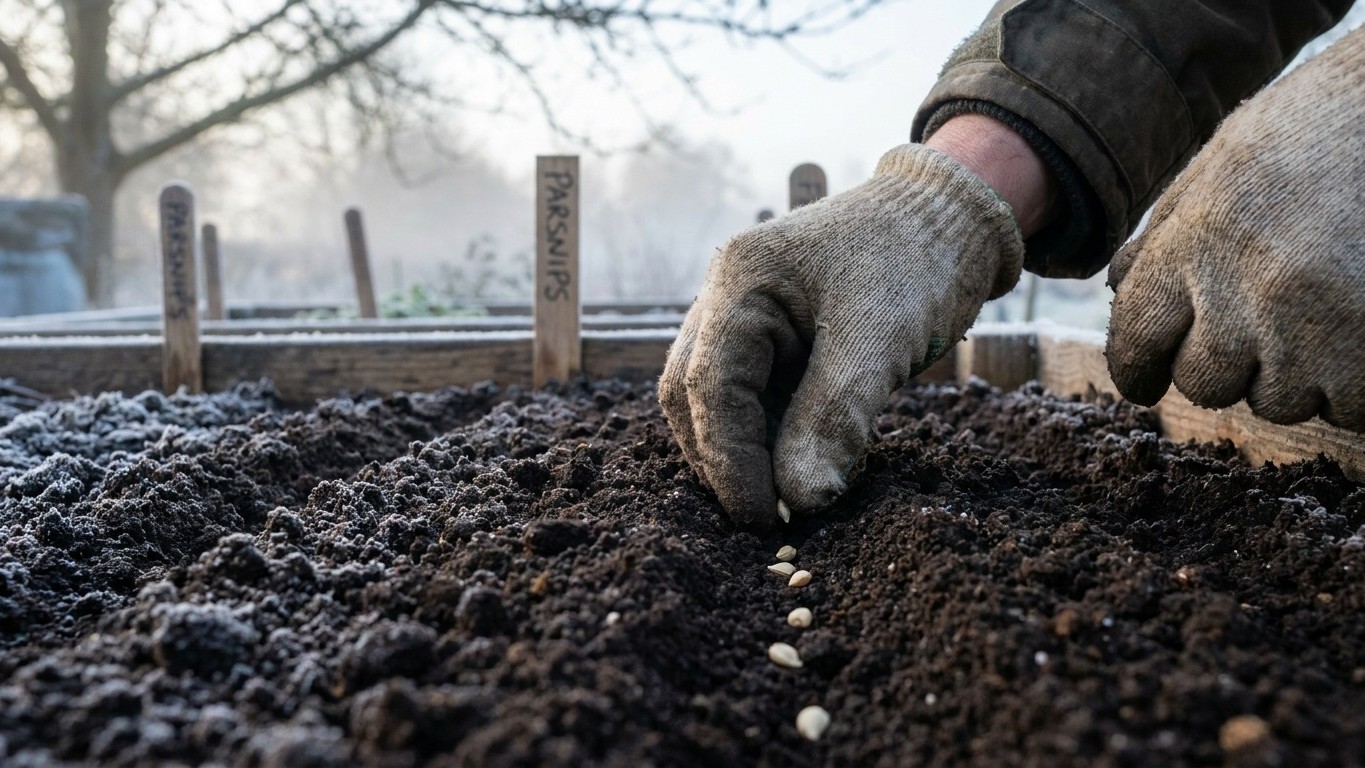

In the Albuquerque area, the last spring frost falls between March 31 and April 12, so parsnip seed goes into the ground roughly two to three weeks before that, in mid-to-late March. That timing gives the crop its full 100 to 120 days before the first fall frost arrives between October 29 and November 9. But the calendar is only half the story here.
The short answer
Before picking a sowing date, ask a different question first: does this stretch of New Mexico actually deliver several weeks of hard, consistent cold? That’s what separates a parsnip that merely grows from one that develops the sweet, nutty flavor the crop is known for. In Albuquerque, the reference station used for New Mexico climate data, the mean daily minimum temperature during the coldest month sits at 26.4°F. That’s well below freezing on an average night, not just an occasional dip, and it points to a stretch of the year where sustained cold is the norm rather than the exception.
This is a different measurement than the hardiness zone you’ll see printed on seed packets or plant tags. A hardiness zone tells you the coldest temperature a perennial plant is expected to survive over winter. It says nothing about how many weeks a root vegetable sitting in the soil will actually spend exposed to freezing air. Parsnips don’t care what zone you’re in. They care whether frost repeatedly touches the ground around them, because that repeated chilling is what triggers the plant to convert stored starch into sugar. A mild zone with only a handful of light frosts can produce a perfectly healthy parsnip that never turns sweet.
Given a coldest-month average minimum of 26.4°F, most of the Albuquerque area and similar mid-elevation parts of New Mexico get considerably more than a handful of frosty nights each winter. That’s a strong sign that parsnips left in the ground after they mature, and harvested after several weeks of this kind of cold, will sweeten the way growers expect. The picture changes at the state’s extremes. Higher elevations around Santa Fe or Taos run colder still and offer no shortage of frost exposure. Lower desert pockets near Las Cruces or the Rio Grande valley’s warmer stretches run milder, and a gardener there should expect a longer wait, and possibly a less pronounced sweetness, before the roots are ready to pull.
The practical takeaway: check your own location’s winter lows against that 26.4°F benchmark before assuming your parsnips will taste the way the seed catalog promises. Cold, not the calendar, is what finishes the job.
Does the season fit?
- Start with the last spring frost window. At the Albuquerque reference station, that falls between March 31 and April 12. Parsnip seed goes in two to three weeks ahead of that date, which lands the sowing window somewhere around mid-to-late March for most of the region. Gardens outside the immediate metro area, especially at higher elevation or in outlying counties, often see frost linger a week or two longer, so it’s worth checking local frost records rather than assuming the airport-station date applies exactly.
- Account for slow germination. Parsnip seed is notoriously unhurried. It takes 14 to 21 days just to break the surface, and the 100-to-120-day maturity window includes that slow start. A gardener who doesn’t see sprouts after a week and digs up the bed to re-sow usually still had a viable planting underneath.
- Count forward to harvest. Add 100 to 120 days to a mid-to-late March sowing and the earliest harvest date lands somewhere in late June through July for the fast end of that range, though most gardeners leave parsnips in the ground much longer to catch the frost-sweetening benefit.
- Compare against the first fall frost. The reference station’s first fall frost arrives between October 29 and November 9. Counting from a mid-to-late March sowing to that late-October date works out to roughly 210 to 220 days of available growing time, well beyond the 100 to 120 days the crop actually needs.
- Read the margin. That gap, close to three months of slack, means the season fits comfortably in the Albuquerque area and similar mid-elevation zones. It also means there’s no penalty for sowing on the later end of the recommended window, and it leaves plenty of room to let the roots sit through several weeks of fall frost before digging them, which is exactly what the crop needs to sweeten.
What goes wrong here
- Forked roots from heavy or stony ground. Parsnip roots push straight down and split around any obstruction, including compacted clay or rocks. New Mexico’s native soils run heavy and alkaline in many areas. The fix is deep sandy soil where possible, or double-digging a heavy bed to at least 12 to 15 inches before sowing.
- Forked roots from overwatering. This is a separate problem from soil texture, even though the symptom looks the same. Excess or inconsistent watering encourages the taproot to branch instead of growing straight. Water evenly and moderately rather than flooding the bed, and let the top inch of soil dry slightly between waterings once seedlings are established.
- A season that runs out. Sowing too late in spring, or waiting for warmer soil out of caution, eats into the margin described above. In most of New Mexico that margin is generous, but gardeners at higher elevation with a shorter frost-free stretch should sow at the early edge of the two-to-three-week-before-last-frost window rather than the late edge.
- A winter too mild to sweeten. In the state’s warmer low-desert pockets, winter frost may be too brief or too light to trigger much starch-to-sugar conversion. The remedy is patience: leave mature roots in the ground through as much of the cold season as the local climate offers, and harvest after the coldest stretch rather than right at the 100-day mark.
- Giving up too early on germination. Because parsnip seed takes 14 to 21 days to sprout, a bare-looking bed at day seven or ten is not a failed planting. Keep the soil consistently moist and wait out the full three weeks before deciding to re-sow.
Common questions
Can I sow parsnips directly, or should I start them indoors?
Parsnips are sown in place. The taproot doesn’t transplant well, and the 100-to-120-day maturity clock starts from the seeding date in the garden bed, not from a transplant date.
How long before I see sprouts?
Expect 14 to 21 days. Keep the bed consistently moist during that stretch, since parsnip seed dries out and fails to germinate if the surface crusts over.
Do I need a hard freeze for parsnips to taste good, or does any frost work?
The crop needs repeated exposure to frosty weather over several weeks, not a single light frost. A mean coldest-month minimum around 26.4°F, as recorded at the Albuquerque reference station, suggests most of the region gets that sustained cold, but warmer low-elevation pockets may fall short.
What should I do if my garden’s frost dates differ from the reference station?
Treat the Albuquerque-area dates as a starting point, not a guarantee. Suburban and rural gardens, and anywhere at higher elevation, commonly see the last spring frost later and the first fall frost earlier than the reference station shows, sometimes by one to two weeks or more. Check your own county’s frost history before locking in a sowing date.