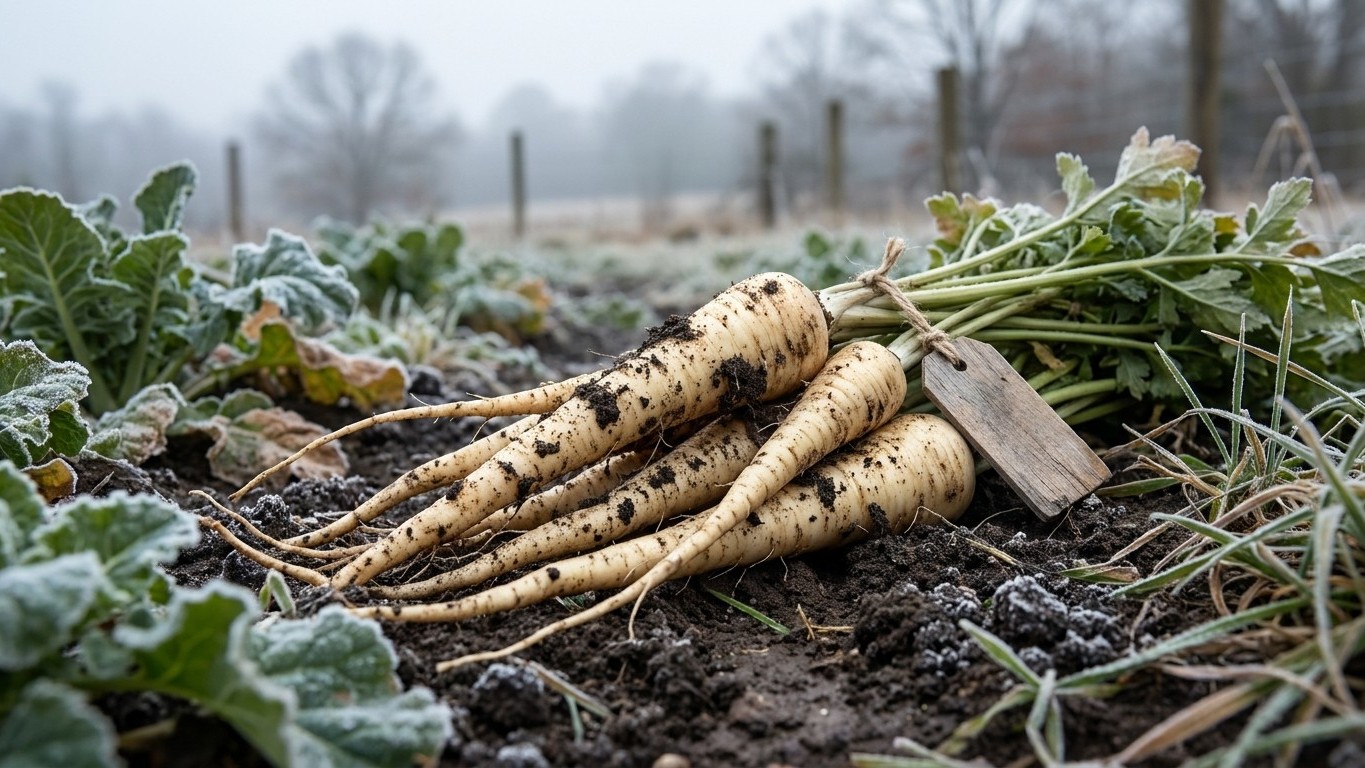

Yes, Pennsylvania delivers the kind of frost exposure parsnips need to turn sweet, not just grow tall. Philadelphia’s coldest month averages a 26.0°F minimum, and that’s cold enough, repeated enough, to do the starch-to-sugar conversion this root crop depends on. The bigger question for most gardeners here isn’t whether winter arrives, it’s whether the growing season before it leaves enough runway.
The short answer
Forget the hardiness zone number for a second. What actually decides whether a parsnip sweetens is how many frosty weeks it sits through in the ground before you dig it. A zone rating tells you whether a perennial survives winter; it says nothing about whether an annual root crop gets exposed to enough cold to trigger sugar conversion. Those are two different questions, and mixing them up leads a lot of gardeners astray.
Pennsylvania’s answer, based on the mean minimum temperature of the coldest month, is straightforward. Philadelphia, the state’s mildest corner, still averages 26.0°F for its coldest month’s daily low. That’s not a single overnight dip. That’s a sustained pattern of freezing nights stacking up across January, which is exactly the kind of repeated frost exposure that pulls sugar out of a parsnip’s starch reserves. Utah State University Extension notes that parsnips taste best after several weeks of cool, frosty weather following that conversion process, and Philadelphia’s winter delivers weeks of it, not just an isolated cold snap.
Move away from the Delaware Valley and the case only gets stronger. The northern tier and the Alleghenies run colder than the reference station used here, with frost arriving earlier and lingering later into spring. If 26°F average lows in the mildest part of the state already qualify as sufficient frost exposure, the higher, colder parts of Pennsylvania aren’t going to fall short. The risk in this state was never going to be a winter too mild to do the job. Coastal Georgia or the Gulf Coast face that problem. Pennsylvania does not.
So the sweetening question resolves early: a parsnip left in Pennsylvania ground through a normal winter, exposed to the state’s typical freeze-thaw pattern, will convert its starches on schedule. What decides whether that parsnip is worth harvesting at all is a separate matter entirely, tied to whether the plant had enough days on the calendar to grow a full root before that frost exposure even starts. That’s where the season length does the real work, and it’s less forgiving than the temperature question.
Does the season fit?
Parsnips are sown directly in the garden bed, not started indoors and transplanted, and the clock for maturity runs from that seeding date, not from germination or from when true leaves appear. Utah State University Extension puts the full timeline at 100 to 120 days from seeding, with germination alone taking 14 to 21 days before you’ll see any green above the soil. Lay that timeline against Pennsylvania’s frost calendar and the arithmetic works out like this:
- Start with the sowing window. Parsnips go in the ground 2 to 3 weeks before the last spring frost. In the Philadelphia area, that last frost falls between March 29 and April 6, which puts the sowing date around mid-March.
- Add the germination lag. Nothing visible happens for 14 to 21 days. A gardener who sows in mid-March won’t see seedlings until early April, and that gap is normal, not a sign of a failed planting.
- Count forward 100 to 120 days from the sowing date, not the sprouting date. From a mid-March sowing, 100 days lands in late June; 120 days lands in mid-July. That’s when the roots reach full size and the plant has technically finished growing.
- Compare that to the first fall frost. Philadelphia’s first fall frost arrives between November 5 and November 16. That leaves roughly four months of slack between “root is grown” and “frost starts sweetening it.”
- Use that slack deliberately. Rather than harvesting in July, the roots stay in the ground through fall and into the early frosts of November, which is exactly the exposure the crop needs to convert starch to sugar before digging.
In and around Philadelphia, the season fits comfortably, with months to spare between maturity and the ideal harvest window. Move north into the state’s higher country and the picture tightens. The northern tier and the Alleghenies see their last spring frost two to four weeks later than Philadelphia, which pushes the earliest safe sowing date into early or even late April. Combined with a fall frost that also arrives earlier at elevation, the cushion shrinks from four months to something closer to two or three, still workable, but with a lot less room for a late sowing or a cool, slow spring.
What goes wrong here
- Forked, twisted roots from heavy or stony ground. Parsnips push a single taproot straight down, and anything that splits that path, a rock, a clay lens, compacted soil, forks the root into two or three skinny legs instead of one clean carrot-shaped root. Utah State University Extension recommends deep sandy soil for parsnips and says heavy soil needs to be double dug before sowing, loosened well beyond the top few inches so the root has a clear, obstruction-free path down.
- Forked roots from overwatering. This is a separate cause from soil texture, not a variation on it. Too much water, especially inconsistent heavy watering after a dry stretch, encourages the root to branch and split even in soil that’s otherwise loose and rock-free. Even, moderate watering keeps the taproot growing in one direction instead of forking in search of drainage.
- A season that runs out in the colder counties. In the northern tier or the Alleghenies, a late sowing (pushed back by a slow, wet spring) can bump right up against that region’s earlier fall frost, leaving roots undersized when the ground finally freezes hard. Sowing at the earliest safe date after the last frost, rather than waiting for perfect weather, protects that timeline.
- Harvesting before the frost has done its work. A parsnip pulled in September or October, before the region’s frosty weeks arrive, will be fully grown and completely bland. The fix isn’t better soil or more water, it’s patience: leave the roots in the ground through the first hard frosts of November and let the cold do the conversion before you dig.
Common questions
Can I sow parsnips later in Pennsylvania to time the harvest closer to frost?
Sowing later shortens the growing window rather than the frost-exposure window, and since the crop needs 100 to 120 days just to size up, a late sowing risks small, underdeveloped roots by the time frost arrives. It’s better to sow on schedule, 2 to 3 weeks before the last spring frost, and simply leave the mature roots in the ground longer before digging.
Do I need to mulch parsnips heavily over winter in Pennsylvania?
That’s not covered in the sourced guidance here, so treat any specific mulching recommendation with caution. What is clear is that the roots need actual exposure to cold, so burying them under so much insulation that the ground beneath stays unfrozen would work against the sweetening process rather than helping it.
Does the northern tier of Pennsylvania sweeten parsnips the same way as Philadelphia?
Yes, and likely more reliably, since colder, higher parts of the state see earlier and harder frosts than the Philadelphia reference station used here. The tighter margin in those areas is on season length, not on whether winter gets cold enough to sweeten the crop.
How do I know if my soil is heavy enough to cause forked roots?
Utah State University Extension’s guidance points to soil texture rather than a soil type name: if digging a hole reveals dense, sticky clay or a layer of compacted soil within the top foot or so, that’s heavy enough to deflect a taproot. Double digging that bed before sowing, breaking up the soil well below where the root will travel, addresses the problem directly.