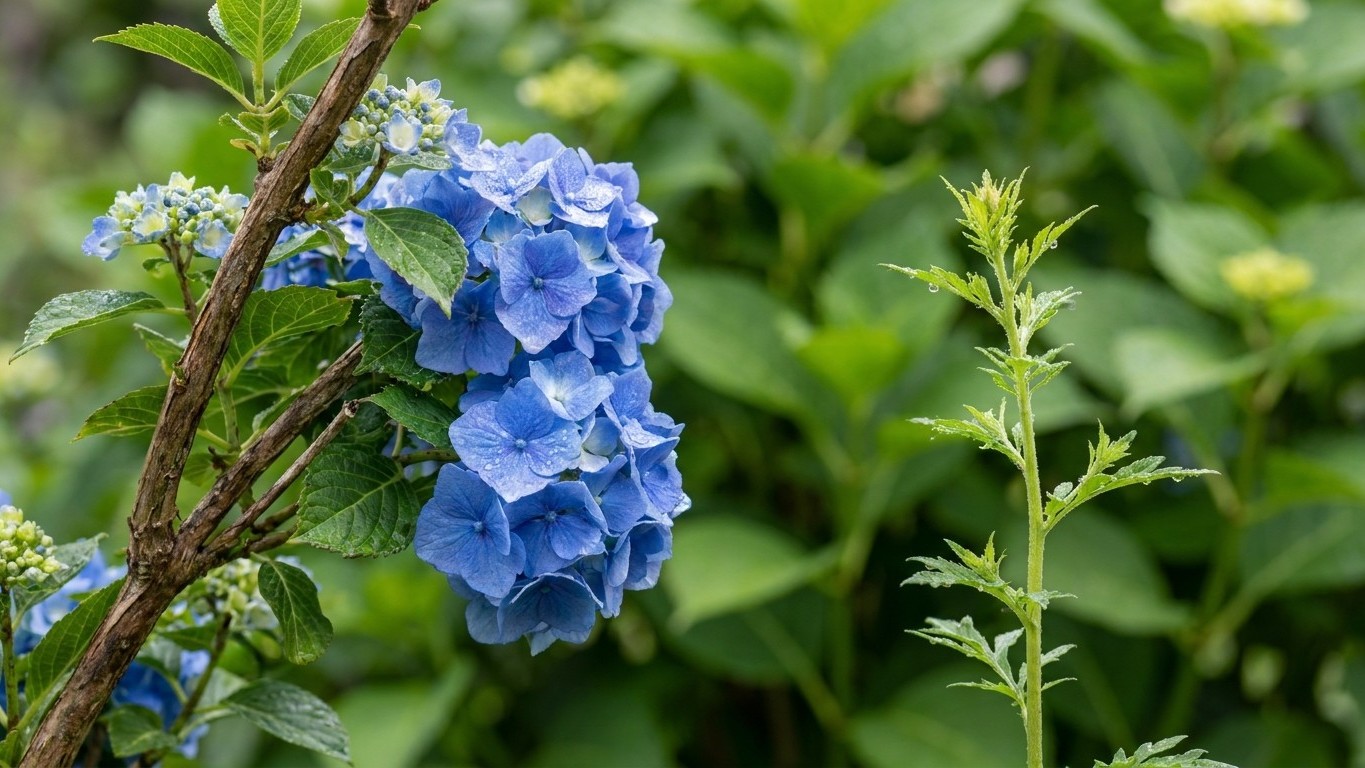

Whether a hydrangea needs winter protection depends on when it sets its flower buds. Bigleaf and oakleaf types form next summer’s buds on this year’s stems, so they get a mulch collar, and often a wire cage, once the leaves drop. Panicle and smooth types bloom on stems they grow in the same season. Even when cold damages the stems, they can regrow and bloom, so they usually need only mulch. In every case, protection goes on after dormancy starts and comes off in stages.
What this comes down to in Pennsylvania

At Philadelphia, one of the mildest corners of the state, the average first fall frost falls between November 5 and November 16, and the average last spring frost between March 29 and April 6, according to NOAA NCEI U.S. Climate Normals. A Philadelphia hydrangea is dormant and exposed from about mid-November to early April, and that stretch gets longer as you go north and west.
Cold hurts these shrubs in three ways. The first is direct kill: a hard winter can finish the flower buds on old wood, and sometimes the stems themselves down to the snow line. The second is a spring trap. A warm spell in March wakes the buds, leaves unfurl, and a freeze a week later blackens the lot. The third is soil movement. Alternating freezing and thawing heaves young, shallow-rooted plants up out of the ground, and a layer of mulch evens out those swings.
The USDA Plant Hardiness Zone Map puts Pennsylvania between zone 5a and zone 7b. That system rests on one variable, the average annual extreme minimum temperature, so it says nothing about a March warm-up followed by a freeze. A bigleaf rated for the zone you live in can still lose its buds to that kind of swing.
| Hydrangea type | Blooms on | Winter risk | What to do |
|---|---|---|---|
| Bigleaf (mophead and lacecap) | Old wood, though some rebloomers also flower on new wood | Highest: buds are exposed at stem tips | Mulch plus a wire cage filled with leaves |
| Oakleaf | Old wood | Moderate: sturdier stems, buds still at risk | Mulch; cage in the colder parts of the state |
| Panicle | New wood | Low once established | Mulch the base, especially in the first winter |
| Smooth | New wood | Low: regrows from the base | Mulch the base |
Many disappointing winters involve bigleafs. A gardener loses the blooms, sees green leaves in June, and wonders what happened. The buds were gone before the plant ever woke up.
Working it out for your own garden
Frost dates move with the year, the site and the county. A method that starts from the frost window will still work after a move or an odd winter, while a fixed calendar date won’t. Two questions drive it: when does your shrub bloom, and when does the cold stop being a threat?
How can you tell if a hydrangea blooms on old wood or new wood?
Start with the leaves and flowers. Glossy, coarsely toothed leaves with rounded mop or flat lacecap heads mark a bigleaf. Leaves lobed like an oak leaf mark an oakleaf. Cone-shaped flower clusters mean a panicle, and big round white heads on a plant that flops easily usually mean a smooth hydrangea. If you don’t know what you have, look at its history. A shrub that gets cut to the ground by cold and still blooms that summer flowers on new wood. One that comes back leafy but flowerless after a hard winter flowers on old wood.
Reblooming bigleafs flower on both old and new wood. Protecting them is still worth the effort, because it saves the early flush that makes them showy in June.
The same answer sets your pruning calendar. Old-wood shrubs get pruned right after they bloom in summer, since a fall or spring cut removes the buds you protected all winter. New-wood shrubs can be cut in late winter, before growth starts. If stems look dead in spring, wait for the leaves. Then scratch a stem with a fingernail. Green underneath means it’s alive, and brown and dry means it’s safe to cut.
When should you put winter protection on and take it off in Pennsylvania?
Work forward from the first fall frost. At Philadelphia that window is November 5 to November 16. A single frost doesn’t end the season, so add about two weeks, until the leaves have dropped and nights stay cold. That points to roughly the third week of November through the end of the month for installing a cage or mulch collar. Water deeply before the ground freezes, because a dry root zone goes into winter at a disadvantage.
In spring, work from the last frost. The Philadelphia window is March 29 to April 6, and watch the plants to judge when to loosen protection. The northern tier and the Alleghenies run two to four weeks later in spring, so add that to the dates and you get roughly mid-April to early May for the colder parts of the state. Open the cage and pull the mulch back from the stems in stages over a couple of weeks. Keep the leaf fill nearby so you can throw it back over the stems when a freeze is forecast. Once buds begin to swell and the forecast shows nights above freezing, you can take it all off.
What changes across the state
A Philadelphia date doesn’t hold for the whole state. Pennsylvania runs from a warm, urban southeast to a high, cold interior, and the gap shows in the zone range of 5a to 7b. Several things move the numbers.
Elevation matters a great deal. The Alleghenies and the Pocono plateau run colder and hold winter longer than the river valleys. Within a single county, a hilltop and a valley floor can differ by a zone. Cold air drains downhill on still nights and pools in low spots, so a hydrangea in a hollow can get hit by a late freeze that skips the neighbor on the slope.
The north differs from the south. The northern tier gets frost earlier in fall and later in spring, which lengthens the dormant season and raises the odds that a shrub will be caught after budding. The southeast, with its warmer nights and heat from pavement and buildings, is gentler. But early warm spells can also wake plants too soon there.
Lake Erie affects the northwest corner. The lake can delay spring a little, which holds buds back, and heavy lake-effect snow often blankets shrubs. Snow is good insulation, and a bigleaf under a deep drift is often in better shape than one on bare, wind-scoured ground a few counties away. Exposure counts as well: a spot shielded from the prevailing wind, near a south- or east-facing wall, protects better than an open lawn.
The mistakes this state punishes

One costly error is uncovering too early. A run of mild days in March feels like spring, and plenty of gardeners strip off the mulch. Buds swell, then a freeze arrives, and the season’s flowers are gone. Use the last frost window as your guide and remove protection in stages, keeping cover on hand.
Covering too early causes a different kind of damage. Wrap or pile leaves around a shrub that’s still in leaf, or while the weather is still mild, and moisture stays trapped around the stems. That invites rot and gives voles and mice a warm place to nest. Wait until the leaves have dropped and the nights stay cold. Skip plastic sheeting altogether, which holds moisture and heats up on sunny winter days. Use burlap or an open wire cage filled with dry shredded leaves or straw.
Late feeding is a quieter problem. Fertilizer in late summer or early fall pushes soft new growth that hasn’t hardened before the first frost. Stop feeding by midsummer.
Fall cutbacks do harm too. Tidying an old-wood hydrangea in October removes next year’s flowers. Leave the stems alone until you can see what survived.
Potted hydrangeas are the last trap. Roots in a container have far less insulation than roots in the ground, so a pot left on a porch can freeze solid. Move pots against the house or into an unheated garage or shed, and water them lightly now and then so the soil doesn’t dry out completely.
Checking this against your county
A frost window for one city is a starting point. Your own yard may run earlier or later depending on elevation, slope and exposure. Penn State Extension has county offices that know local conditions, and they can tell you how winters have actually behaved near you. For planting, siting and care, the full guide on growing hydrangeas in Pennsylvania covers the rest.
Common questions
Do hydrangeas need to be covered for winter in Pennsylvania?
Bigleaf hydrangeas, and oakleaf hydrangeas in the colder parts of the state, benefit from a cage and mulch because their buds form on old wood. Panicle and smooth types usually only need mulch at the base, and mostly in their first winter. Young plants of any type are more vulnerable than established ones.
When should I take winter protection off hydrangeas?
Watch the last spring frost window, which at Philadelphia runs from March 29 to April 6, and add two to four weeks in the northern tier and the Alleghenies. Loosen the cover gradually over a couple of weeks and keep the material close by for a late freeze. Take it off for good once the buds are swelling and the forecast stays above freezing.
Should I cut back hydrangeas in fall?
Not the old-wood types. Bigleaf and oakleaf hydrangeas carry next summer’s flower buds on their current stems, so pruning in fall or early spring removes the blooms. Panicle and smooth hydrangeas can be cut back in late winter, before new growth begins. When in doubt, wait for leaves to show and then remove only what is dead.
Can a potted hydrangea stay outside all winter?
It’s risky. A container exposes roots to cold from every side, so the root ball can freeze solid. Move the pot to an unheated garage, shed or sheltered spot against the house, and give it a little water through the winter so the soil never goes bone dry. Bring it back out gradually in spring once the last frost window has passed.