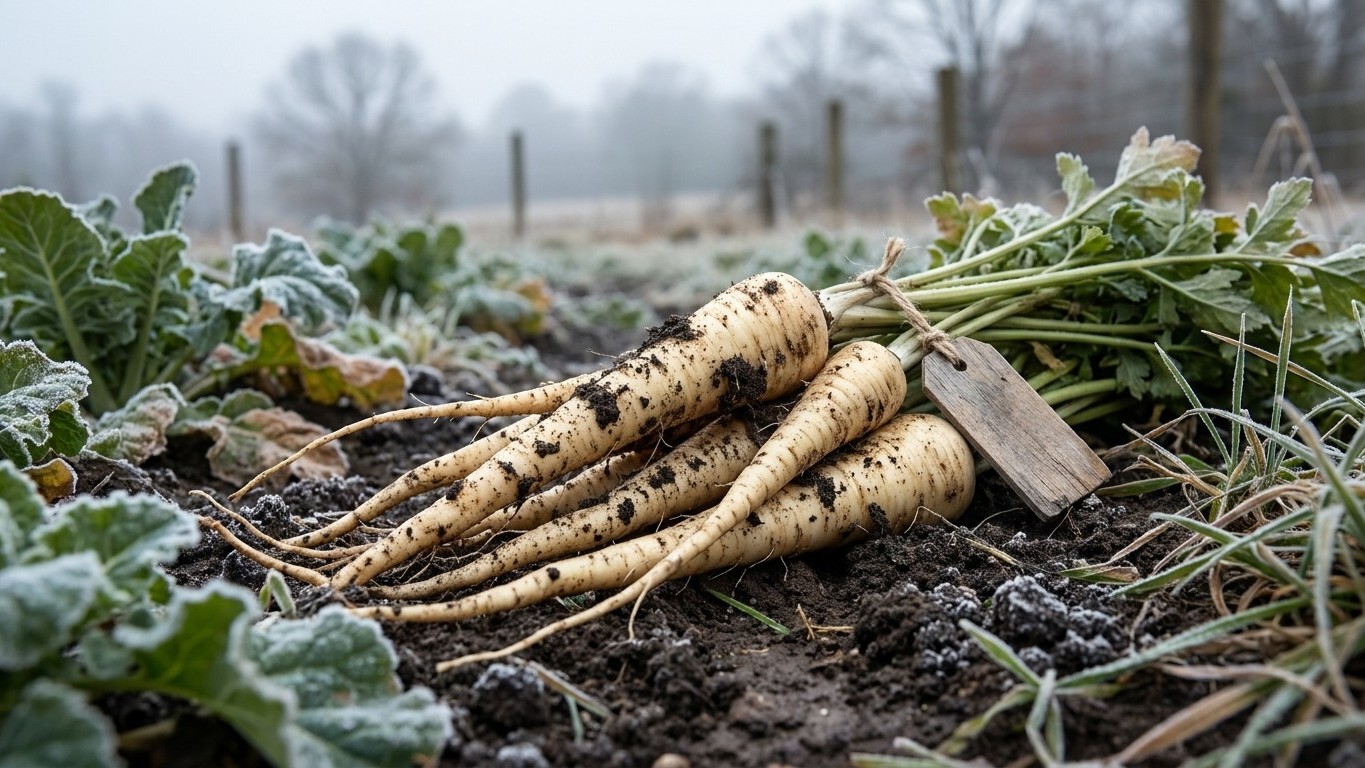

Yes. Prince Edward Island delivers the frosty stretch parsnips need to convert starch into sugar, and the frost-free window between the average last and first frosts leaves enough room for a full 100 to 120 day crop. Sown from seed in place, with patience for slow germination, this is one of the more reliable parsnip climates in the cluster.
The short answer
Start with the number that actually decides this, not the zone map: the mean daily minimum temperature of the coldest month at Charlottetown runs 10.3°F. That is not a record low and not a monthly average, it is the typical overnight floor across the coldest weeks of winter, and it sits well below freezing for an extended stretch. That single figure is what separates a territory where parsnips merely grow from one where they actually sweeten.
The sweetening step has nothing to do with which hardiness zone a map assigns to a place. It comes from direct exposure to cold, several weeks of it, cold enough that the plant’s stored starch breaks down into sugar as a survival response. A territory with a mild winter can grow a perfectly healthy parsnip that never crosses that threshold, because the ground simply never stays cold enough long enough. Prince Edward Island does not have that problem. A coldest-month mean minimum of 10.3°F is firmly in frost-and-then-some territory, and it points to weeks, not days, of the kind of cold that pushes sugar conversion along.
This matters more for parsnips than for almost any other root vegetable in the garden. A carrot pulled in October is fine. A parsnip pulled in October, before the cold has done its work, is often described by gardeners as woody, bland, even a little bitter, next to the same root left in the ground through a string of frosty weeks. Utah State University Extension’s guidance on the crop is blunt about this: taste improves after several weeks of cool, frosty weather, because that cold converts stored starch to sugar. It is the frost exposure that does it, not the calendar date, not the zone number, and not a single overnight dip.
Charlottetown’s climate normal gives a strong signal that this exposure happens reliably. A mean minimum of 10.3°F in the coldest month means that in a typical year, cold spells deep enough to trigger sweetening are not a rare event, they are the pattern. That is good news for anyone planning to grow parsnips on the Island, whether the goal is a fall harvest right after the first frosts or a crop left in the ground longer for a sweeter result. The climate does the sweetening work; the gardener mostly needs to get the timing and the soil right, which is the next question.
Does the season fit?
Parsnips are sown directly in the ground where they will grow, not started indoors and transplanted, and the clock for the 100 to 120 day maturity window starts the moment seed goes into soil. Here is how that window lines up against Prince Edward Island’s average frost dates, step by step.
- Sowing date. Utah State University Extension recommends sowing 2 to 3 weeks before the last expected frost. With the average last spring frost at Charlottetown falling on May 16, that puts a typical sowing date somewhere in the last week of April to the first days of May. Remember this is a mean date, not a guarantee: in one year out of two, the last frost actually falls later than May 16, so a cautious gardener leans toward the later end of that sowing range rather than the earlier one.
- Germination. Parsnip seed is notoriously slow to come up, taking 14 to 21 days to germinate. Sown in late April or early May, that means no visible seedlings until roughly mid to late May. This is the point where impatient gardeners dig up the row thinking the seed failed and re-sow, when the bed simply needed more time.
- Days to maturity. From the seeding date, the crop needs 100 to 120 days to reach full size. Counting forward from a sowing in late April or early May, that lands maturity somewhere in mid-August to early September.
- First fall frost. The average first fall frost at Charlottetown arrives October 17. That leaves roughly six to nine weeks of margin between the crop reaching maturity and the season’s first frost, well beyond the minimum needed.
- Frost-free window, total. Counting from May 16 to October 17 gives about 154 days between the average last spring frost and the average first fall frost. Even a parsnip sown right at the last frost date, with no head start at all, comfortably clears the 100 to 120 day requirement within that window.
- The sweetening margin. Because the crop matures weeks before the average first frost, there is ample time afterward for the several frosty weeks the roots need to sweeten, whether that cold arrives right on schedule in mid-October or later, and whether the gardener chooses to harvest soon after those first frosts or leave the roots in the ground longer for a sweeter result.
Put together, this is a comfortable fit, not a tight one. The Island’s frost-free stretch has enough slack to absorb a late sowing, a slow germination, or a cool spring, and still leave weeks of frost exposure afterward for the flavor payoff.
What goes wrong here
- Forked roots from heavy or stony ground. Parsnips push a single long taproot straight down, and any obstruction, a rock, a clay lens, compacted subsoil, splits that root into forks. Utah State University Extension’s advice is to grow the crop in deep sandy soil, and where the ground is heavier, to double dig the bed before sowing so the taproot has loose, obstruction-free soil to travel through.
- Forked roots from overwatering. This is a separate cause from soil texture, and it is worth keeping the two apart. Excess water, especially uneven watering that swings from soggy to dry, can also cause the root to fork or branch as it grows. The fix is steady, moderate moisture rather than heavy soaking followed by dry spells, particularly once the seedlings are established.
- A season that runs out from a late start. Because germination alone takes 14 to 21 days, a sowing pushed too late into spring, or a cold snap that stalls germination further, can eat into the margin between maturity and the first frost. On Prince Edward Island that margin is generous, roughly six to nine weeks, but a very late sowing still narrows it. Aiming for the recommended 2 to 3 weeks before the average May 16 last frost, rather than waiting for warmer soil, keeps that buffer intact.
- Harvesting before the cold has finished its work. Prince Edward Island’s winters run cold enough, a coldest-month mean minimum of 10.3°F, that a mild winter failing to sweeten the crop is not a real risk here. The more common mistake is timing: pulling the roots immediately at the first light touch of fall frost, before several weeks of cold have had a chance to convert starch to sugar. Waiting through more of that frosty stretch, rather than rushing the harvest, is what actually delivers the sweeter result the climate here is capable of.
Common questions
Can parsnips overwinter in the ground on Prince Edward Island?
The climate data here does not include a specific frozen-ground or soil-temperature threshold, so no overwintering date is published on this page. What the coldest-month figure does confirm is that winters are cold enough to deliver the frost exposure parsnips need to sweeten well before deep winter sets in.
What soil should I prepare before sowing?
Utah State University Extension points to deep sandy soil as the starting point, and recommends double digging heavier ground so the taproot can grow straight down without obstruction. Treat that as a starting point for your own bed, not a full diagnosis, since stones and compaction vary plot to plot.
Why haven’t my parsnip seeds come up after a week?
That is normal. Germination for this crop runs 14 to 21 days, noticeably slower than most other root vegetables, so a bare-looking bed a week after sowing is not a failed sowing.
Does the exact sowing date matter more than the frost date?
Both matter, but remember the last frost date given here, May 16, is a mean, not a guarantee: in half of all years the last frost actually falls later. Sowing 2 to 3 weeks ahead of that date, and accepting a slightly later start in a cool spring, protects the margin the crop needs to mature and then sweeten before winter.