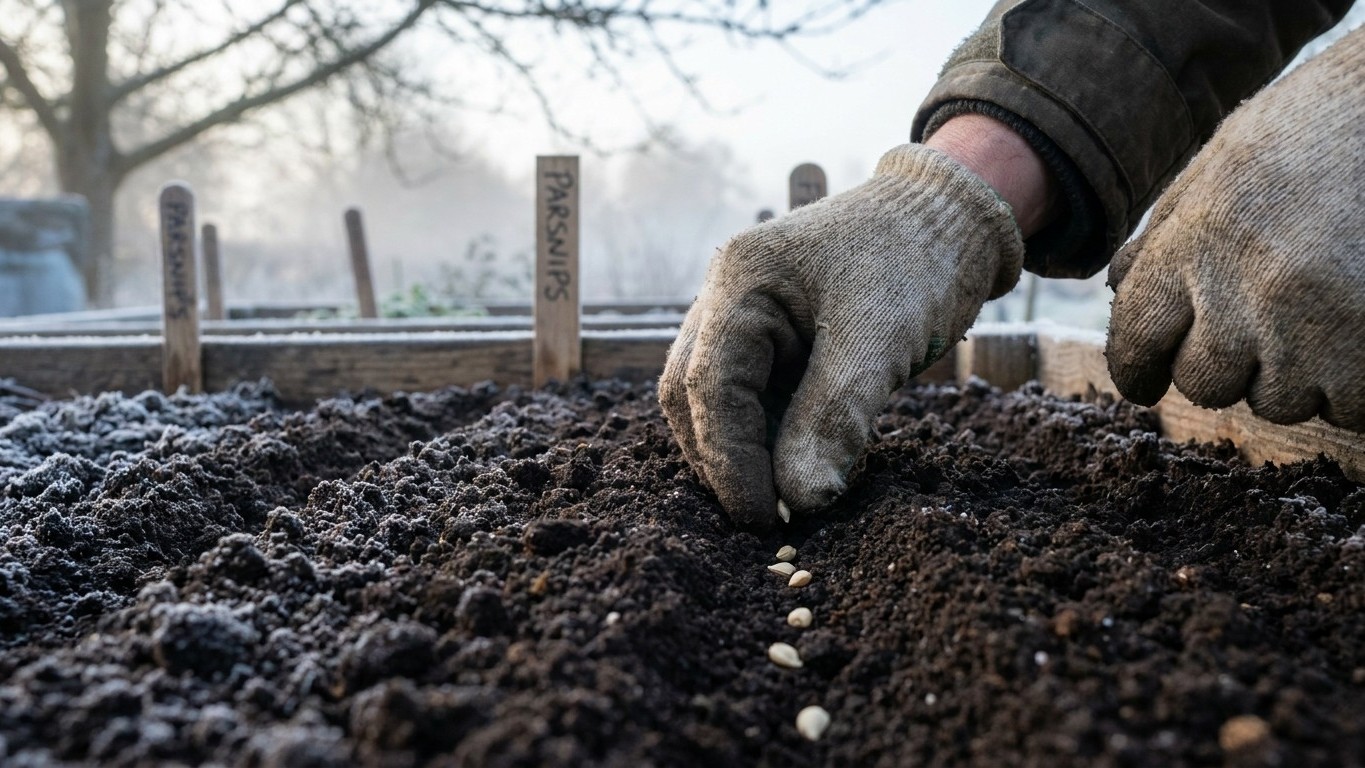

Sow parsnip seed directly in the ground in late April to early May, two to three weeks before Saskatoon’s average last spring frost of May 18. That timing gives the crop its full 100 to 120 days to mature before the average first fall frost on September 18, and it lines up the 14 to 21 days parsnip seed needs to germinate with the last cool stretch of spring. Saskatchewan’s hard winters also mean the roots left standing after that first frost will actually turn sweet, not just grow big.
The short answer
Does this stretch of prairie hand parsnips the weeks of frost they actually need to turn sweet, or does it just let them grow tall and starchy? The mean daily minimum of the coldest month at the Saskatoon reference station sits at -5.3°F, a figure that comes from Environment and Climate Change Canada’s 1981-2010 climate normals. That number describes an ordinary winter here, not a record cold snap, and it settles the question fast: this is not a mild-winter territory where parsnips grow well but never sweeten.
What -5.3°F actually means for the crop
Parsnip sweetness comes from a specific process. Cold weather converts the starch stored in the root into sugar, and that conversion needs several weeks of frost exposure, not a single cold night. A comfortable hardiness zone rating tells a gardener whether a perennial plant will survive winter dormant in the ground. It says nothing about whether an annual root vegetable, harvested in a single season, gets enough frost while it is still sitting in the soil waiting to be pulled. Those are two different questions, and mixing them up is the most common mistake a parsnip grower makes when reading climate data.
Saskatchewan answers the second question clearly. A mean coldest-month minimum well below zero Fahrenheit means the ground here sees sustained, repeated frost through the fall and into early winter, not an occasional light touch. Once the first fall frost arrives, on average around September 18, the roots do not just get one cold night and then a thaw. They sit through week after week of dropping temperatures before the ground eventually locks up hard, which is exactly the exposure the sugar conversion needs.
So the short answer holds on both fronts. Sow in that late-April to early-May window, and by the time frost arrives in fall, this climate delivers the sustained cold a parsnip needs to finish the job the soil started. A parsnip pulled from a Saskatchewan garden in October, after a few real frosty weeks, will taste noticeably different from one dug the day after the first light frost.
Does the season fit?
The math here is simple enough to check by hand before committing a row of the garden to a crop that takes months to prove itself. Parsnip needs 100 to 120 days from the day the seed goes into the ground, sown two to three weeks ahead of the last spring frost, and Saskatoon’s frost dates give a clear frame to test that against.
The arithmetic in words
- Start with the average last spring frost, May 18. Sowing two to three weeks earlier lands the seeding date somewhere in the last week of April through the first days of May.
- Add the 14 to 21 days parsnip seed typically takes to germinate. That means seedlings won’t break the soil surface until roughly mid to late May, well after the seed itself went in the ground. This matters because a gardener who assumes nothing happened in the first two weeks and re-sows is simply starting the clock over for no reason.
- Count forward 100 days from the seeding date (not the germination date). From an early-May sowing, that lands around the second week of August.
- Count forward the full 120 days from that same seeding date. That lands near the end of August.
- Compare both figures to the average first fall frost, September 18. Even the slower end of the maturity window, the 120-day mark, finishes about three weeks before that frost date arrives on average.
That gap is the margin that decides comfort. A three-week cushion between expected maturity and the first frost is not a photo finish. It fits the calendar with room to spare, and it leaves extra time afterward for the roots to sit through frosty weeks before harvest, which is the part of the process that builds sweetness rather than just size. The one caution worth repeating: both frost dates are means, not guarantees. In roughly half of all years, frost arrives later than May 18 or earlier than September 18, so treat these numbers as the midpoint of a window rather than a fixed appointment on the calendar.
What goes wrong here
Saskatchewan’s climate and soils create a specific, repeatable set of problems for parsnip growers, and most of them trace back to one of two causes: what’s under the seed, or what’s falling on it after it’s planted.
Common failures and fixes
- Forked, twisted roots. This has two separate causes here, and they call for different fixes. The first is heavy or stony ground: parsnip roots need deep, loose soil to grow straight, and prairie clay or rocky patches split the root as it pushes down. The remedy is deep, double-digging the bed before sowing, working the soil down well past a foot, and clearing out stones. The second cause is overwatering, which produces the same forked look through a different mechanism, encouraging shallow, erratic root branching instead of one clean taproot. The fix there is simply less frequent, deeper watering rather than constant light watering.
- A season that runs out before the root fills in. This shows up when sowing gets pushed later than the recommended two-to-three-week-before-last-frost window, often because a gardener waits for warmer soil out of habit. Since the germination clock alone eats up two to three weeks, a late sowing compounds fast, and the 120-day maturity window can bump right up against the average September 18 frost with no margin left. The fix is discipline on the sowing date, not the weather.
- A winter too mild to convert the starch. Not a real risk in this territory, given the -5.3°F mean coldest-month minimum, but it’s worth naming because it’s the mistake growers repeat when they move here from a milder climate and pull their parsnips too early, right after the first light frost, instead of letting several more frosty weeks do their work.
- Uneven or patchy germination. Parsnip seed loses viability fast and germinates unevenly even in good conditions, taking the full 14 to 21 days. Sowing fresh seed each season, keeping the seedbed consistently moist during that window, and resisting the urge to re-sow after only a week or two are the practical fixes.
Common questions
Can parsnip seed handle a late frost after it’s sown? Sowing two to three weeks before the average last frost of May 18 is standard practice specifically because parsnip seed and young seedlings tolerate cool soil and light frost far better than many other vegetable seeds. The real risk in this territory isn’t sowing too early, it’s sowing too late and losing days off the back end of the maturity window.
Should parsnips be left in the ground after the first fall frost? Yes, and that’s the whole point of timing the sowing date around this climate. The sugar conversion that gives parsnips their flavor happens over several weeks of frost exposure after that first frost, not overnight. Pulling the crop immediately after September 18 misses most of the benefit that Saskatchewan’s cold fall weather provides.
Does Saskatchewan’s soil type affect sowing timing? Not the timing itself, but it affects preparation. Parsnips need deep, loose soil to grow a straight root, and heavy prairie clay has to be double dug well ahead of the sowing date so the ground is ready when the late-April to early-May window arrives, rather than trying to prep and sow on the same day.
What happens if parsnip seed is sown right at the last frost date instead of two to three weeks earlier? The crop will still likely mature, but the margin before the average September 18 fall frost shrinks. Since May 18 and September 18 are both averages, and frost can arrive later or earlier than either date in any given year, cutting into that built-in cushion raises the odds the root won’t get its full 100 to 120 days before the season turns.