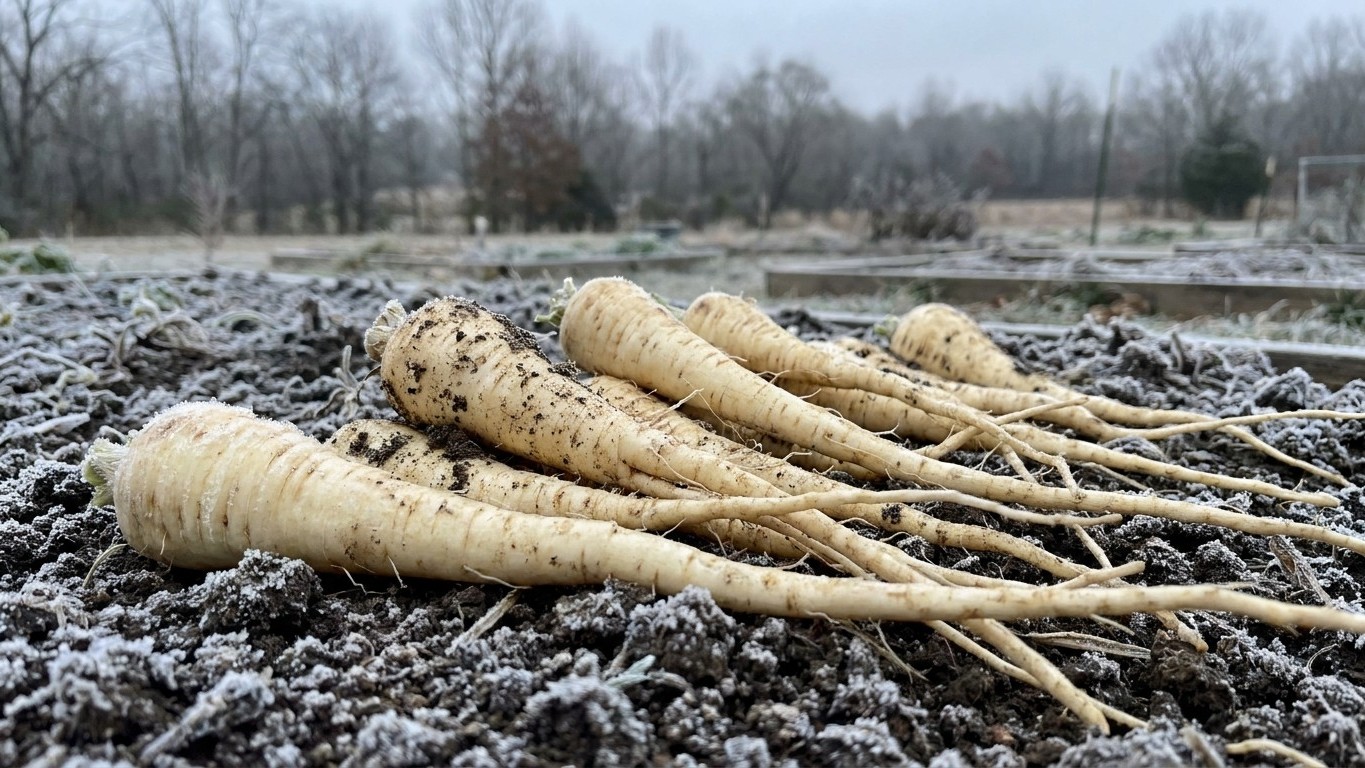

For coastal Virginia, the answer leans toward “grow” more than “sweeten.” The mean minimum temperature in the coldest month sits at 31.6°F, a bare few degrees under freezing on an average night. That’s enough cold to check growth but not the sustained run of frosty weeks that turns a parsnip’s stored starch into sugar. Inland and mountain counties, running weeks colder in both directions, are a different story.
The short answer
The question that actually decides this isn’t what zone map you’re standing on. It’s whether the coldest stretch of your winter delivers several consecutive weeks of hard frost, because that’s the mechanism that sweetens a parsnip root. At the reference station used for coastal Virginia (Virginia Beach), the mean daily minimum for the coldest month comes in at 31.6°F. That’s a monthly average of overnight lows barely dipping below freezing, not a deep, sustained cold snap.
That number matters more than a hardiness zone label ever could. A zone rating tells you what a plant can survive over a whole year. It says nothing about how many frosty weeks you’ll actually get in November, December, and January, which is the specific exposure a parsnip root needs to convert starch to sugar. A 31.6°F average minimum means some nights dip well below freezing and plenty of others hover right at or just above it. That’s a marginal frost signal, not a strong one.
So in coastal Virginia, a parsnip planted and left in the ground will almost certainly grow into a full, usable root. Whether it sweetens the way parsnip growers talk about, that mellow, almost nutty flavor that shows up after a real cold snap, is far less certain. Some winters will deliver enough frosty weeks. Others, especially mild ones, won’t get there at all.
This is exactly where geography inside the state starts to matter more than anything else on this page. The Blue Ridge and southwest Virginia run their coldest month’s minimum well below what the coastal plain sees, and their first fall frost arrives earlier while their last spring frost lingers longer. A gardener in those higher, colder counties is working with a much stronger frost signal, and a much better shot at that classic sweetened parsnip. A gardener on the coastal plain is working with a shorter, gentler cold season, and should expect the sweetening effect to be inconsistent from one year to the next rather than a sure thing.
None of this means parsnips are a poor choice near the coast. It means the payoff, that deep sweetness after frost, is a bonus some years deliver and others don’t, rather than a guarantee baked into the local climate.
Does the season fit?
Parsnips are sown directly in place, not started indoors and transplanted, and the clock that matters starts the day seed goes into the soil. Utah State University Extension puts the full run at 100 to 120 days from seeding to maturity, with sowing recommended 2 to 3 weeks before the last expected frost. Layer that timeline over the coastal Virginia frost window and the arithmetic works out with room to spare.
- Find the sowing window. The last spring frost at the coastal reference station falls between March 20 and April 3. Sowing 2 to 3 weeks ahead of that puts seed in the ground sometime between late February and mid-March.
- Add germination time before anything visible happens. Parsnip seed is notoriously slow, taking 14 to 21 days just to sprout. A gardener who doesn’t see green after a week hasn’t failed; that’s simply how this seed behaves. Digging up the row and resowing at that point wastes seed and time.
- Count 100 to 120 days from the seeding date, not from germination. Starting around early March, that maturity window lands somewhere between mid-June and early July.
- Compare that maturity date against the first fall frost, which runs November 10 to November 24 at the coastal station. There’s a gap of roughly four to five months between a root reaching usable size in early summer and the season’s first hard frost arriving in mid to late fall.
- Use that gap deliberately. Rather than harvesting in summer, the standard practice is to leave mature roots in the ground through fall so they’re sitting there, fully sized, when the first frosty nights arrive and start the sweetening process.
Coastal Virginia’s season fits comfortably here, with more slack than most vegetables get. The tight part isn’t the growing window, it’s the quality of the frost exposure once the roots are mature and waiting. Inland counties with colder, longer winters get the same comfortable season length plus a stronger dose of the cold that actually sweetens the crop.
What goes wrong here
- Forked or split roots from heavy or stony ground. Parsnips push a single taproot straight down, and any obstruction, whether it’s clay, compacted subsoil, or buried stones, splits that root into two or three forked legs. Utah State University Extension notes parsnips do best in deep, sandy soil, and where the ground is heavier, it needs to be double dug to loosen and clear the root’s path well below the surface.
- Forked roots from overwatering. This is a separate cause from soil texture, and it’s easy to confuse the two. Inconsistent or excessive watering, especially heavy watering after a dry stretch, encourages the root to branch rather than grow as one straight taproot. The fix is steady, moderate moisture rather than feast-or-famine watering cycles.
- A season that runs out before the root sizes up. This shows up when sowing gets delayed past the recommended window, or when the 14 to 21 day germination lag isn’t accounted for and the effective growing season shrinks. Sowing on time, 2 to 3 weeks before the local last frost, and being patient through the slow germination period keeps the full 100 to 120 days intact.
- A winter too mild to sweeten. On the coastal plain, where the coldest month’s mean minimum sits at 31.6°F, some winters simply won’t deliver enough sustained frost to convert much starch to sugar. There’s no soil fix for this one. Leaving roots in the ground as long as possible, through whatever cold does arrive, and mulching lightly to keep the ground workable for a later harvest, gives the crop its best shot at whatever frost the season provides.
Every part of a parsnip plant carries a compound that reacts with sunlight on skin, and it’s a hazard that most garden guides never mention. North Carolina State Extension states it plainly: “All parts of this plant contain furocoumarins which can make skin sensitive to light causing burns so be sure to wear gloves, long sleeves and long pants when dealing with it.”
The reason this catches people off guard is the mechanism itself. The sap alone doesn’t burn skin. It’s sap combined with sunlight that triggers the reaction, which is why the injury tends to show up after a bright day spent pulling tops, digging roots, or handling foliage in the garden, and why it often doesn’t appear until hours later, once the skin has had time to react to UV exposure. Washing up after the fact doesn’t undo that reaction the way it would with a simple irritant. The protection that actually works is worn before contact: gloves, long sleeves, and long pants, every time hands and forearms are going to be in contact with the leaves, stems, or roots.
Checking this against your own county
Every figure on this page comes from a single coastal reference station, and Virginia’s frost dates, coldest-month averages, and soil conditions shift substantially by county, especially once elevation climbs toward the Blue Ridge or southwest Virginia. Before planting, it’s worth checking local frost dates and soil guidance against your specific county rather than relying on a coastal benchmark.
Virginia Cooperative Extension, run through Virginia Tech and Virginia State University, maintains local offices in counties across the state and publishes region-specific planting guidance. Their site, ext.vt.edu, is the direct way to confirm frost timing and soil recommendations for your own location rather than extrapolating from a single coastal data point.
Common questions
Do parsnips need a hard freeze to sweeten, or does any frost do it?
The sweetening comes from sustained exposure to frosty weather, several weeks of it, rather than a single cold night. A location that gets one or two light frosts and then turns mild again won’t deliver the same effect as a location with a long, steady cold stretch.
Can parsnips be left in the ground all winter in coastal Virginia?
The facts here don’t cover winter storage specifics, but the general practice described by Utah State University Extension is leaving roots in place through the frosty weeks to gain sweetness, then harvesting as needed. Local extension guidance is the place to confirm how long that’s practical in a given county.
Why did my parsnip roots come out forked instead of straight?
Two separate causes produce this. Heavy, compacted, or stony soil blocks the taproot and splits it, which is why deep sandy soil or thoroughly double-dug ground matters. Overwatering, particularly inconsistent watering, is a second and unrelated cause that encourages branching regardless of soil texture.
Is it safe to touch parsnip greens without gloves on a cloudy day?
The safety warning from NC State Extension covers all parts of the plant without specifying weather conditions, and the reaction depends on sap contact plus sunlight exposure. Since the source draws no line based on cloud cover, wearing gloves, long sleeves, and long pants whenever handling the plant is the guidance to follow.