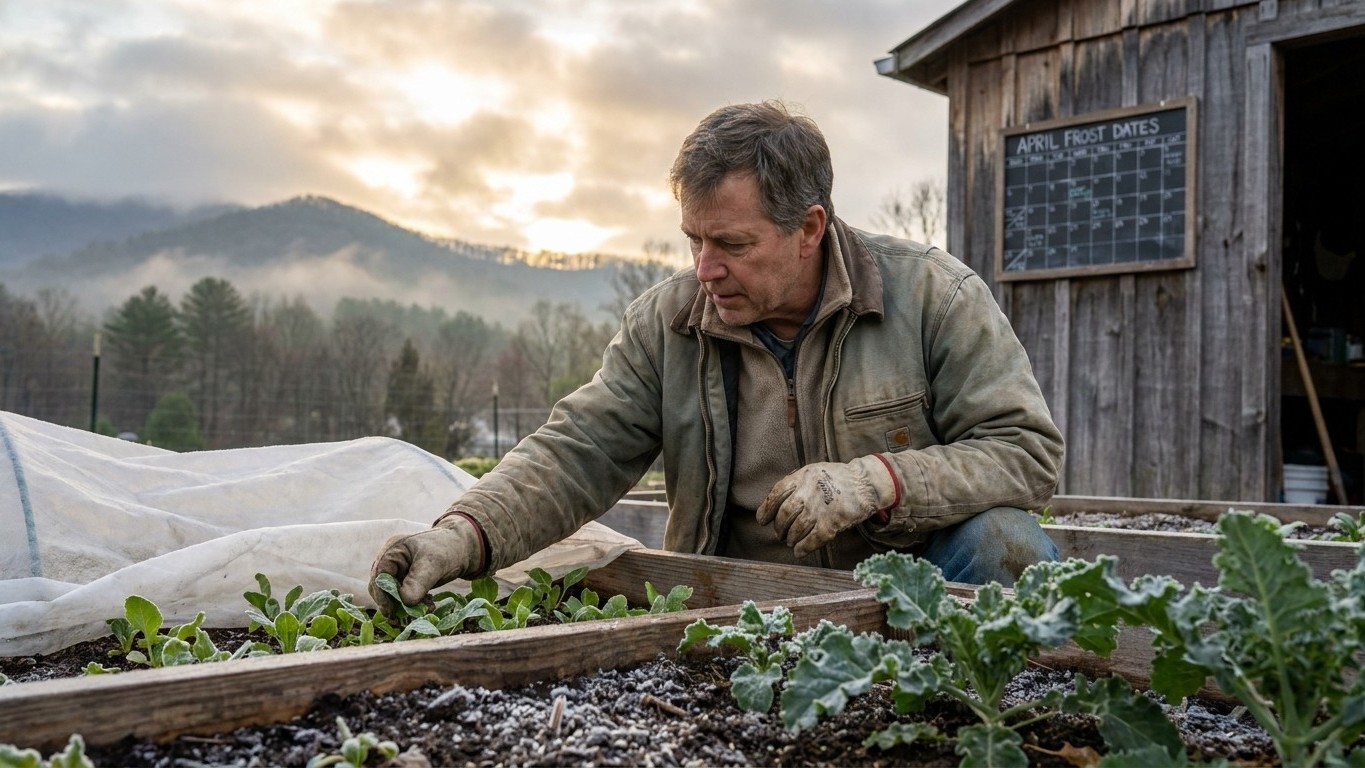

Virginia’s growing season isn’t one thing. It runs about 220 to 250 days near the coast, weeks shorter in the mountains, and the state spans four USDA hardiness zones. Here’s what that actually means for what you can plant, and when.
How long your season really is

Three numbers set the boundaries of what’s possible in a Virginia garden: the USDA hardiness zone, the average last spring frost, and the average first fall frost. Put together, they answer the only question that matters before you buy a single seed packet: how many frost-free days do you actually have to work with?
| Measure | Value |
|---|---|
| USDA Hardiness Zone | 5a-8b |
| Average last spring frost | March 20 to April 3 |
| Average first fall frost | November 10 to November 24 |
Those frost dates come from NOAA’s 1991-2020 climate normals at a reference station in Virginia Beach, one of the mildest spots in the state. Do the math on the frost-free window and you land somewhere between roughly 221 and 249 days, depending on which end of each range you use. That’s a genuinely long season by national standards. But it’s a coastal number. Move inland toward the Blue Ridge, or further southwest, and both frost dates shift against you, spring frost later, fall frost earlier, shaving weeks off that total.
Averages are not guarantees
Here’s the part gardeners tend to forget: an average frost date is not a safe date. By definition, roughly half of all years bring a frost later than the “average” spring date, or earlier than the “average” fall date. Planting tomatoes, Growing Peppers in Virginia, Growing Potatoes in Virginia, or even Growing Sweet Corn in Virginia out on April 3 because that’s the average last frost means you’re betting on a coin flip going your way, and the same caution applies to cool-season crops like Growing Beets in Virginia, Growing Carrots in Virginia, Growing Parsnips in Virginia, and Growing Spinach in Virginia, not to mention perennial crops such as Growing Asparagus in Virginia that need their crowns protected from a late cold snap. Experienced Virginia gardeners typically build in a buffer, a week or two past the average, before setting out anything tender.
What does a 220-to-250-day window rule out? Not much, if you stick to crops suited to a temperate climate. But it does mean the longest-season varieties, the 100-plus-day pumpkins involved in Growing Pumpkins in Virginia, the late-maturing melons bred for hot desert climates, are a gamble rather than a plan, especially west of the coastal plain. If you do take the pumpkin gamble, knowing When to Carve a Pumpkin in Virginia can help you time the harvest right. A gardener in Roanoke or Wytheville is working with a noticeably shorter window than one in Virginia Beach, even though both fall under the same state-level average.
What the summer does to a garden here
Length of season is only half the story. The reference station in Virginia Beach averages 26 days a year at or above 90 degrees Fahrenheit. That’s not an extreme heat load compared to the Deep South or the Southwest, but it’s enough to matter, and it lands at the exact moment many crops are trying to set fruit.
Above roughly 90F, tomato flowers drop without setting fruit. Lettuce, spinach, and other cool-season greens bolt and turn bitter. This isn’t a matter of the plants being unhappy in a vague sense, it’s a hard physiological ceiling. So the 26 days above 90F aren’t spread evenly across summer; they cluster in July and into August, carving out a stretch where cool-season crops simply can’t survive and warm-season crops stall rather than thrive.
The practical result is a garden that behaves less like one long growing season and more like two productive shoulders, spring and fall, bracketing a midsummer lull for anything that isn’t heat-tolerant. Crops bred for real heat, like okra, southern peas, and sweet potatoes, shrug off that stretch. Lettuce and broccoli don’t.
What the winter minimum tells you
The other number worth knowing is the average daily minimum in the coldest month: 31.6F at the Virginia Beach reference station. That figure, not the record low, not the monthly average, is what decides whether a perennial or a marginally hardy shrub actually survives the winter here. It’s consistent with the milder end of the state’s zone range, and it’s a reminder that “hardiness zone” is built on exactly one variable, the average annual extreme minimum. A plant rated for zone 7 can still struggle in a zone 7 garden if other conditions, drainage, wind exposure, don’t cooperate.
What tends to go wrong in Virginia
Virginia Cooperative Extension tracks a long list of insects that show up in home vegetable gardens across the state. Most gardeners here won’t meet all of them, but a handful turn up reliably enough to be worth knowing on sight, and roughly when to expect them.
- Colorado potato beetle: appears in spring as soon as potato and tomato foliage is up, and strips leaves down to bare ribs if left unchecked.
- Squash bug and squash vine borer: show up in early to midsummer, wilting entire squash and pumpkin vines seemingly overnight as they hollow out the stems from inside.
- Corn earworm: arrives mid- to late summer and works its way down from the ear tip, the classic reason a home-grown ear of corn has a chewed-out end.
- Japanese beetle: peaks in midsummer, skeletonizing leaves on everything from beans to roses down to the veins.
- Brown marmorated stink bug: builds through late summer into fall, leaving pitted, discolored damage on tomatoes and other soft fruit.
That’s a working shortlist, not the extension service’s full catalog. Pressure on any given pest varies by region and by year, and identification matters more than memorizing names, since damage that looks like one insect is sometimes another. When something’s chewing on your plants and you’re not sure what, that’s exactly the kind of question a county extension office answers quickly and for free.
Where to check before you plant
Everything above is a state-level average, and Virginia is not a small, uniform state. It stretches across several degrees of latitude and four USDA hardiness zones, from the coastal plain to the Blue Ridge to the far southwest corner near Kentucky and Tennessee. A planting calendar tuned to Richmond or Virginia Beach can run two to three weeks off for a garden in the mountains, in either direction, spring planting too early, fall harvest cut short by an earlier frost.
That’s the gap Virginia Cooperative Extension fills. It’s the state’s land-grant extension service, and it publishes region-specific planting guides, pest alerts, and soil testing programs that account for exactly the local variation a state-wide average can’t. Every Virginia county and independent city also has its own extension office, usually the fastest way to get a frost date, a pest ID, or a soil recommendation calibrated to your actual address rather than a reference station miles or mountains away.
Understand the shape of the season here. Use the county office to nail down the dates that apply to your particular patch of ground.