
In most of Virginia, pumpkin seed goes into the ground somewhere between mid-May and early June, once soil has warmed well past the last frost. Coastal spots near Virginia Beach can push a little earlier; the Blue Ridge and southwest Virginia usually wait longer, since both spring and fall arrive on a different schedule there. The whole calendar is really built backward, starting from the first fall frost, not forward from the last spring one.
The short answer
Virginia’s first fall frost lands somewhere between November 10 and November 24, depending on where you are relative to the reporting station (NOAA NCEI 1991-2020 Climate Normals, station USW00013769 at NAS Oceana, Virginia Beach). That’s the hard stop for the growing season. Every pumpkin flower on the vine needs 45 to 55 days after it opens to turn into a fruit that’s actually ripe, according to Utah State University Extension. Run the math backward from that frost window and you get the real deadline: the last date a flower can open and still finish before the cold hits.
Subtract 45 days from November 10 and you land near September 26. Subtract 55 days from that same date and you’re at September 17. Push the calculation to the later end of the frost window, November 24, and the range shifts to between September 30 and October 10. So somewhere between mid-September and early October, across most of the state, is the last window for a pumpkin flower to open if it’s going to finish before a hard freeze shuts the season down.
That’s a flowering deadline, not a planting deadline, and the two get mixed up constantly. A vine doesn’t produce a mature, fruit-bearing flower the day it sprouts. It has to grow leaves, run vine, and push out both male and female blooms before pollination can even start. None of that groundwork happens overnight, and none of it is optional. The flowering window above only marks the last date the vine can afford to open a flower that’s going to become a harvestable pumpkin. It says nothing yet about when the seed needs to go into the soil, because that part of the calculation depends on soil temperature, not the frost calendar. That’s covered next.
The 45- to 55-day figure itself measures fruit development after pollination, when a female flower’s ovary begins swelling into what will eventually become the pumpkin. A flower that opens too close to frost may set a small fruit, but there isn’t enough time left for the skin to harden and color fully before the cold arrives. Where you sit inside Virginia shifts this math. The coast, closer to the mild end of the frost window, buys a few extra days of flowering time. The Blue Ridge and southwest Virginia lose time from both directions, with frost arriving weeks earlier in fall and lingering weeks later in spring, which squeezes the whole season from both ends at once.
When to sow here
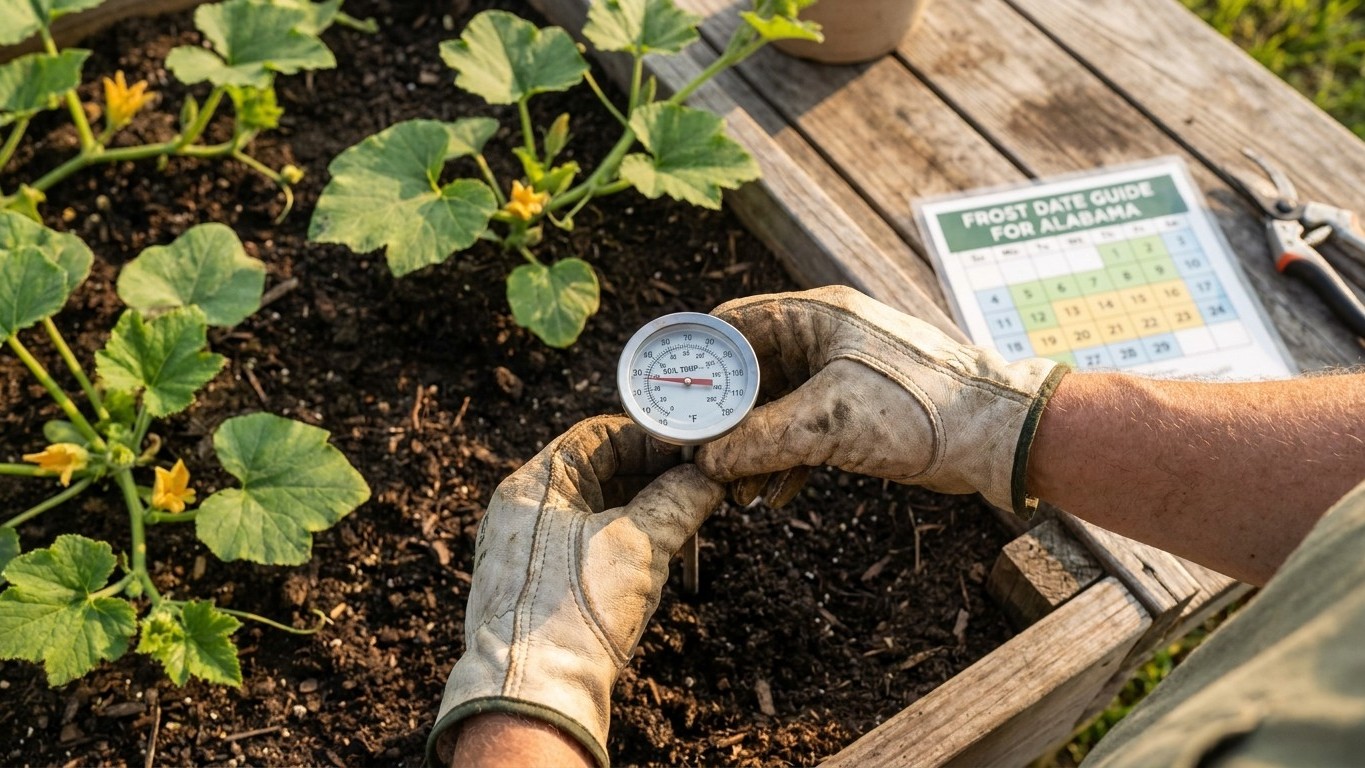
Soil temperature, Not the Frost Date, decides when pumpkin seed goes into the ground. Utah State University Extension is clear on this: pumpkins are sown once soil reaches 65 F, and that number has nothing to do with the day the air stops freezing. The gap between the two matters, because soil warms slower than air does. Virginia’s last spring frost falls between March 20 and April 3, but soil doesn’t hit 65 F on that same day, or even close to it. It takes real time after the last frost for the ground itself to catch up, and that lag is exactly why gardeners who sow the week after the last frost often end up with seed sitting in cold soil that won’t germinate.
- Let the last spring frost window pass completely. March 20 to April 3 is the range for most of the state; treat the later end of that window as the safer bet rather than gambling on the earlier date.
- Wait for the soil itself, not the calendar, to reach 65 F. This happens weeks after the air has cleared frost, since soil holds cold longer than air does. Check the soil directly with a thermometer a few inches down rather than guessing from the weather forecast.
- Use row cover to buy roughly two weeks. A floating row cover traps heat near the ground and can let you get seed in earlier than bare soil would allow, effectively pulling the sowing date forward without exposing seedlings to a real cold snap.
- Check the sowing date against the flowering deadline from the section above. Once seed goes in and the vine develops, count forward to the point where flowers are expected to open, and compare that against the mid-September-to-early-October cutoff for your part of the state.
- Adjust for where you garden. Coastal areas near Virginia Beach can sow closer to the earlier end of the window. Gardeners in the Blue Ridge or southwest Virginia should expect soil to lag further behind and plan a later sowing date accordingly.
What goes wrong here
- A late flower that never colors. When a flower opens close to the fall frost cutoff, the fruit inside doesn’t get its full 45 to 55 days, and the skin stays pale or greenish instead of turning the deep orange gardeners expect. The remedy is tracking the flowering deadline in the first section and sowing early enough, with row cover if needed, that flowering wraps up well before the cutoff rather than right at it.
- A fruit caught by frost before it finishes ripening. Even a fruit that’s close to ready can be damaged by a hard freeze if it’s still on the vine when temperatures drop. The remedy is to harvest before the first fall frost date arrives, cutting the fruit with the stem attached, and moving it somewhere it won’t freeze rather than leaving it in the field on a gamble.
- A vine that dies back before the skin has hardened. Vines weakened by pest pressure or disease late in the season sometimes collapse before the pumpkin’s shell has cured, leaving fruit with soft, thin skin that won’t store. Two of the most common culprits in Virginia gardens are covered in detail on this site’s pages for squash bugs in Virginia and cucumber beetles in Virginia; scouting for both early in the season is the most direct way to keep the vine intact long enough for the skin to harden properly.
Common questions
Can I start pumpkin seeds indoors before the soil warms outside in Virginia?
The Utah State University Extension guidance behind the dates on this page centers on direct-seeding once soil reaches 65 F. It doesn’t publish an indoor-starting timeline. If you do start indoors, hold off transplanting until both the last frost window has closed and the outdoor soil itself has warmed, since a transplanted seedling is just as vulnerable to cold soil as a directly sown seed.
What pumpkin varieties do Virginia gardeners typically plant?
Names that show up regularly in Virginia gardens include Connecticut Field, Jack Be Little, Cinderella, Long Island Cheese, Baby Boo, Big Max, New England Pie, Autumn Gold, and Howden. No maturity length, size, or color data is attached to these names here; check with the seed source for those specifics.
How should I store pumpkins after harvest in Virginia?
Utah State University Extension’s guidance stops at telling growers to keep harvested pumpkins somewhere they will not freeze. No specific storage temperature, humidity level, or keeping time is published in that source, so nothing more precise than “frost-free” is stated here.
Why doesn’t the last frost date tell me when to sow?
Because soil temperature lags behind air temperature by weeks, not days. The air can clear 32 F well before the soil a few inches down reaches the 65 F pumpkins need to germinate reliably. Sowing by the frost date alone, without checking soil temperature directly, is one of the more common reasons seed sits in the ground and fails to come up.