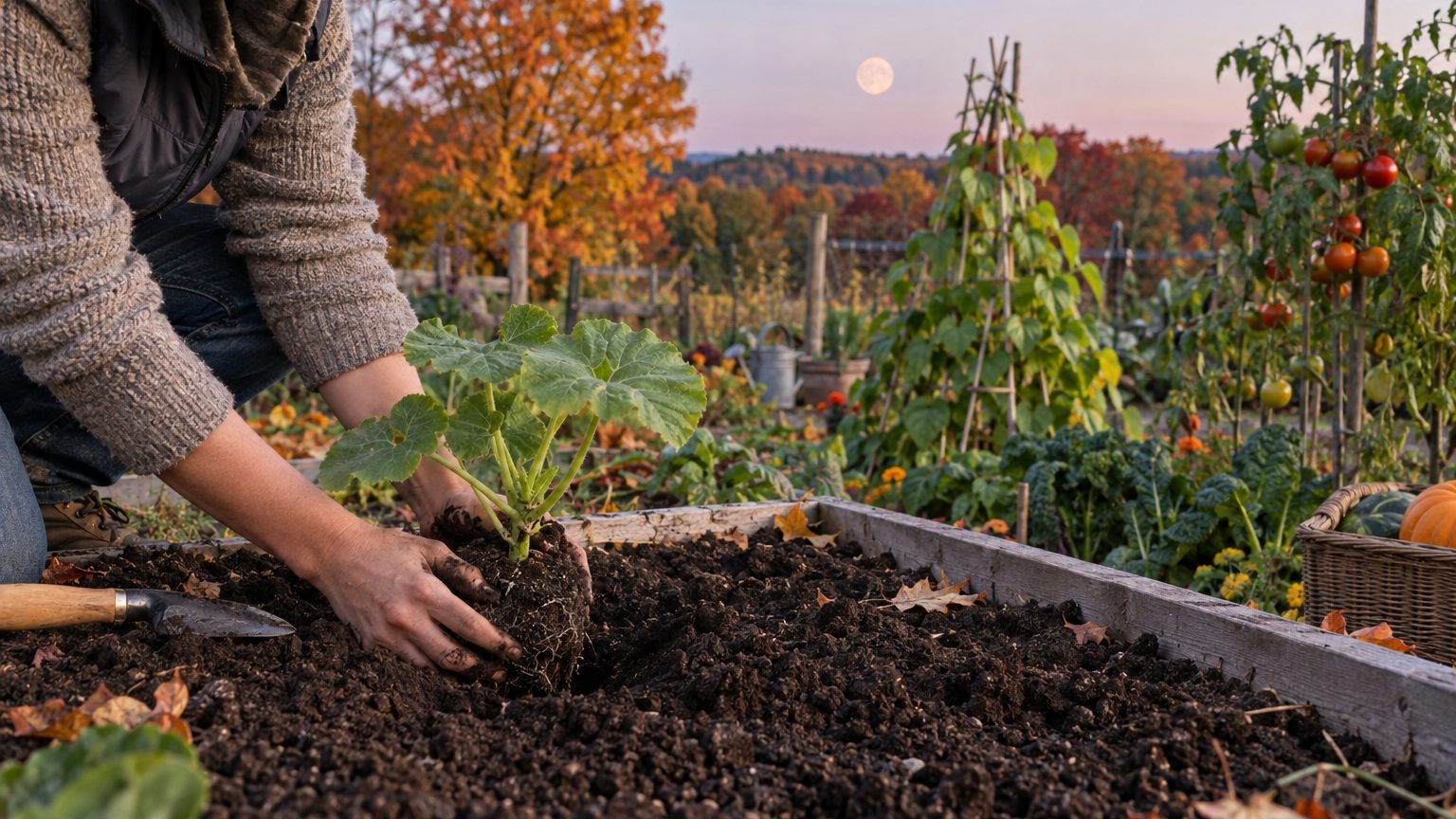

According to almanac tradition, pumpkins are a fruit-type crop, planted in the second quarter of the Moon while it sits in a fruitful or semi-fruitful sign. For 2027, that rule gives these traditional windows: May 16-19, June 12-16, and July 11-13 plus July 16-17 (all in Eastern time). No effect of the Moon on pumpkins has been proven, so read the list as a custom you may follow, not a forecast.
What the tradition says about planting pumpkins
The almanac rule is built from two filters, and a traditional day has to pass both. The first filter is the phase. Gardeners who plant by the Moon divide the 29.53-day cycle (new moon to new moon) into four quarters, and each quarter is assigned a type of crop. Pumpkins belong to the “fruit” type, meaning above-ground crops that bear seed inside the fruit. Almanac lists place tomatoes, peppers, beans, squash and corn in the same group.
| Crop type | Quarter in the almanac rule | Examples named by the tradition |
|---|---|---|
| Leaf | First quarter (new moon to first quarter) | Lettuce, spinach, cabbage, broccoli, celery |
| Fruit (pumpkins) | Second quarter (first quarter to full moon) | Tomatoes, peppers, beans, squash, corn |
| Root | Third quarter (full moon to last quarter) | Potatoes, carrots, garlic, onions, beets |
The second quarter is the stretch of the waxing Moon between first quarter and full moon, which is why many gardeners ask about planting in a waxing moon. The fourth quarter, from last quarter to new moon, is set aside in the tradition for rest: weeding, pruning, turning the soil and composting.
The second filter is the Moon’s sign. This convention labels Cancer, Scorpio and Pisces fruitful, and Taurus, Libra and Capricorn semi-fruitful. Aries, Gemini, Leo, Virgo, Sagittarius and Aquarius are labeled barren, although almanacs disagree on Virgo, Sagittarius and Aquarius. A traditional window for pumpkins is a run of days when the second quarter and a fruitful or semi-fruitful sign overlap. The full system is laid out in our guide to planting by the moon.
Now the part that matters for honesty. Nobody has shown that the Moon’s phase or sign changes how a pumpkin seed sprouts or how much a vine yields. The astronomy points the same way. At its strongest, the Moon’s tidal pull at the Earth’s surface is about 1.1 millionths of a meter per second squared, roughly one ten-millionth of gravity. That is far too small to move anything as light as a seed or a root. Treat the practice as an old almanac custom, kept for its own sake.
Traditional pumpkins planting days, 2026 and 2027
Each row below lists days when the Moon is in the second quarter and in a fruitful or semi-fruitful sign, read at noon Eastern time. Days in the second quarter when the Moon sits in a barren sign are left out.
| Month | Traditional days for pumpkins | Moon sign |
|---|---|---|
| May 2027 | May 16-19 | Libra/Scorpio |
| June 2027 | June 12-16 | Libra/Scorpio |
| July 2027 | July 11-13 | Scorpio |
| July 2027 | July 16-17 | Capricorn |
How to read the rows
Under this convention, Libra and Capricorn are semi-fruitful and Scorpio is fruitful. That is why a run such as May 16-19 spans two signs: the Moon changes sign partway through, and both signs qualify. July holds two separate runs, the first with the Moon in Scorpio and the second with the Moon in Capricorn.
The months shown are those when gardeners in much of the country plant pumpkins. Your state may start earlier or later, so only the rows that fall inside your state’s own window count. A row outside that window is not a planting date for you, whatever the Moon is doing.
Days are read at noon Eastern time, and the Moon changes sign during the day. Treat the first and last day of each run as approximate edges. A gardener in the Central or Mountain time zone, or on the West Coast, should be especially cautious with those edge days, since the clock reads differently there.
Check your state first: when to plant pumpkins where you live
The order of decisions matters more than the table above. Start with your state’s planting calendar for pumpkins. Only after you know your own window should the Moon come in, and only if you want it to.
Frost dates and soil temperature decide whether a crop can go into the ground. The Moon, if you follow it, only chooses among days that are already open to you. It never moves a planting date earlier, and it never justifies sowing on a day your local calendar rules out.
The page on when to plant pumpkins where you live is where those local dates are kept, so this page does not repeat them. If you want the full picture for your area, browse our state guides and open the one for your state. A gardener in Ohio, for instance, would open the Ohio planting calendar for pumpkins and note the window it gives.
With that window in hand, the Moon table becomes a filter. Lay the rows from the table above over your state’s window, and cross out every row that falls outside it. What remains is the short list of traditional days that are also open for planting where you garden. If nothing remains, the tradition has no day to offer you that season, and the state calendar still stands.
Two practical notes follow from this. If your state window opens before the first traditional row, you can plant on an ordinary day without breaking any rule of the place. And if you move the planting to catch a traditional day, check that you have not moved it outside your state window.
A fair way to try it
You do not have to take the tradition on faith or dismiss it. A home gardener can run a small comparison in a single bed, with a few simple steps:
- Divide your pumpkin seed or transplants into two equal batches, with the same variety and the same source.
- Plant the first batch on a traditional day from the table that also falls inside your state’s window. Plant the second batch on an ordinary day in the same week.
- Label both plantings clearly with a stake and a note of the date and the type of day.
- Keep notes on the date of planting, the date seedlings emerge, and the date and weight of the harvest.
Be realistic about what this tells you. One season, one bed and one set of vines will not settle anything. Weather, pests and where the sun falls across the plot can all swamp a small difference between batches. If the two plantings end up close, that is a result too.
Repeat it for a few seasons and your notes become a record specific to your own soil. It is the only way a home gardener can judge the tradition for a particular plot, because no published table can speak for your yard.
Questions about planting pumpkins by the moon
Does the tradition say to plant pumpkins in a waxing or a waning moon?
A waxing moon. The almanac rule puts fruit-type crops in the second quarter, between first quarter and full moon, while the Moon is growing toward full. The waning quarters are given to other work: root crops in the third quarter, and rest tasks in the fourth.
What if the traditional day falls on a frost?
Your state’s calendar decides, as described above. Skip that day, pick another day in the same run if one is open, or wait for the next window in the table. The tradition is a way to choose among days, never a reason to plant on a particular one. For local frost and planting dates, use the pumpkin planting page and your state guide.
Do I need to follow the Moon sign as well?
Not if you only want the phase rule. The quarter is the older and simpler layer, and the sign is an extra step added by moon-sign almanacs. The table in this article already applies both, so its days are narrower than the quarter alone would give.
Be aware that other systems use different sign lists. Biodynamic gardening, following Maria Thun, groups the signs into root, flower, leaf and fruit days, with Aries, Leo and Sagittarius as fruit days. A gardener using that system would have a different list of days from the one above.