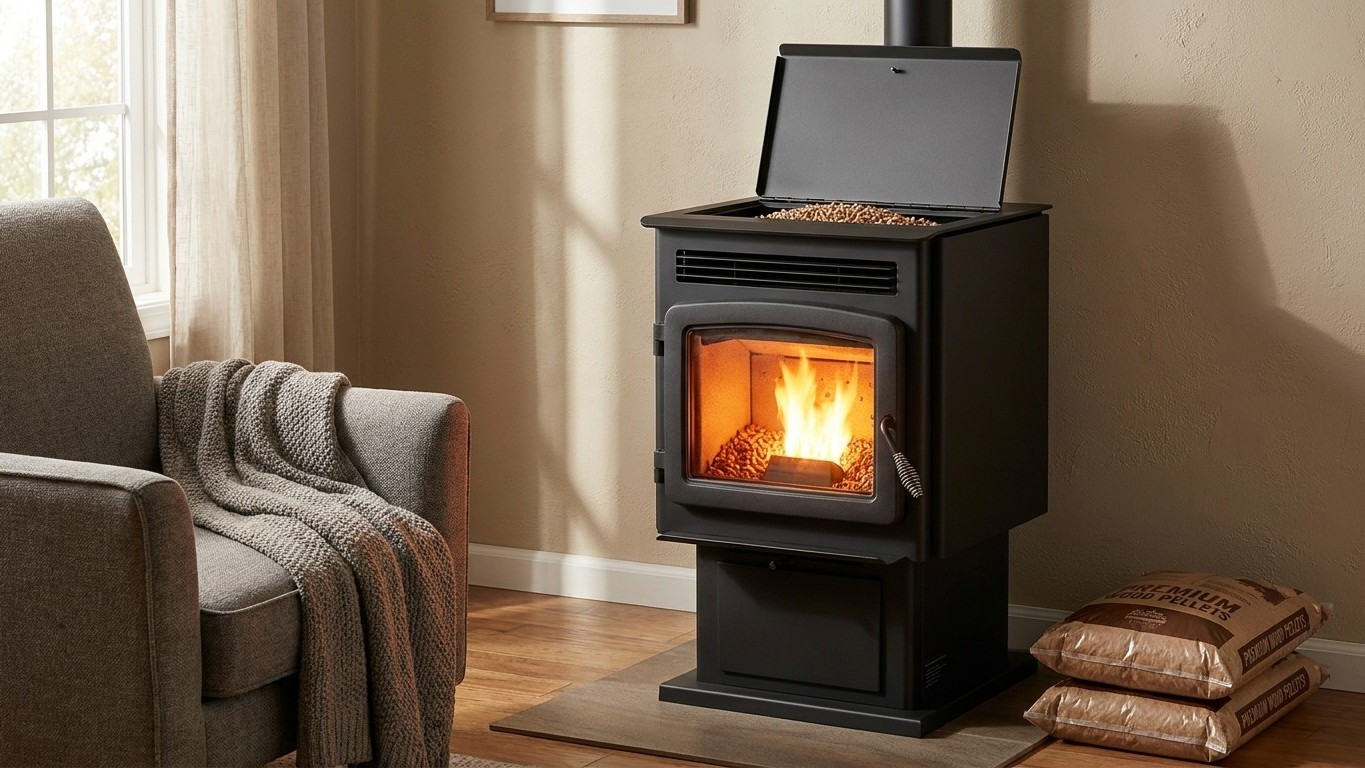

A pellet stove burns compressed wood or biomass pellets that feed themselves from a hopper into a firebox, using electric fans and augers to push warm air into a room. It suits households that want the steady, radiant feel of wood heat without splitting logs or tending a fire by hand. The catch: it needs power to run, and the pellets themselves vary enough in quality to change how well the whole system performs.
What the appliance is for
At its core, a pellet stove is a heating appliance built around automation. Instead of stacking logs and adjusting a damper, the owner fills a hopper with bagged pellets and lets a computer-controlled auger meter fuel into the burn pot on a schedule. That difference in mechanics is what makes pellet stoves appealing to homeowners who want consistent output, programmable heat, and less daily labor than a traditional wood stove demands. They tend to fit best as a supplemental heat source for a living room, basement, or converted garage, though larger units can carry a significant share of a small home’s heating load.
Whether one of these stoves makes sense for a specific house comes down to a handful of questions this hub doesn’t try to answer on its own. How much heating capacity does a given room or floor plan actually require, and where does a household fall in the wide range EPA-certified models cover? What does it cost to install one, and what does a season of pellets run compared with the fuel it replaces? Does an existing chimney or wall layout support the venting a pellet stove needs, or does the appliance call for a different setup than a wood-burning insert? And for anyone comparing options, how does a pellet stove actually stack up against a wood stove or a gas unit in daily use, upkeep, and cost per hour of heat?
Those questions get their own detailed answers elsewhere in this guide, covering sizing and Btu calculations, installation and venting requirements, running costs, and side-by-side comparisons with wood stoves. This page is the starting point: it lays out what the appliance is, what it demands from a household, and what to know before buying or lighting one, so the more specific pages make sense once you get there.
The households that tend to do well with a pellet stove are the ones willing to plan around two fixed realities: pellets have to be bought, stored, and kept dry, and the stove has to stay plugged into a working electrical outlet to function at all. Neither requirement is a dealbreaker, but both shape where and how a stove gets installed, and both come up repeatedly in the sizing, cost, and installation pages linked above.
Choosing one
The first real decision is sizing: how much heat a given space needs, measured in Btu per hour, and how that compares to the output range a pellet stove can deliver. According to the U.S. Environmental Protection Agency, “EPA-certified pellet stoves usually fall into the 70-83% efficiency range, while heating capacities range from 8,000-90,000 Btu per hour.” That’s a wide spread, and matching a stove’s rated output to a room’s actual heat loss, rather than guessing, is the job of the dedicated sizing and Btu guide in this cocoon.
The second decision is cost, and it splits into two separate numbers a buyer needs before signing anything: the upfront price of the unit plus installation, and the ongoing cost of pellets and electricity over a heating season. Those two figures don’t always move together. A cheaper stove that runs less efficiently, or one installed without the right venting, can cost more over five years than a pricier unit installed correctly the first time. The cost page in this series breaks down both sides of that equation with current pricing patterns.
Fuel and placement matter too
A third decision, easy to underweight, is where the stove will physically sit and how it will vent. Pellet stoves don’t need the same masonry chimney a wood stove often relies on, but they do need a code-compliant vent path and a nearby, accessible spot for a hopper that gets refilled regularly. The installation page in this cocoon walks through venting types, clearances, and the practical layout questions that come up before a stove ever gets delivered.
Fuel quality belongs in the buying conversation too, even though it’s not a decision made once. As the EPA notes, “Pellets can differ significantly in how well they’re made and how well they burn. Lower quality pellets may provide less heat and create a fine dust. Higher quality pellets tend to burn cleaner and produce less ash.” A buyer choosing a stove is also choosing, implicitly, to become a recurring buyer of pellets, and that ongoing relationship with a fuel supplier is worth thinking through before the stove itself is picked.
What to know before it runs
Every pellet stove works on the same basic principle. Per the EPA, “The pellets are poured into a hopper, which automatically feeds into the stove.” From there, an auger carries a metered amount of fuel to the burn pot, an igniter starts the fire, and a fan distributes the resulting heat into the room. That automation is the main selling point, but it’s also the reason a pellet stove has a dependency a wood stove doesn’t share: it runs on electricity, not just fuel.
The EPA is direct about this: “Pellet stoves need an electrical supply to work because they use motorized components to feed the fire and blow out hot air.” No power, no auger, no fan, and effectively no heat, regardless of how full the hopper is. That single fact shapes decisions about backup power, generator sizing, and whether a pellet stove can serve as a reliable heat source during a winter outage, a topic worth planning for separately rather than assuming away.
Emission standards by vintage
Pellet stoves sold new today are held to the same federal emission limits as wood stoves, under EPA’s New Source Performance Standards. The specific number depends on when a unit was certified.
| Certification vintage | Emission limit | Test fuel |
|---|---|---|
| 2015 standard | 4.5 grams per hour | Not specified |
| 2020 standard (current) | 2.0 grams per hour | Crib wood |
| 2020 standard (current) | 2.5 grams per hour | Cord wood |
Since 2020, newly manufactured room heaters, pellet stoves included, must meet the tighter of those two figures depending on the test fuel used, a real tightening from the 4.5 grams per hour ceiling that applied to appliances certified under the 2015 rule. That’s part of why a stove bought new today generally burns cleaner than one from a decade ago, even before pellet quality enters the picture. For buyers weighing options, the EPA notes it “currently certifies over 90 different pellet stoves,” giving households a substantial pool of compliant models to choose from rather than a handful of options.
Keeping it running
A pellet stove is lower-maintenance than a wood stove day to day, but it isn’t maintenance-free, and the EPA draws a clear line between what an owner should handle and what belongs to a professional. As the agency puts it, “Pellet stoves need to be regularly cleaned to ensure that the stove runs efficiently and safely. Additionally, you should have your stove professionally cleaned at least once a year.”
The first half of that instruction is routine work: clearing ash from the burn pot, wiping down the glass, checking the hopper and auger path for debris, and emptying ash pans on a schedule that depends on how much the stove runs and how the pellets themselves burn. Lower quality pellets, as noted above, tend to leave more ash and more fine dust behind, which means the burn pot and glass need attention more often when fuel quality is inconsistent.
The second half is not optional, and it’s not something most owners are equipped to do themselves. A yearly professional cleaning typically covers the venting system, the internal components an owner can’t easily reach, and a safety check on the electrical and mechanical parts that keep the auger and fans running correctly. Skipping that annual visit is one of the more common ways a well-chosen, well-sized stove ends up underperforming or, worse, becoming a safety issue years down the line.
The full maintenance page in this cocoon breaks down a cleaning schedule by task, from daily ash checks to the annual professional service, along with signs that a stove needs attention sooner than the calendar suggests. That page is the natural next stop for anyone who already owns a stove, or anyone about to buy one and wants to know what ownership actually looks like month to month.
Common questions
Do pellet stoves work during a power outage?
No, not without a backup power source. Because the auger, igniter, and fans are all electric, a pellet stove stops feeding fuel and blowing heat the moment power drops, even with a full hopper of pellets.
How often does a pellet stove need cleaning?
Routine cleaning happens on an ongoing basis as ash builds up, and the EPA recommends at least one professional cleaning per year in addition to that regular upkeep.
Are all wood pellets the same quality?
No. Pellet quality varies in how well pellets are made and how they burn, and lower quality pellets can produce less heat along with more fine dust and ash than higher quality ones.
How many pellet stove models are certified for sale?
The EPA currently certifies over 90 different pellet stoves, giving buyers a wide range of certified options to compare on size, output, and features.