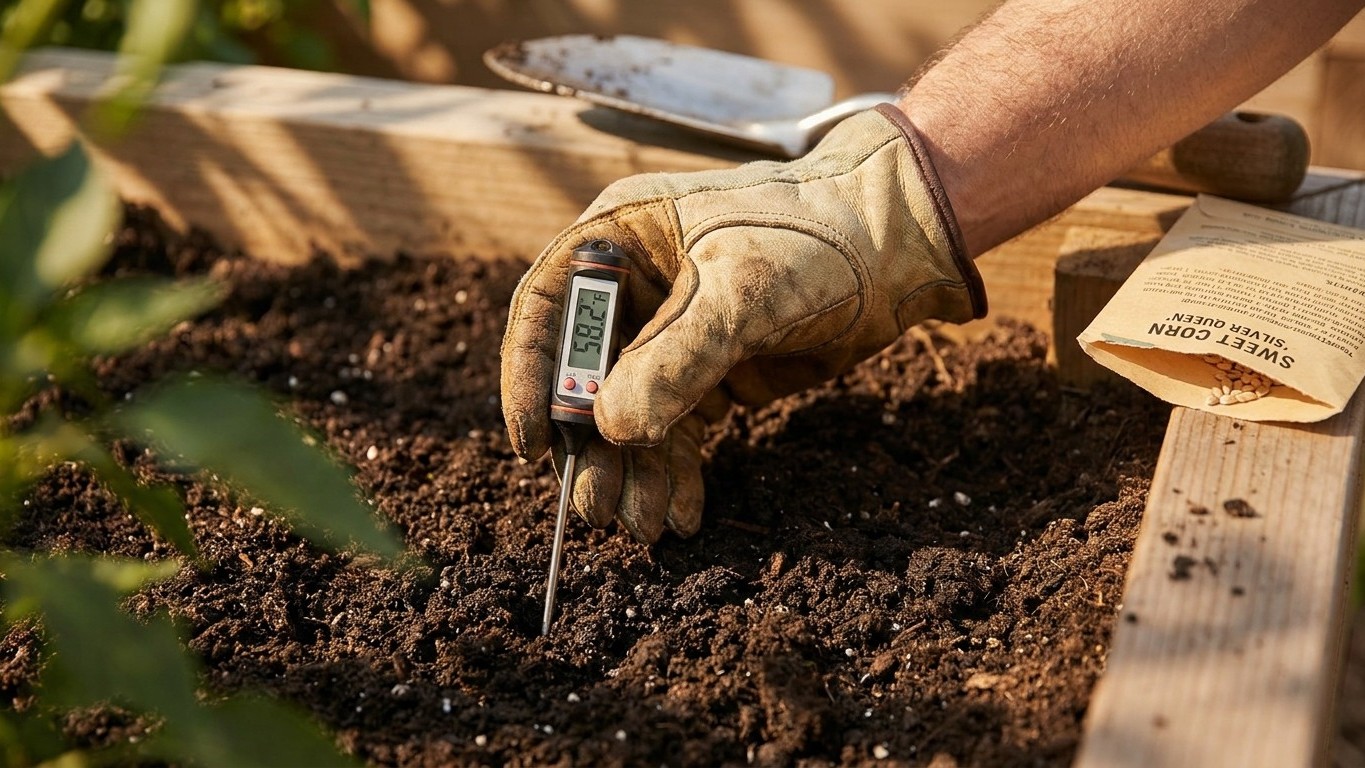

In most of Colorado, sweet corn goes into the ground once soil has warmed past 60 F, which lands later than the last spring frost (May 1 to May 11 on the plains). From there, 60 to 90 days need to fit before the first fall frost (September 30 to October 12), and for most of the state, that window has plenty of room to spare.
The short answer
Here’s the part that trips up a lot of gardeners: the last frost date and the date soil is warm enough for corn are not the same thing, and treating them as one day is the fastest way to lose a planting. The 1991-2020 climate normals for the reference station put the last spring frost somewhere between May 1 and May 11. That’s the day the air stops freezing. Soil is a slower creature. It holds onto cold long after the sky clears, and sweet corn seed sitting in ground below 60 F just sits there, rotting instead of sprouting. So the real starting line for sweet corn isn’t the frost date on the calendar. It’s whatever week the dirt itself catches up, which for most plains gardens runs into the back half of May.
Why does this matter more here than in a milder climate? Because Colorado’s growing season is bracketed on both ends by numbers worth knowing. On the front end, that 60 F soil threshold. On the back end, the first fall frost, which arrives between September 30 and October 12. Stack those together and you get a working season of roughly four and a half months on the plains, give or take, depending on exactly how fast the soil warms in a given spring. Sweet corn needs 60 to 90 days from planting to maturity, so on paper that window has margin built in, even in a year when soil warms on the slow side.
The other number worth keeping in your back pocket is heat load. The reference station averages 39.6 days a year at 90 F or hotter. That’s not a small detail. Heat is what pushes soil temperature up quickly once the frost risk clears, which is good news for germination. But it also means water demand climbs fast in July and August, and corn under stress from dry soil during tasseling and silking pollinates poorly no matter how well the calendar math worked out. The season length isn’t the only thing sweet corn has to survive here. The heat in the middle of it matters just as much as the frost dates on either end.
None of this applies evenly across the state. Denver sits at 5,280 feet on the plains, and that’s the elevation these frost dates describe. Mountain towns run a dramatically shorter season and can see frost even in July some years. The Western Slope runs on its own pattern again. A planting plan built around the plains numbers above can fail outright in a mountain valley, so anyone gardening above the Front Range foothills needs to treat these dates as a starting reference, not a local guarantee.
Does a late variety fit here?
Days-to-maturity numbers on a seed packet describe how the plant behaves in average conditions, not a promise. Whether a given maturity length actually fits Colorado’s frost-free stretch is a separate question, and the answer changes depending on where in the state you’re standing.
A 60-day variety
Count forward from whenever soil actually clears 60 F, and a 60-day type has finished its work well before the first fall frost shows up, even in a year where that frost arrives on the early side of the September 30 to October 12 range. That’s a wide cushion. On the plains, a fast-maturing type leaves enough slack in the calendar that a gardener could even try a second, staggered planting a few weeks behind the first, stretching the harvest window rather than getting one big flush all at once. Short-season types are also the safer default for anyone gardening at higher elevation, where the whole frost-free stretch is compressed and there simply isn’t room to gamble on a longer-maturing plant.
A 90-day variety
Run the same math with a 90-day type and the fit gets tighter, but it still works for most of the plains. Planted once soil has warmed, a 90-day variety typically finishes up in time to beat the September 30 start of the fall frost range, though the buffer shrinks considerably compared to a 60-day type. In a year where soil is slow to warm in spring, or where frost shows up on the early end of its normal range, that margin can disappear. This is exactly where elevation becomes the deciding factor rather than a footnote: at higher, cooler sites where the season is already shorter and frost can arrive well ahead of the plains average, a 90-day variety is a poor bet and a 60-day type is the safer call.
| Variety length | Fits plains window | Fits mountain/high-elevation gardens |
|---|---|---|
| 60-day | Yes, wide margin | Yes, still the safer choice |
| 90-day | Yes, narrower margin | Not recommended, season too short |
What goes wrong here
- Seed sown before soil is warm enough. Planting right at the last frost date, rather than waiting for soil to clear 60 F, is the single most common failure. Seed sits in cold, wet ground and rots before it ever sprouts. The fix is patience: wait for soil, not for the frost date on the calendar, and if in doubt, check the ground with a soil thermometer before planting rather than guessing from the weather forecast.
- A variety too long for the site. A 90-day type planted in a mountain garden, or planted late in a season where soil warmed slowly, can run out of days before the first fall frost closes things out. The remedy is matching maturity length to elevation: 60-day types for higher, cooler ground, and reserve longer-season types for the plains where the frost-free stretch runs longest.
- Sweetness lost to timing, not weather. This one has nothing to do with Colorado’s climate at all. Sweet corn comes in different types (su, se, and sh2 among them), and if two of those types tassel at the same time nearby, cross-pollination degrades the sweetness of both. No isolation distance is published for this; what matters is timing. The fix is staggering planting dates so the different types don’t tassel in the same window, or simply growing one type at a time. Plant in blocks of three or more rows rather than a single skinny row, since that shape is what gives the pollen a fair shot at reaching every ear.
Common questions
Is the last frost date the same as when I can plant sweet corn?
No. The last frost date (May 1 to May 11 at the reference station) marks when the air stops freezing. Soil takes longer to warm, and sweet corn needs that soil above 60 F before seed will germinate reliably. Planting right at the frost date, before soil has caught up, is a common way to lose a planting to rot.
How do I know when sweet corn is actually ripe?
Look for three signs together, not just one: silks that have turned dry and brown, husks that are still moist and green, and milky (not clear, not thick) juice from a kernel you’ve punctured with a thumbnail. This is a separate clock from the 60-to-90-day maturity window used for planning the season. Once silks emerge, ears are typically ready to pick somewhere in the 17 to 24 day range afterward, which is the number to watch closely as harvest approaches rather than the original days-to-maturity figure.
Does elevation change these dates within Colorado?
Yes, and by a lot. The frost dates and days-above-90 figures here describe the reference station near Denver, at 5,280 feet on the plains. Mountain towns run a much shorter frost-free season and can see frost even in July in some years. The Western Slope runs on its own separate pattern. Anyone gardening away from the Front Range plains should treat these numbers as a starting reference, not a local forecast.
Can I grow two types of sweet corn in the same garden without losing sweetness?
Yes, but timing is what protects flavor, not distance between rows. If two types (say, an su and an sh2) tassel during the same window, they’ll cross-pollinate and both lose sweetness. Stagger planting dates so their tasseling periods don’t overlap, or grow one type per season if the garden is small. Plant each type in a block of three or more rows rather than a single line, since that arrangement gives pollen a much better chance of reaching every ear within its own block.