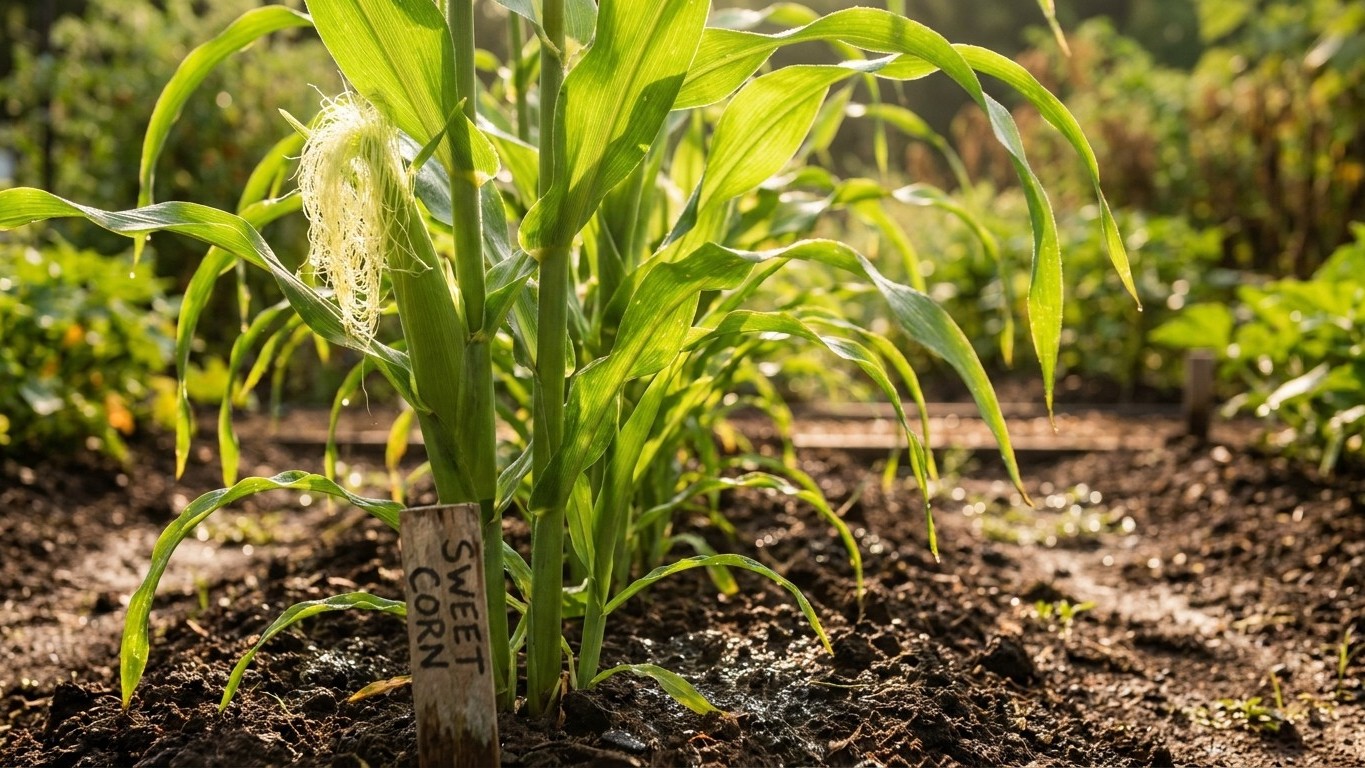

Yes, in most of Colorado’s populated valleys and plains, sweet corn can ripen before the first fall frost, but the calendar math is tighter than gardeners moving from milder states expect. The soil has to warm well past frost-free before you even plant, and that delay eats into the 60- to 90-day window the crop needs. Site elevation decides the rest.
The short answer
Start with the number gardeners usually skip: soil temperature, not air temperature. Sweet corn seed needs soil consistently above 60 F to germinate reliably, and that threshold arrives later than the last spring frost, sometimes considerably later. Along Colorado’s Front Range and eastern plains, the last spring frost falls between May 1 and May 11, based on NOAA’s 1991-2020 climate normals for the region. But frost-free air doesn’t mean warm soil. Ground takes weeks to catch up to spring air temperatures, especially at elevation, so treating the frost date as your planting date is the single most common miscalculation gardeners make here.
Once the soil does hit 60 F, the clock that matters is the one from planting to harvest: 60 to 90 days, depending on variety, according to Utah State University Extension. That’s a separate clock from the one that tells you which week to pick, which runs 17 to 24 days from silk emergence and has nothing to do with how long the whole crop takes to mature. Confusing the two leads to picking too early or letting ears go starchy while you wait for a maturity number that already passed.
Do the arithmetic for Colorado’s plains and Front Range. First fall frost lands between September 30 and October 12. That gives a frost-free stretch of roughly 140 to 165 days depending on the exact site and year. Subtract the weeks it takes soil to climb from the last frost date up to 60 F, and you’re left with a working season that comfortably covers a 60-day variety and still has margin for a 90-day one in most years, on the plains. The real variable is heat, not just day count. Denver’s climate normals show an average of 39.6 days a year at or above 90 F, which is real heat load for a crop that drinks heavily during tasseling and grain fill. That heat also speeds up the maturity clock somewhat, but it raises water demand at the same time, so the growing season being long enough on paper doesn’t mean the crop is worry-free.
Mountain valleys are a different story entirely. Higher elevations can see frost into July and again in early September, shrinking the frost-free window to a fraction of what the Front Range gets. If you garden above roughly 7,000 feet, the season math above simply doesn’t apply, and a 60-day variety may be the only realistic option, if any sweet corn fits at all.
Does a late variety fit here?
Whether a given maturity length works comes down to counting backward from your local first fall frost and forward from the date soil actually reaches 60 F, not from the last frost date on a calendar. That gap between frost-free and soil-warm is the part gardeners consistently underestimate in Colorado’s climate.
A 60-day variety
A 60-day sweet corn is the safer bet almost everywhere in the state. Even accounting for a soil-warming delay that pushes planting well past the last spring frost, a 60-day crop only needs to squeeze into roughly two months before the first fall frost arrives. Given the 140-to-165-day frost-free window along the Front Range and eastern plains, there’s enough slack to absorb a late, cool spring and still finish weeks ahead of the September 30 to October 12 frost range. This is the maturity length that gives the most reliable outcome across the state’s lower-elevation gardens, and it’s the one to default to in shorter-season mountain valleys as well.
A 90-day variety
A 90-day variety is a tighter fit. On paper, the frost-free window is long enough to hold it, but that assumes soil warms promptly and the season runs close to its typical length on both ends. Push planting back because of a cold, wet spring, or lose a week or two to an early fall frost, and a 90-day crop can run out of runway before the ears finish filling. On the plains and Front Range, in an average year, it likely fits. In a cool or short year, or in any garden at meaningfully higher elevation, it does not fit, and gardeners chasing it should treat the outcome as a gamble rather than a plan. Given the source material provides no variety names, the honest answer is: match your seed packet’s stated days-to-maturity against your own site’s frost dates each year, rather than assuming a 90-day corn is safe just because the state average allows it.
What goes wrong here
- Soil sown too cold. Planting right after the last spring frost, before soil has actually climbed to 60 F, causes poor or uneven germination and rot in the seed row. The remedy is patience: check soil temperature directly rather than relying on the frost date as a planting signal, and wait for consistent warmth, not a single warm afternoon.
- A variety too late for the season. Choosing a 90-day corn in a short-season site, or in a year when spring runs cold and planting slips later than usual, leaves ears unfinished when the first fall frost hits between September 30 and October 12. The remedy is matching maturity length to your actual site conditions each year rather than the state’s best-case average, and defaulting to a shorter-season variety if there’s any doubt.
- Sweetness lost to tasseling together, which has nothing to do with climate. Su, se, and sh2 types cross-pollinate if they tassel at the same time, and the result is starchy, disappointing ears regardless of how well the season’s weather cooperated. Utah State University Extension gives no isolation distance for this, so don’t plant by a distance rule. Instead, stagger planting dates so different types don’t tassel in the same window, and always plant sweet corn in blocks of three or more rows rather than a single thin row, since block shape affects pollination reliability independent of timing.
When ears are close to ready, judge them by three signs together, not one alone: dry, browned silks, husks that are still moist and green, and milky juice from a punctured kernel. Any single sign by itself is unreliable and leads to picking too early or too late.
Common questions
Can I just plant sweet corn on the last frost date in Colorado?
Technically you can, but soil is usually still too cold for reliable germination that soon. The last frost date (May 1 to May 11 along the Front Range) marks when air is unlikely to freeze, not when soil has warmed to the 60 F sweet corn needs. Waiting an extra stretch after that date, until soil is consistently warm, produces stronger stands.
Does the state’s heat help or hurt sweet corn?
Both. An average of 39.6 days a year at or above 90 F can speed up the maturity clock somewhat, but it also raises water demand sharply during tasseling and grain fill. Heat load isn’t a reason to skip watering just because the season looks long enough on paper.
How do I know which week to actually pick, once the crop is close?
That’s a separate question from days-to-maturity. Count 17 to 24 days from when silks first emerge, then confirm with all three ripeness signs together: dry brown silks, husks still moist and green, and milky (not clear or doughy) juice from a punctured kernel.
Is mountain gardening the same math as the Front Range?
No. The frost dates and heat-day figures here reflect a lower-elevation reference station. Mountain towns can see a much shorter frost-free window, with frost possible into July and again in early September, and the western slope runs on its own pattern again. Treat any of this territory’s numbers as a starting point to check against your own site, not a guarantee.