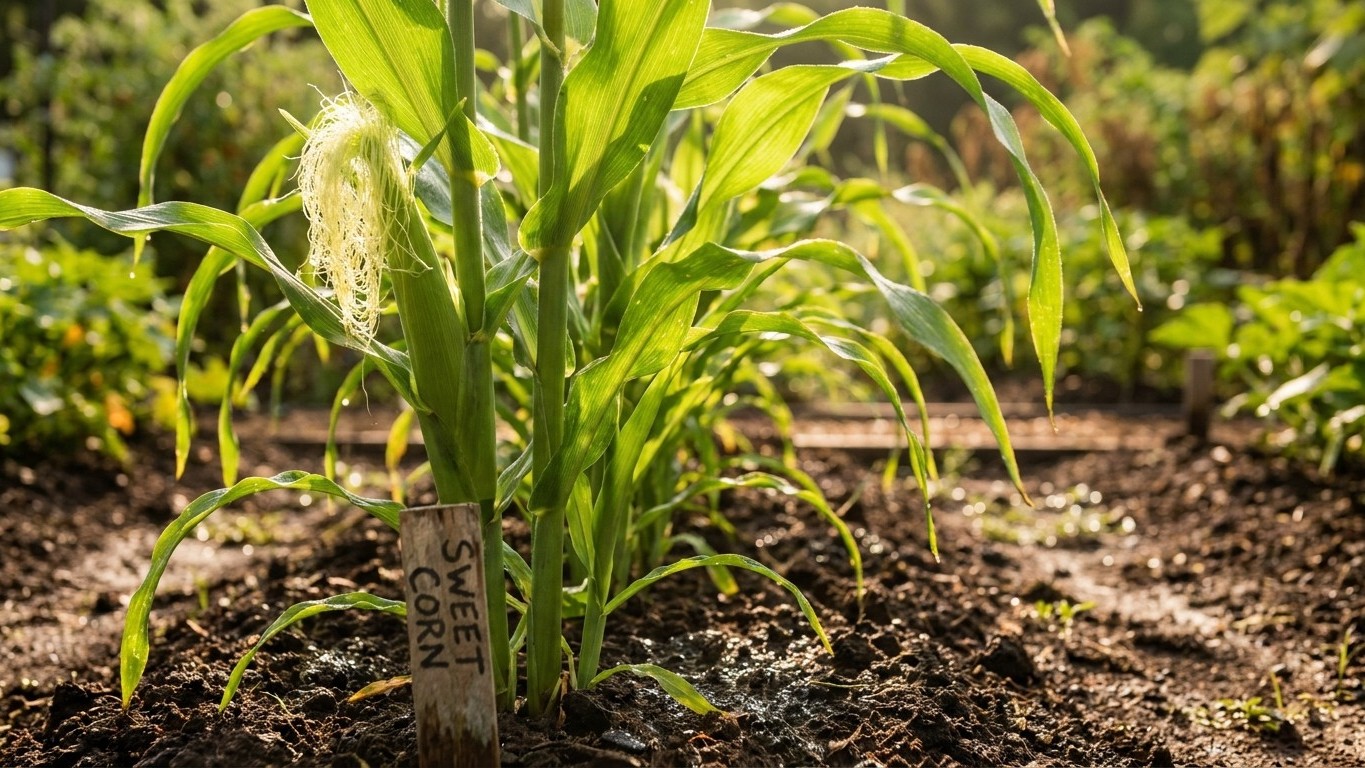

Yes, sweet corn ripens reliably in Connecticut in most years, but the timing depends on soil temperature more than on the calendar frost date. Once soil warms past 60°F, a variety with a maturity window of 60 to 90 days from planting has enough room to reach harvest before the first fall frost. The margin is generous along the coast and narrower inland.
The short answer
The soil doesn’t hit 60°F on the same day the last frost passes. It takes additional weeks of sustained warmth for the ground itself to catch up to the air, and that lag is exactly why so many home gardeners in Connecticut end up with corn that germinates unevenly or sits stalled for two weeks after planting. NOAA’s 1991-2020 climate normals for the Bridgeport reference station put the last spring frost between April 2 and April 12, but that date only tells you when the air stops freezing, not when the soil is ready for corn seed.
What matters for sweet corn is the stretch between that soil-warming point and the first fall frost, which the same NOAA data places between October 28 and November 10 at the coastal reference station. Even using the latest last-frost date (April 12) and the earliest first-frost date (October 28), the calendar gap between those two markers runs to roughly 199 days. That’s the outer boundary before any adjustment for soil lag, and it already leaves far more room than the 60 to 90 days sweet corn needs from planting to maturity.
Subtract several weeks to account for the soil catching up to 60°F, and the usable window still comfortably clears 90 days almost everywhere in the state. That’s the mechanism worth understanding: Connecticut’s growing season isn’t tight for sweet corn, it’s generous, as long as the seed goes into ground that has actually warmed rather than ground that merely looks frost-free.
Heat load factors in too. Bridgeport averages 6.2 days a year at 90°F or above, a modest number that signals moderate summer heat stress rather than the punishing runs of triple-digit days some corn-growing regions see. That matters for pollination, since extreme heat during tasseling can dry out silks and reduce kernel fill. Connecticut’s summers rarely push that hard, which is one more reason the state’s sweet corn outlook is favorable rather than marginal.
Inland and northwest Connecticut change the math somewhat. Those areas see frost arrive earlier in the fall and linger later in spring than the coastal reference station suggests, which tightens the window on both ends. The mechanism doesn’t change, only the buffer around it does.
Does a late variety fit here?
Maturity length is the number stamped on a seed packet, the days from planting to harvest under normal conditions. Utah State University Extension frames the sweet corn season as a 60- to 90-day span, and Connecticut’s frost-free window is wide enough to test both ends of that range against local conditions.
A 60-day variety
A fast-maturing variety in the 60-day range fits Connecticut’s season with room to spare. Even accounting for the delay before soil clears 60°F and planting can safely begin, a 60-day corn planted at that point still finishes weeks before the earliest fall frost date at the coastal reference station. This is the variety type that gives gardeners flexibility: a first planting in late spring, a second sown a few weeks later, both maturing before the season closes. Inland gardeners facing an earlier fall frost still have plenty of buffer with a 60-day type, since even a tightened window measured in weeks rather than months leaves this maturity length untouched.
A 90-day variety
A 90-day variety asks more of the season, but it still fits at the coastal reference station. Working from the latest last-frost date and earliest first-frost date, the calendar gap runs close to 199 days before any subtraction for soil warm-up. Even a generous allowance of several weeks for the soil to reach 60°F leaves a remainder well past the 90 days this variety needs. The margin narrows inland, where fall frost lands earlier and spring frost lingers longer, but the gap between frost dates statewide is wide enough that a 90-day variety is not the risky choice it would be in a shorter-season state. The caution is timing, not feasibility: plant as soon as soil conditions allow rather than delaying into midsummer, since a late-June or July planting of a 90-day type pushes the harvest date close to the inland frost line with little room for a cool, wet stretch to slow things further.
What goes wrong here
- Seed sown before soil warms. Planting on the calendar frost date rather than waiting for the soil itself to clear 60°F is the most common failure. Cold, wet soil rots seed or produces weak, uneven stands that never catch up. The remedy is patience: check soil temperature directly rather than relying on the frost date as a stand-in, and hold off until it consistently reads above 60°F.
- A late planting date pushing a 90-day variety too close to fall frost. The maturity window fits the season when planting happens promptly after soil warms. Delaying a 90-day variety into midsummer, especially inland where frost arrives earlier, leaves too little buffer if a cool September slows development. The remedy is to treat longer-maturity types as an early-season planting, not a late one, and to favor 60-day varieties for any planting done later in the summer.
- Sweetness lost because two types tasseled together. This failure has nothing to do with Connecticut’s climate. Utah State University Extension notes that su, se, and sh2 sweet corn types lose their distinct sweetness when they tassel at the same time, since cross-pollination between types changes the kernel’s sugar content. The source gives no isolation distance to plant by. The remedy is timing and planting shape, not spacing: stagger plantings of different types so they don’t tassel in the same window, and grow each variety in a block of three or more rows rather than a single thin row, since blocks pollinate more reliably within themselves.
Common questions
Is the last frost date the same as when I can plant sweet corn?
No. The last frost date only marks when freezing air temperatures typically end. Sweet corn needs soil that has warmed past 60°F, which happens later than the frost date passes. Planting on the frost date alone risks cold, slow-germinating seed.
How many days does sweet corn actually need to ripen?
Utah State University Extension puts sweet corn’s maturity window at 60 to 90 days from planting, depending on variety. That figure is separate from the 17 to 24 days it takes from silk emergence to harvest readiness, which tells you which week to pick rather than whether the crop fits the season.
How do I know when an ear is actually ready to pick?
Check for three signs together: silks that have dried and turned brown, husks that are still moist and green, and juice from a punctured kernel that runs milky rather than clear or watery. One sign alone isn’t a reliable test.
Does inland Connecticut have a shorter corn season than the coast?
Yes. The coastal reference station used for Connecticut’s frost dates sits in the mildest part of the state. Inland and northwest areas see frost arrive earlier in fall and linger later in spring, narrowing the window, though it generally still leaves enough time for both 60-day and 90-day varieties.