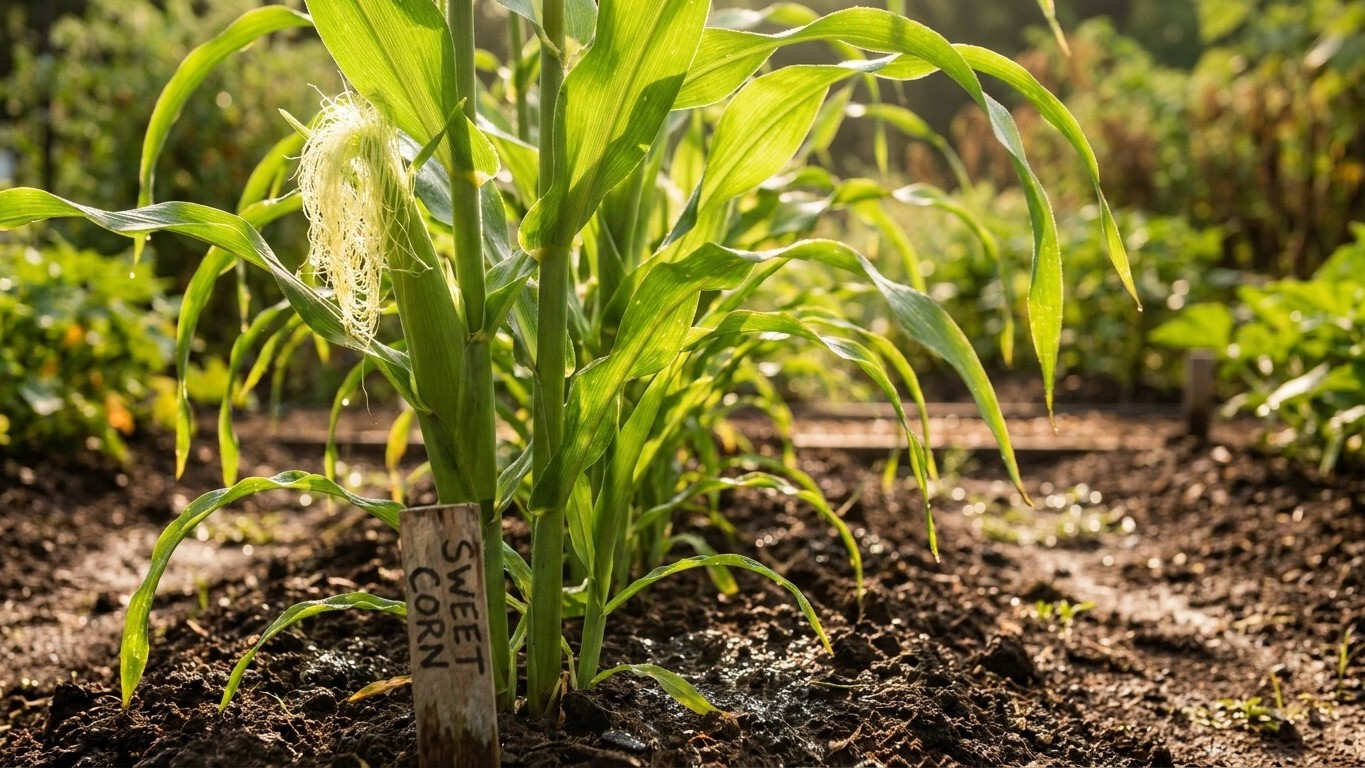

Yes, sweet corn ripens reliably in Delaware, but the answer hinges on planting date, not frost date. The state’s frost-free stretch runs long enough for even a slow-maturing variety, provided the soil has actually warmed before seed goes in the ground. Get that timing wrong, and no amount of summer heat afterward fixes a crop planted into cold soil. Here’s the math behind that answer, and where Delaware gardeners tend to trip up.
The short answer
Frost dates get all the attention, but they’re the wrong number to plan sweet corn around. Near Wilmington, the last spring frost typically falls between April 3 and April 14 (NOAA NCEI 1991-2020 Climate Normals, station USW00013781). Soil, though, doesn’t follow that calendar. Ground warms far more slowly than air, and sweet corn seed needs the soil itself, not just the surrounding air, to sit above 60 F before it will germinate instead of rotting. That threshold typically isn’t reached until well into May across Delaware, often a full month or more after the last frost risk has cleared.
That gap matters, because every week spent waiting on cold soil is a week subtracted from the growing season, not added to it. Sweet corn needs 60 to 90 days from planting to reach harvest, depending on variety (Utah State University Extension). So the real question isn’t whether Delaware has a long enough frost-free stretch, it’s how much of that stretch remains once the soil finally cooperates.
This is where Delaware’s climate works in a gardener’s favor. The first fall frost doesn’t arrive until October 26 to November 7 at the reference station. Even counting from a planting date in mid-May, that leaves roughly five months of frost-free growing before the season closes out, comfortably more than the 90 days even the slowest sweet corn varieties require. A gardener who waits for genuinely warm soil in Delaware isn’t racing the calendar the way a grower further north would be.
The other number worth knowing is heat load, not just season length. Wilmington averages 17.6 days a year at 90 F or above (NOAA NCEI Climate Normals 1991-2020). That’s a real stretch of hot weather sitting inside the growing season, and it matters more for pollination and water demand than for whether the crop technically has enough days to mature. Sweet corn pollinates through silk emerging from each ear, and a run of 90-plus-degree days during that narrow window can dry pollen and thin out kernel fill even when the calendar math checks out fine.
So the plain version: sweet corn ripens in Delaware without much doubt on the season-length question. But ripening and ripening well are separate things, and the second one depends on watching a soil thermometer instead of the frost calendar, and on timing the pollination window around the hottest stretch of summer rather than ignoring it.
Does a late variety fit here?
Once soil hits 60 F, usually sometime in May in most Delaware gardens (suburban and rural spots often run a week or two behind or ahead of the Wilmington reference station, so a soil thermometer beats a date on a calendar), the countdown to harvest starts. The question then is how much room a 60-day variety has compared with a 90-day one, and whether the slower option is worth the wait.
| Variety type | Days to maturity | Typical planting window | Approximate harvest | Margin before earliest fall frost (Oct 26) |
|---|---|---|---|---|
| 60-day | 60 days | Mid-to-late May | Mid-July | About 14 weeks |
| 90-day | 90 days | Mid-to-late May | Mid-August | About 10 weeks |
A 60-day variety
This is the low-risk choice, and it shows in the numbers above. Planted once soil has genuinely warmed, a 60-day type is off the stalk by mid-July with roughly three months of frost-free days still ahead of it. That margin is wide enough that a gardener can plant a second or even third round two to three weeks apart and still finish well before the earliest fall frost date. If the goal is a long, staggered harvest rather than one big picking, the fast variety is the one that makes succession planting easy.
A 90-day variety
Here’s the useful part for Delaware specifically: the 90-day variety fits too, and comfortably. Even with a mid-May planting pushed a little later by a cool, slow spring, an 90-day type reaches maturity by mid-to-late August, still about two months ahead of the October 26 to November 7 frost window. Push the planting date all the way to late June, an unusually late start, and the math still lands before the earliest frost. In states with a shorter frost-free stretch, a late variety is often a gamble. In Delaware, it isn’t. The one place a 90-day crop actually loses ground is heat stress during pollination, not season length, so timing silk emergence to dodge the worst run of 90-degree days matters more than the maturity date itself.
What goes wrong here
- Seed sown before the soil is actually warm. Delaware’s last frost clears by mid-April most years, which tempts an early planting date. But sweet corn seed sitting in soil below 60 F doesn’t just grow slowly, it often rots before it germinates at all. The fix is a soil thermometer, not a calendar date: wait for a consistent 60 F reading a few inches down before dropping seed, even if that means planting well into May.
- A variety chosen without checking the season against it. Delaware’s window is long enough for a 90-day type, but that margin shrinks fast if planting gets pushed into July, or if a garden sits somewhere cooler or higher than the Wilmington reference point and sees frost arrive a week or two early. Matching the maturity days on the seed packet against the actual planting date, not an assumed one, avoids a late crop caught by an early frost.
- Sweetness lost to timing, not weather. This failure has nothing to do with soil or frost. Su, se, and sh2 sweet corn types lose their sweetness if they tassel at the same time, because cross-pollination between types changes the sugar content of the kernels. The source publishes no isolation distance for this, so the fix isn’t about spacing plants further apart, it’s about staggering planting dates so different types don’t tassel together, and planting each type in blocks of three or more rows rather than thin single rows, which improves pollination within the block itself.
Common questions
Does Delaware’s growing season really support a slow, 90-day sweet corn variety?
Yes. Once soil warms to 60 F, typically in May, there’s roughly two to three months of buffer before the earliest fall frost date of October 26, more than enough for even a 90-day type to finish well ahead of frost.
How do I know when the corn is actually ready to pick?
Look for three signs together, not just one: silks that have turned brown and dried, husks that are still moist and green underneath, and a milky liquid (not clear, not thick) when a kernel is punctured. This picking window is a separate clock from the 60-to-90-day planting-to-maturity figure, and it runs roughly two to three weeks after silks first appear, so don’t judge readiness by planting date alone.
Can I grow two sweet corn varieties in the same garden without losing sweetness?
Yes, but timing matters more than spacing. The two types need to avoid tasseling at the same time. Staggering planting dates so one type finishes pollinating before the other begins works better than trying to separate plants by distance, since no isolation distance is published for home gardens.
Should I worry about Delaware’s hot summer days hurting a late-planted crop?
It’s a real factor. With an average of 17.6 days a year reaching 90 F or higher, a stretch of extreme heat during pollination can dry out silks and reduce kernel fill, regardless of whether the plant has enough days left to mature. Timing planting so silk emergence avoids the hottest weeks matters more than chasing extra season length.