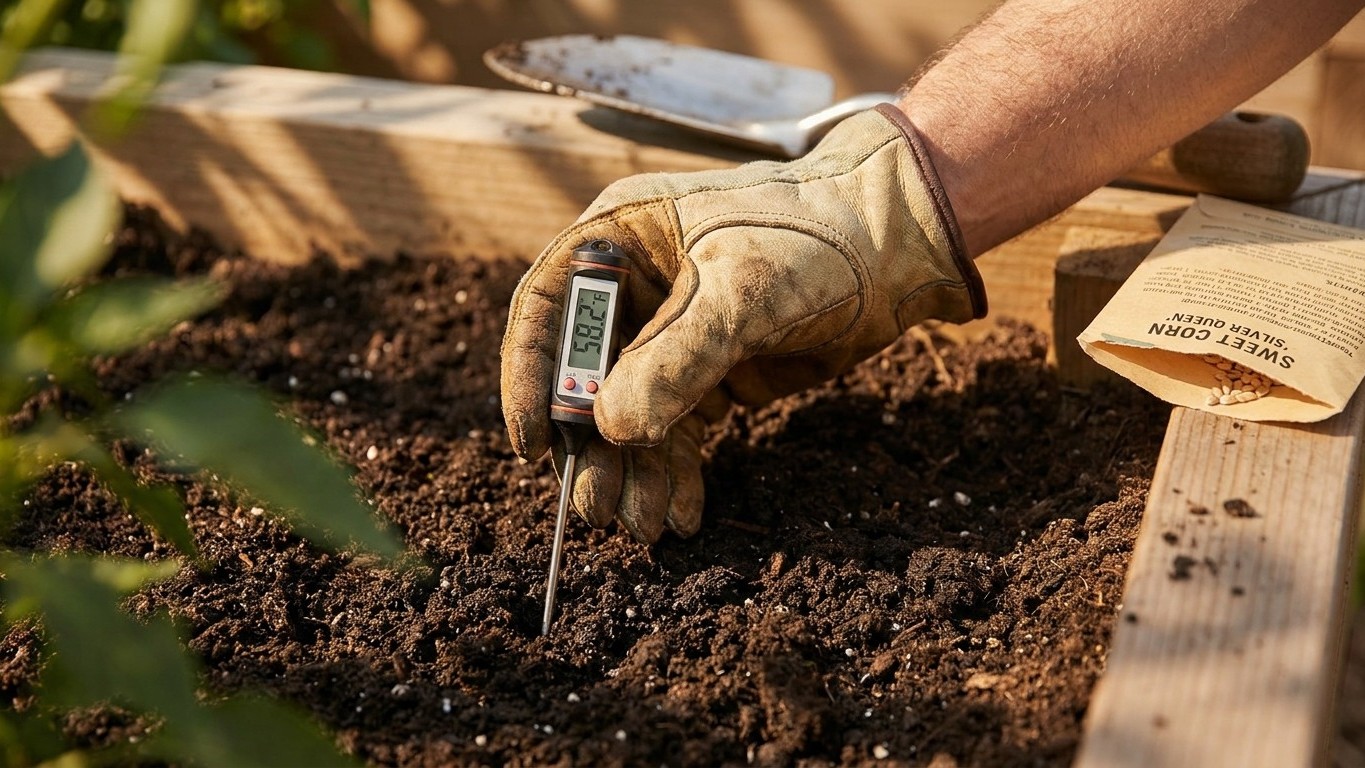

There’s no frost calendar to consult here, so the question really comes down to soil temperature and elevation. Sweet corn needs soil consistently above 60 F, and once that threshold is met, gardeners have a 60 to 90 day window to work with before conditions shift enough to matter. Lower, drier, leeward sites reach that mark earliest; cooler upland plots lag behind.
The short answer
Soil warms unevenly across the islands, and that unevenness is the whole story. A leeward garden near sea level, the kind found on the dry side of Oahu or the Kona coast, holds heat in the ground far longer than a windward plot exposed to trade-wind rain and cloud cover. Soil at 60 F or above is what sweet corn actually needs before germination proceeds reliably, and at low elevation that threshold is met for most of the year. This is a different question than the old “last frost” marker gardeners in temperate states use, and it matters to say so plainly: there is no frost season in inhabited Hawaii to anchor a calendar to. NOAA’s 1991-2020 Climate Normals for the reference station show zero days per year at or below 32 F, and the freeze percentiles are flagged as not computable because freezing simply doesn’t happen where people garden. Frost exists only on the summits of Mauna Kea, Mauna Loa and Haleakala, thousands of feet above any vegetable bed.
That absence of a frost boundary means the growing calendar here isn’t built around a start date and an end date the way it is on the mainland. It’s built around rainfall patterns, elevation, and whether a site faces into the trade winds or sits in their shadow. A garden at 1,500 feet on a windward slope behaves nothing like one at 200 feet on a leeward plain, even though both are technically the same island. The practical takeaway is that soil temperature, not a date on a calendar, is the gate gardeners should be watching.
Once soil crosses 60 F, the 60 to 90 day clock from planting to harvest starts to matter. In most low-elevation gardens, that window fits without much pressure, because there’s no autumn frost cutting the season short the way there would be in a northern state. The heat load, though, is a real constraint in its own direction. The reference station averages 18.7 days a year at or above 90 F, and that number is a measure of water demand and heat stress, not of average summer weather. A 90-day variety planted into a stretch of unusually hot, dry weeks can suffer from moisture stress and poor pollination even if the calendar math says the season is long enough.
So the short answer is this: watch the soil, not the almanac. Once it holds steady above 60 F, and once irrigation is arranged to carry the crop through the hotter weeks, a 60 to 90 day planting window is workable in most lowland Hawaii gardens for much of the year. Upland and windward sites need to shift that timing later, toward whenever their own soil finally warms.
Does a late variety fit here?
The variety length matters more here than it would in a place with a firm frost cutoff, because Hawaii’s growing season isn’t bounded the same way. Without an autumn frost to race against, the real limiting factors become soil warmth at planting and heat stress during the growing period. That changes how a 60-day and a 90-day variety each perform.
A 60-day variety
A shorter-season type reaches harvest before the crop spends much time in the hottest stretch of weather, which is an advantage in a climate that logs close to 19 days a year at 90 F or above. Planting a 60-day variety once soil is reliably above 60 F gives it a tight window to mature before extended heat sets in, and in a leeward or low-elevation garden that timing is usually achievable without much difficulty. The tradeoff is less flexibility if planting gets delayed. There’s no fall frost forcing an early cutoff, but a delayed planting still runs the crop through more of the year’s hot stretch than a gardener might want, especially without consistent irrigation.
A 90-day variety
A longer-season type asks more of the garden. Ninety days of growth means the crop spends a longer stretch exposed to whatever heat the season delivers, and in a territory where soil is warm for much of the year, that’s less about running out of season and more about running into stress. Without a frost deadline to worry about, a 90-day variety technically fits the calendar almost anywhere in lowland Hawaii. But “fits the calendar” isn’t the same as “grows well.” Extended heat during pollination can reduce kernel set, and a 90-day plant asks for more sustained watering through a longer window of high evapotranspiration. In a garden that can keep up with irrigation demand, a 90-day variety is workable. In a garden that can’t, the shorter option is the safer bet, and that’s worth saying plainly rather than assuming the long variety is always the better choice just because there’s no frost to stop it.
What goes wrong here
The failures that show up in Hawaii gardens aren’t the ones a mainland gardener would expect. There’s no early frost to blame, but the climate still creates its own set of mistakes, and one common failure has nothing to do with weather at all.
- Soil sown too cold. Some upland and windward gardens hold cooler, wetter soil longer than gardeners expect, especially through cloudy stretches. Sowing before the ground has settled above 60 F leads to slow, uneven germination. The remedy is checking soil temperature directly rather than assuming a warm island automatically means warm soil, and waiting until it holds steady above that mark before planting.
- A variety too late for the season. Even without a frost deadline, a long 90-day variety planted right before the hottest stretch of the year can struggle through pollination under sustained heat stress. The remedy is timing a 90-day planting so its pollination window falls before or after the peak of the year’s hottest weeks, or shifting to a 60-day variety when that timing can’t be arranged.
- Sweetness lost because two types tasselled together. This is the one that has nothing to do with elevation, rainfall or heat. Su, se and sh2 sweet corn types cross-pollinate readily, and when two different types tassel at the same time nearby, the sweetness and texture of the harvest suffers, sometimes badly. The remedy is timing, not distance: stagger planting dates so different types don’t tassel in the same window, and grow each type in its own block of three or more rows rather than a single thin row, which helps pollen from each block pollinate its own type more reliably.
Common questions
Does Hawaii have a real last-frost date for corn?
No. NOAA’s Climate Normals for the reference station show zero days per year at or below 32 F, with freeze percentiles flagged as not computable. Frost only occurs on the high volcanic summits, never in gardens.
What soil temperature should trigger planting?
Soil consistently above 60 F is the threshold sweet corn needs for reliable germination and growth, regardless of what the calendar or air temperature suggests.
Can two sweet corn varieties be grown at the same time?
Yes, as long as they don’t tassel during the same window. Su, se and sh2 types cross-pollinate and reduce sweetness when their tassels overlap, so stagger planting dates to separate their tasseling periods.
How do I know when the corn is actually ready to pick?
Check for three signs together: dry brown silks, husks that are still moist and green, and milky juice from a punctured kernel. One sign alone isn’t a reliable indicator; all three should be present.