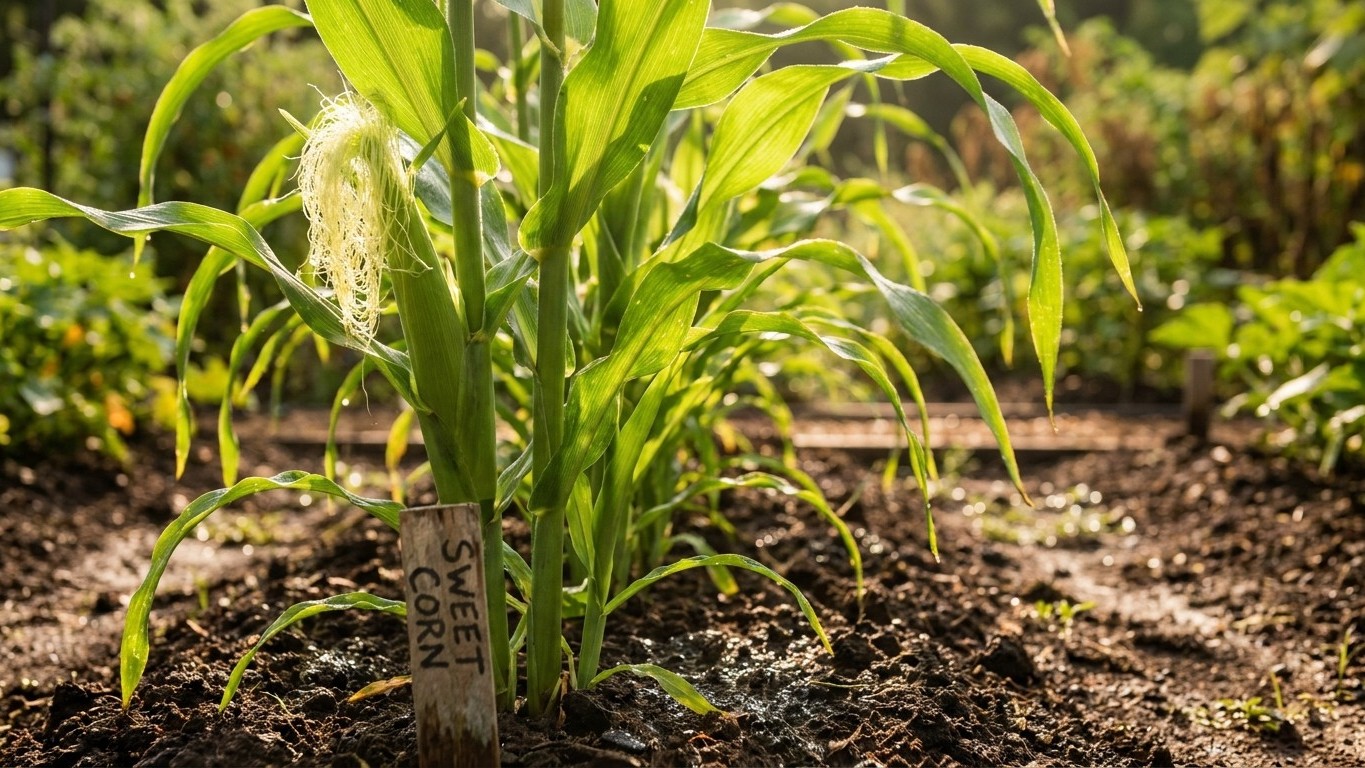

Yes, sweet corn ripens in lowland Hawaii, but not because of a spring-to-fall frost calendar. There isn’t one. Lowland Hawaii records zero freeze days a year, so the two dates that anchor a mainland planting guide, last spring frost and first fall frost, don’t exist here. What decides whether an ear fills out sweet and full is soil warmth, the variety’s day count, and what tassels alongside it in the row.
The short answer
Sweet corn germinates reliably once soil holds above 60 F, and on the mainland that threshold usually lands weeks after the last frost date, sometimes a full month later in cold clay ground. In lowland Hawaii, that lag effectively disappears. NOAA’s 1991-2020 climate normals for the reference station show zero days a year at or below 32 F, with freeze percentiles that couldn’t even be computed because there was nothing to measure. No spring cold snap means no cold soil to wait out. Ground at sea level and on leeward slopes stays warm through what a mainland calendar would call winter, so the 60 F threshold isn’t a date circled on the wall here. It’s closer to a baseline condition than a milestone.
The second half of the question, whether 60 to 90 days of growing time fits before autumn shuts things down, answers itself the same way. The same NOAA dataset shows no measurable freeze at the end of the year either, so there’s no first-fall-frost deadline forcing an early harvest. A 60-day variety and a 90-day variety are both working against a season that, from a pure temperature standpoint, never closes.
That doesn’t mean timing is irrelevant. It just changes what you’re timing against. Hawaii’s growing calendar runs on rainfall, elevation, and whether a garden sits windward or leeward, not on frost. A garden on a wet, windward slope faces different planting windows than one on a dry leeward flat a few miles away, even though both are frost-free. Heat becomes the stress factor a mainland grower doesn’t usually plan around this way: the reference station averages 18.7 days a year at 90 F or hotter, and that’s the figure worth watching, since sweet corn’s pollination and ear-fill both suffer when tasseling lands inside a hot stretch.
So the short answer holds. Sweet corn will ripen in Hawaii, and the frost-based planting chart printed on the back of a seed packet simply doesn’t apply here. Pick your window by soil moisture and elevation, not by circling a frost date that never comes.
Does a late variety fit here?
Whether a quick type or a long one, the frost-free calendar means neither variety gets shut out by an early autumn freeze. The real difference between them here is how much heat and rain each one has to sit through before harvest.
A 60-day variety
A quick sweet corn, harvested roughly 60 days from planting, has an easy time in Hawaii. Without a first fall frost drawing a hard line, there’s no autumn deadline to race against, and the short window means the crop spends less total time exposed to whatever stretch of the year delivers the most 90 F-plus days. For a gardener working a small leeward plot with limited irrigation, a 60-day type is the safer bet. It’s in and out before a dry spell or a heat run gets much chance to hit the tassels.
A 90-day variety
A longer, 90-day sweet corn isn’t ruled out by season length the way it would be on the mainland, where planting one might mean racing an early fall frost. That constraint doesn’t exist in lowland Hawaii. But the extra month in the ground means more days folded into whatever rainfall pattern or heat stretch the garden is riding out, and with an average of 18.7 days a year reaching 90 F or better at the reference station, a 90-day crop carries roughly half again the exposure window a 60-day crop does. It will still ripen. Just plan irrigation to carry it through, since nothing about season length will shut it down early the way frost would elsewhere.
| Criteria | 60-day variety | 90-day variety |
|---|---|---|
| Days to maturity | About 60 days from planting | About 90 days from planting |
| Blocked by fall frost? | No, none recorded | No, none recorded |
| Exposure to 90 F+ days | Lower, shorter window | Higher, longer window |
| Best fit | Small plots, limited irrigation | Larger plots with reliable water |
What goes wrong here
- Soil sown too cold. Even without a frost season, higher-elevation gardens and shaded, wet-season plots can still sit below the 60 F threshold sweet corn needs to germinate. Remedy: check soil temperature directly at planting depth before sowing rather than assuming a frost-free climate guarantees warm ground everywhere.
- A variety too late for the season. Here the risk isn’t frost, it’s heat. A longer 90-day corn strung along through the hottest stretch of the year risks tasseling right when the 18.7 annual days above 90 F cluster, and pollination suffers in that heat. Remedy: stagger plantings, or lean on the shorter 60-day type in gardens where a long hot stretch runs the growing season.
- Sweetness lost to cross-tasselling. Sweet corn’s sugar content collapses when su, se and sh2 types tassel at the same time nearby, regardless of climate. Remedy: stagger planting dates between types so they don’t tassel together, and always sow in blocks of three or more rows rather than single rows, since block planting keeps pollination reliable within the same type.
Common questions
Does Hawaii have a frost date for planting sweet corn? No. NOAA’s climate normals for the reference station show zero freeze days a year, with freeze percentiles that couldn’t even be computed. Lowland gardens have no last spring frost and no first fall frost to plan around.
When does soil reach 60 F in Hawaii? No specific date is published for this. Given the absence of any recorded freeze, lowland soil doesn’t face the cold snaps that delay mainland planting, so the practical move is to check soil temperature directly at planting depth rather than rely on a calendar date.
Why do heat and rainfall matter more than frost here? Because there’s nothing else left to limit the season. With zero measured freeze days at either end of the year, the reference station’s average of 18.7 days a year at 90 F or hotter becomes the main stress factor, alongside rainfall and whether a garden sits windward or leeward.
How do I keep sweet corn sweet when growing more than one type? Time plantings so the different types don’t tassel at the same time, and grow each type in its own block of three or more rows rather than scattered single rows. No isolation distance is published for this; the deciding factor is timing, not spacing.