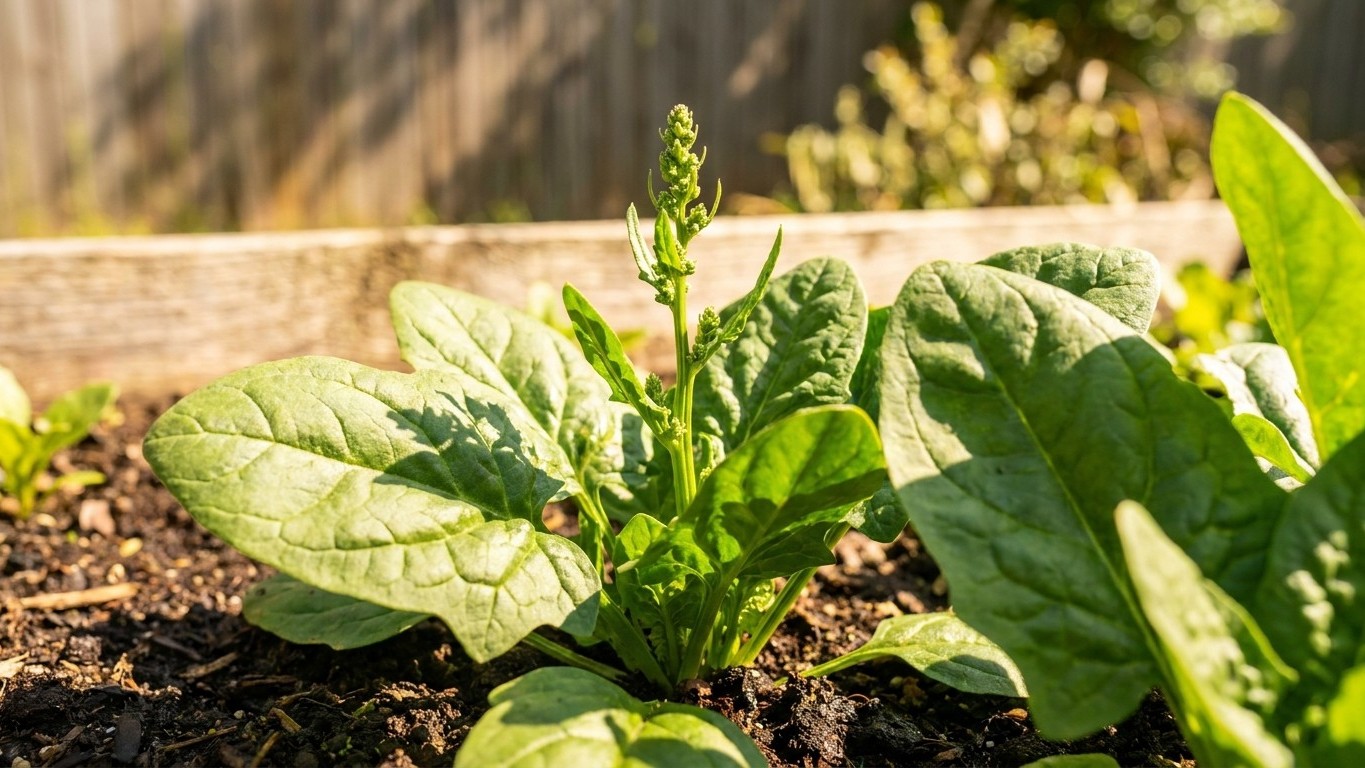

Yes, spinach bolts early almost everywhere in Kentucky, and the reason isn’t purely the calendar. Louisville logs 14 hours and 39 minutes of daylight on the longest day of the year, and that alone starts pushing spinach toward flowering. Add an average of 37.2 days a year at or above 90 degrees, and the plant is being squeezed from two directions at once. Spring and fall each open a narrow gap, and gardeners who plant a week off either end usually watch the crop bolt before the basket fills.
The short answer
Spinach flowers, or “bolts,” in response to two separate signals, and it’s worth separating them before blaming the weather for everything. The first signal is day length. As days stretch out heading into summer, spinach reads that lengthening light as a cue to stop making leaves and start making a seed stalk. The second signal is heat. Spinach grows best where temperatures stay below 75 degrees, and once that ceiling gets crossed regularly, the plant bolts and the leaves that remain turn bitter.
In Kentucky, both signals arrive, and they arrive close together. The 14 hours and 39 minutes of daylight on the summer solstice is a long day by any measure, long enough to trigger flowering in spinach on its own, independent of temperature. That’s the piece gardeners often miss: a mild June wouldn’t save the crop, because the day-length trigger doesn’t care what the thermometer says. Even a string of cool, cloudy days in late spring won’t stop bolting if the days themselves have grown long enough.
Layered on top of that is Kentucky’s heat load. An average of 37.2 days a year reach 90 degrees or higher at the Louisville reference station, and that heat typically builds fast once late spring turns to early summer. So while the day-length trigger sets the outer limit on how late spinach can be grown, the heat arrives close enough behind it that the two triggers usually overlap rather than one dragging the other out. That overlap is the practical reason the “short answer” here is both: day length closes the window from one side, heat slams it shut from the other, and in most years, spinach in Kentucky doesn’t get the luxury of only fighting one of them.
What this means for anyone planning a garden is straightforward. There’s no trick of variety selection or shade cloth that changes the day-length trigger, since that’s a fixed astronomical fact tied to latitude. What can be managed is timing: getting the crop planted early enough, and harvested fast enough, that it finishes its useful growth before the days get too long and the mercury climbs past that 75-degree mark. The next two sections work out exactly how much time that leaves, in spring and in fall.
How long the spring window really is
- Kentucky’s last spring frost, based on the 30 to 70 percent freeze probability band, falls between March 24 and April 4 at the Louisville reference station. Rural gardens away from that urban station should expect the true window to run tighter on both ends.
- Spinach seed should go in the ground 2 to 3 weeks before that last frost date, which puts the sowing window somewhere around the first three weeks of March, from roughly the start of the month to just past the third week.
- Spinach seed germinates fine in cool soil, so there’s little reason to wait. Waiting into April just eats into the usable growing period on the other end.
- Once seedlings are up, spinach grows well as long as temperatures stay under that 75-degree ceiling. April in Kentucky typically stays mostly under that mark, which gives the crop several genuinely productive weeks.
- The trouble starts as the calendar moves toward the spring equinox and beyond. Day length keeps building steadily toward that 14-hour-39-minute peak at the solstice, and that lengthening light strengthens the bolting trigger with every week that passes, regardless of how the temperature behaves.
- By the time both triggers, long days and rising heat, line up in late spring, most home plantings across the state are bolting. Counting from an early-March sowing to that point, the realistic spring cropping window in Kentucky runs somewhere around two months, roughly early March into early May, before the plants run to seed.
That’s a tight window compared to states farther north, not because Kentucky summers are cooler or warmer in some special way, but because the last frost arrives relatively early here and the heat and long days arrive close behind it. Gardeners who treat spinach as a one-shot spring crop and plant late are the ones most likely to end up with a bolted patch instead of a harvest.
The autumn crop, and when the soil lets you sow
A fall planting dodges the day-length problem almost entirely, since days are shortening rather than lengthening after the summer solstice. But autumn brings its own pair of obstacles, and they sit at opposite ends of the season.
Soil that’s still too warm to germinate
Spinach seed germination drops sharply once soil temperatures climb above 80 degrees. In a state that averages 37.2 days a year at 90 degrees or hotter, soil in July and August routinely holds well past that 80-degree mark, and it doesn’t cool off the moment the air temperature does. That’s the reason fall spinach can’t simply be sown “whenever it feels like fall.” The soil has to actually drop below that threshold first, which in a hot Kentucky summer often doesn’t happen until deeper into August or into September. Gardeners who check soil temperature directly, rather than going by the date on a calendar, avoid wasting seed on a bed that’s still too warm to sprout it.
The frost that ends the season
Kentucky’s first fall frost, again in that 30 to 70 percent probability band from the same NOAA climate normals, arrives between November 2 and November 12 at the reference station, with rural areas typically seeing it arrive somewhat earlier. That frost date is the hard backstop for how late a fall crop can run.
Working backward from a harvest target around that early-November frost, and using the 50 to 75 day window Utah State University Extension gives for planting ahead of a desired harvest date, sowing should happen somewhere between mid-August and mid-September. That range only works, though, once the soil has actually cooled below 80 degrees, which is why the two obstacles have to be checked together rather than one at a time: sow too early and the seed sits in soil too warm to sprout, sow too late and the frost cuts the harvest short before the crop matures. Four spinach varieties commonly discussed for this kind of planting are Bloomsdale, Melody, Teton, and Olympia, though specific maturity data for each isn’t published in the source used for this article.
Common questions
Does shade cloth stop spinach from bolting in Kentucky?
Shade cloth can lower soil and leaf temperature somewhat, which helps with the heat side of bolting, but it does nothing about day length. Since Kentucky’s long summer days trigger flowering on their own, shade alone won’t hold off bolting once the daylight hours climb high enough.
Is a cool, rainy spring enough to extend the spinach harvest?
Not reliably. A mild stretch of weather helps with the heat trigger, but the day-length trigger keeps building regardless of temperature. Once the days get long enough, bolting tends to start even in a cool season.
Why does bolted spinach taste bitter?
The same 75-degree threshold that marks the growth ceiling for spinach also marks the point where leaves turn bitter. Once the plant shifts energy toward the seed stalk, the leaves that remain are past their best quality regardless of appearance.
Should rural Kentucky gardeners use the Louisville frost dates directly?
Use them as a starting reference, not a fixed rule. The reference station’s own data notes that it runs later in spring and earlier in fall than the surrounding rural county, so gardens outside the immediate Louisville area should plan for a somewhat tighter frost-free window on both ends.