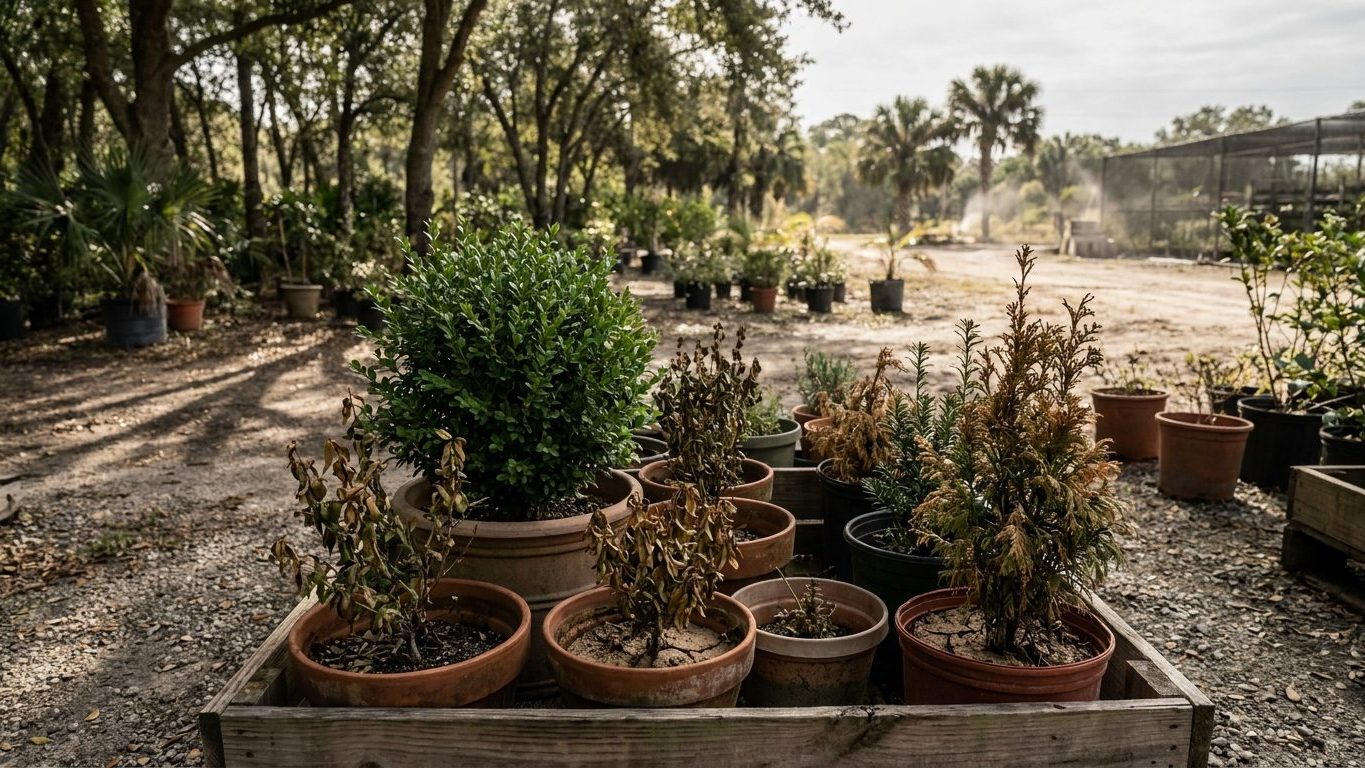

All 12 hedge species documented for Kentucky survive winter across the whole state, which runs from zone 6a to 7a on the USDA map. None of them fails on cold. The mistakes show up later, with a pair of shears: three of the twelve can never be cut back to size once they outgrow their spot, so one hard cut is permanent. And “survives” is a lower bar than “thrives.”
What actually holds in Kentucky
Twelve for twelve, and why that is not the whole answer
The USDA Plant Hardiness Zone Map (2023 edition, built on 1991-2020 normals) rates Kentucky 6a to 7a. Set each species’ documented hardiness range against that band and the result is lopsided: 12 hold across the entire state, none hold in only part of it, and none fail everywhere. Boxwood, American hornbeam, Leyland cypress, inkberry holly, winterberry holly, eastern red cedar, privet, cherry laurel, yew, arborvitae, eastern hemlock and arrowwood viburnum all clear the bar.
Read that carefully, though. The USDA zone rests on a single variable, the average annual extreme minimum temperature. It says nothing about a July heat wave, a wet spring, or a summer without rain. The upper end of a plant’s range is often a heat limit rather than a cold one, and a plant can sit inside the zone on paper while looking tired every August. “Holds” here means it lives through a Kentucky winter. It does not promise a good-looking hedge.
Kentucky is also a range, not one number. A garden in 6a and one in 7a will not behave identically, and the state’s dataset does not carve up which counties fall where. Check your own zone on the USDA map before leaning on any single plant.
What the calendar says for this fall
Louisville is the reference city for the frost dates here, and it is one city, not the state. NOAA NCEI’s 1991-2020 normals put the last spring freeze (32°F, in the 30 to 70 percent probability band) between March 24 and April 4. The first fall freeze lands between November 2 and November 12. As of late September, that leaves roughly five weeks before the earliest of those dates.
Rural gardens should expect a tighter window. The Louisville station is urban, and NWS Louisville has warned that it runs later in spring and earlier in fall than the surrounding rural part of Jefferson County. Plan on a somewhat earlier first freeze than the dates above if you garden outside town. For plants that leaf out early, such as privet, that same urban-versus-rural gap works the other way in spring: a rural yard can catch a freeze after the town has stopped getting them.
The hedges you can never cut back down
Three of the twelve have a trait that matters more than any hardiness number. Leyland cypress, eastern red cedar and arborvitae do not regrow from old wood. Cut into the bare, brown interior of one of these and it does not send out new green. The gap stays. A hedge you let grow too tall is a hedge you are stuck with at that height, or one you must replace.
Leyland cypress is the sharpest example. It adds 3 to 4 feet a year and heads for 15 to 25 feet as a screen, so a row planted along a property line can outpace anyone’s plan for it within a few seasons. Pruning runs from late spring to midsummer, and it has to stay ahead of the growth. Once a Leyland is 20 feet tall and brown at the base, no trim brings it back down.
Eastern red cedar grows 12 to 24 inches a year and reaches 8 to 20 feet as a screen. The recommended pruning is late winter, light cuts only, and the “light” is not a suggestion. Arborvitae is slower, at 6 to 9 inches a year, and stays in the 4 to 15 foot range as a hedge. It takes pruning in late winter before growth starts, or in midsummer. Both windows are for shaping tips, not for reducing size. Buy arborvitae for the height you want in ten years, not the height on the tag today.
The other nine forgive you. Boxwood, American hornbeam, inkberry, winterberry, privet, cherry laurel, yew, eastern hemlock and arrowwood viburnum all regrow from old wood. If one gets away from you, a hard renovation cut costs a season of looks but not the plant. Two of them come with a caveat: hemlock is on a light-cuts-only schedule (late spring) despite regrowing, and privet wants trimming twice a season, in spring and midsummer, to stay tight. Regrowing from old wood is a safety net, not a license to skip the schedule.
That single field, regrows or does not, should decide a lot of purchases. A gardener who trims once a year with a hand tool and hates maintenance is better served by a species that forgives a missed season. A gardener who wants a fast wall of green and will keep pace with it can use the fast growers, knowing the ceiling.
Matching the plant to the job
Hedges get bought for a job: privacy, a low formal edge, winter color, a windbreak. The table below sets all twelve on the same terms so the job can drive the choice.
| Plant | Height as hedge | Growth a year | Regrows from old wood | When to prune |
|---|---|---|---|---|
| Boxwood | 2 to 6 feet | 3 to 6 inches | Yes | Late spring, after the last frost |
| Yew | 3 to 8 feet | 6 to 12 inches | Yes | Late spring, after new growth hardens |
| Inkberry holly (evergreen) | 5 to 15 feet | 6 to 12 inches | Yes | Late winter, while dormant |
| Winterberry holly (loses its leaves) | 5 to 15 feet | 6 to 12 inches | Yes | Late winter, while dormant |
| Privet | 4 to 12 feet | 2 to 3 feet | Yes | Twice a season, spring and midsummer |
| Cherry laurel | 6 to 15 feet | 1 to 2 feet | Yes | Late spring, after flowering |
| American hornbeam | 6 to 15 feet | 12 inches | Yes | Midsummer, after the first flush |
| Arrowwood viburnum | 6 to 10 feet | 12 to 24 inches | Yes | Right after flowering |
| Eastern hemlock | 10 to 20 feet | 12 to 24 inches | Yes | Late spring, light cuts only |
| Arborvitae | 4 to 15 feet | 6 to 9 inches | No | Late winter before growth, or midsummer |
| Eastern red cedar | 8 to 20 feet (screen) | 12 to 24 inches | No | Late winter, light cuts only |
| Leyland cypress | 15 to 25 feet (screen) | 3 to 4 feet | No | Late spring to midsummer |
For a low, formal edge, boxwood and yew are the ones in the 2 to 8 foot range. Boxwood is the slowest of the twelve at 3 to 6 inches a year, so a hedge of it is a long project measured in years. Yew grows twice as fast and tops out taller.
For fast privacy, privet at 2 to 3 feet a year fills in quickest among the ones that regrow, and it pays for that speed with two trims a season. Leyland is faster still but carries the no-cut-back penalty. American hornbeam, at about 12 inches a year, sits in the middle and reaches 6 to 15 feet.
For winter, read the labels closely. Inkberry holly is evergreen. Winterberry holly loses its leaves, so it will not screen a neighbor’s window in January. Both are pruned in late winter, while dormant, which is a job you can do on a mild February day when little else in the garden needs you.
Tall screens of 10 feet or more come down to eastern hemlock, eastern red cedar, Leyland cypress, or cherry laurel at the upper end. Of those, hemlock is the one that regrows, and it takes light cuts only.
The ground you are planting into
Kentucky’s official state soil, named by law in 1990, is the Crider series, an Alfisol: a forest soil of moderate fertility that holds nutrients reasonably well. USDA NRCS records its surface horizon at a pH of about 6.2 (slightly acid), with 5 percent sand, 19 percent clay and 76 percent silt, and about 3.0 percent organic matter. It is well drained. Those figures are representative values across 255 mapped components, queried in August 2026.
Treat that as a portrait of the state’s tendency, not of your yard. A silty loam like this drains well yet still holds nutrients, which is the friendly end of the spectrum for a hedge row. Silt-heavy ground can crust or compact under foot traffic and heavy equipment, so keep machines off a planting line before you dig. The pH near 6.2 sits close to neutral, and a slightly acid surface suits most of the twelve species without amending.
Plenty of Kentucky gardens will not look like this. River bottoms, hill country and any lot a builder has scraped or filled will behave differently, and a new subdivision often sits on subsoil with little of the organic matter above. The 3.0 percent figure describes the mapped surface layer, not a worked garden bed, and the pH is not your pH.
The number that matters is the one from your own soil. The University of Kentucky Cooperative Extension Service (extension.ca.uky.edu) is the state’s land-grant extension, and county offices handle soil testing. Test before you plant a whole row, because a hedge is a commitment you make once, and the roots go into whatever is actually there. If you garden across the Ohio River in the neighboring states, the same lens applies: see Hedge Plants for West Virginia: What Holds, and What Only Looks Hardy and Hedge Plants for Tennessee: What Holds, and What Only Looks Hardy for how the same species sort out under different zones. For the wider picture, start at Hedges.
Common questions
Will any of these hedge plants die from a Kentucky winter?
Not on cold alone. All 12 documented species hold across the full 6a to 7a range. The realistic risks are heat, poor drainage and pruning mistakes, none of which the USDA zone captures.
Can I plant a hedge this fall?
Late September leaves time. The first fall freeze at the Louisville reference station arrives between November 2 and November 12, and rural gardens should expect it a bit sooner. Water new plantings through dry spells and test the soil first.
Which hedge can I cut back hard if it gets too big?
Nine of the twelve regrow from old wood: boxwood, American hornbeam, inkberry, winterberry, privet, cherry laurel, yew, eastern hemlock and arrowwood viburnum. Leyland cypress, eastern red cedar and arborvitae do not, so a hard cut leaves permanent bare patches.
Is there a Kentucky frost date I can rely on statewide?
No. The dates here (last spring freeze March 24 to April 4, first fall freeze November 2 to November 12) come from NOAA NCEI’s 1991-2020 normals for the Louisville station, and that station runs later in spring and earlier in fall than nearby rural land. A figure for your own county is not published in this dataset, so your local extension office is the place to ask.