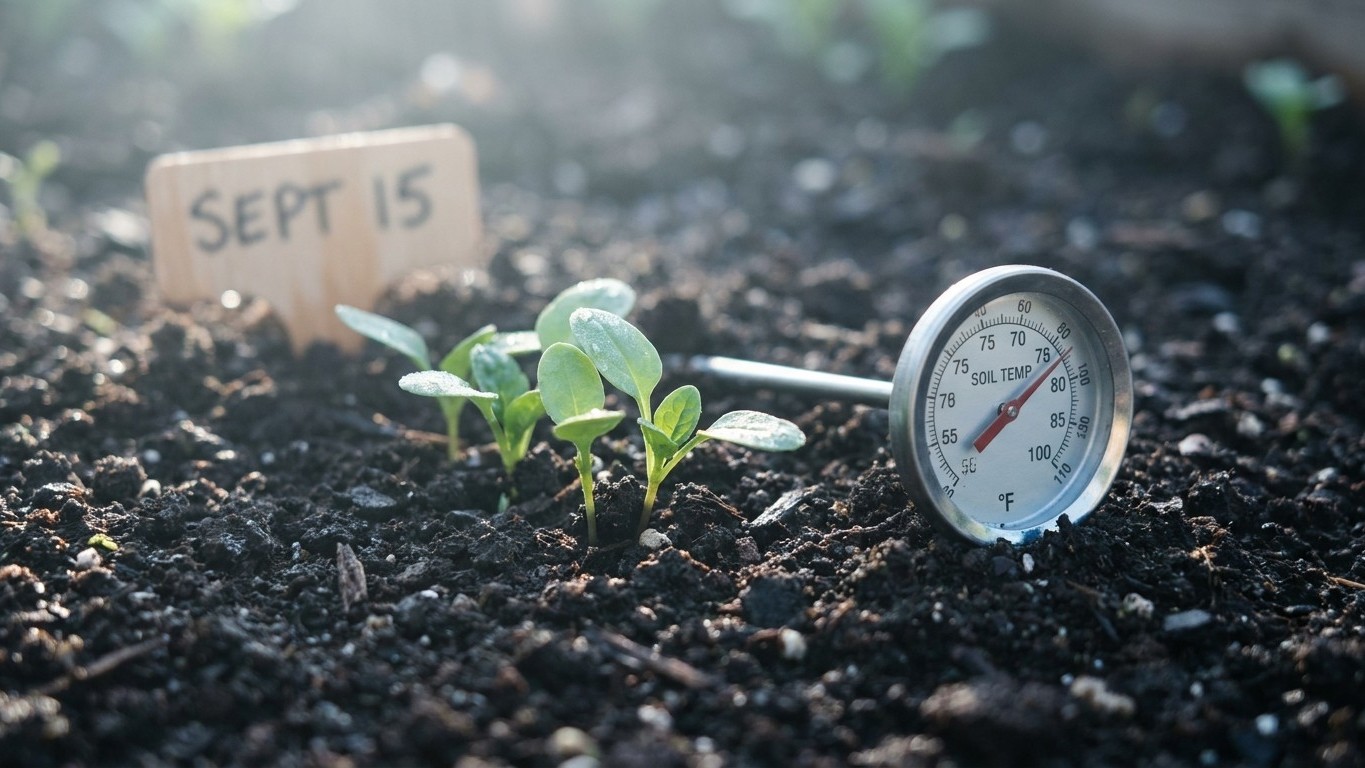

Sow Autumn Spinach in Michigan between mid-August and early September, counting back 50 to 75 days from the harvest you’re aiming for, before the first fall frost hits between October 6 and October 21 in zone 6a. The real gatekeeper isn’t the calendar. It’s soil temperature. Push seed into ground still running above 80 F and germination stalls before it starts. Wait too long and the frost closes the window before the leaves size up.
The short answer
Michigan’s reference city sees 15 hours and 5 minutes of daylight on the longest day of the year. That’s a lot of light, and for spinach that’s a problem, not a bonus. Flowering in this crop is triggered by long days working together with warmth, so a mild Michigan summer doesn’t buy extra growing weeks just because the air feels tolerable. The day length alone does the work of pushing the plant toward seed once June rolls in, regardless of how the thermometer reads that week.
Heat piles on top of that. The reference station near Detroit averages 10.3 days a year at 90 F or hotter. That’s a modest heat load compared to the Deep South, but spinach doesn’t need extreme heat to suffer. Its growth ceiling sits at 75 F, and once temperatures climb past that mark the leaves turn bitter even before the plant visibly bolts. Michigan crosses that 75 F line regularly through the warm months, and those 10-ish days a year in the 90s just make the bitterness sharper on top of an already-closing window.
So the limit here is both mechanisms working at once. Long daylight forces the plant toward flowering on its own schedule, and the accompanying summer heat degrades leaf quality along the same timeline. Neither one alone would be devastating. Together, they turn spinach into a crop that has to dodge the middle of the growing season entirely rather than simply slow down through it.
That’s why gardeners in this state don’t treat spinach as a season-long planting the way they might treat lettuce mixes or chard. It goes in early, while day length is still short enough and soil still cool enough to keep the plant vegetative. It comes out well before the solstice pushes daylight past the point where bolting becomes inevitable. Then the garden goes spinach-free through the hottest, longest-day stretch of summer, and a second sowing goes in later, timed so it matures as days shorten again and the heat load eases going into October.
Understanding that two-part mechanism, day length forcing the flower and heat degrading the leaf, is what makes the rest of the timing make sense. Every date that follows, spring or fall, is really just an attempt to keep the plant on the cool, short-day side of that line for as long as possible.
How long the spring window really is
- Start with the last spring frost date. In the Detroit area that lands around April 30; across most of the Lower Peninsula it runs early to mid-May. Spinach seed goes in 2 to 3 weeks before that date, which puts sowing in early-to-mid April for southern Michigan and a bit later, into mid-to-late April, farther north.
- From sowing, spinach gets roughly six to eight weeks of genuinely good growth while soil is still cool and daylight hasn’t yet stretched toward its summer peak. This is the productive core of the spring crop, and it’s short by design, not by neglect.
- As daylight climbs toward the summer solstice’s 15-hour-5-minute peak, the plant starts bolting regardless of how the soil temperature reads that day. Day length is doing that work on its own schedule, and no amount of watering or shade cloth reverses it once the trigger has been crossed.
- Add it up and the usable spring window in Michigan runs about eight weeks, from early April sowing to a last harvest somewhere around late May or early June. After that, the plant is turning to seed and any leaves left on it are heading past the 75 F bitterness threshold even on cooler days.
Eight weeks isn’t a long run compared to crops that tolerate a wide temperature range. It’s enough for a full harvest if the sowing date is respected, but it leaves no room for a delayed planting to still finish before the daylight forces the issue.
The autumn crop, and when the soil lets you sow
The fall planting solves the day-length problem automatically, since sowing happens after the solstice, when daylight is already shortening rather than building toward a bolting trigger. What it doesn’t solve on its own is soil heat, and that’s the obstacle that actually decides the sowing date in Michigan.
Soil too warm to germinate
Spinach seed germinates poorly once soil temperature climbs above 80 F, according to Utah State University Extension. Michigan air temperatures may only hit 90 F on about 10.3 days a year at the reference station, but soil near the surface runs hotter than the air above it through a full sunny July, and it stays in that 80-plus range for weeks even after the hottest air days have passed. Sowing spinach into that warm soil isn’t a matter of slower germination. Much of the seed simply won’t come up at all. The practical fix is to wait until soil has cooled, which in Michigan usually means mid-to-late August rather than trying for an early-August or late-July sowing on the calendar alone.
The frost that ends the season
First fall frost in Michigan’s zone 6a arrives somewhere between October 6 and October 21, according to MSU Extension’s garden calendar. Counting back 50 to 75 days from that range gives a sowing window stretching from late July through early September, depending on which end of the frost range applies and how close to frost the gardener is willing to harvest. Lay that math over the soil-temperature constraint, though, and the realistic window narrows: sowing before mid-August risks poor germination in still-warm soil, while sowing after the first days of September leaves too little time to reach 50 days of growth before frost even under the later, October 21 date. That puts the dependable autumn sowing window for most of Michigan at mid-August through the first few days of September.
Common varieties available to home gardeners include Bloomsdale, Melody, Teton, and Olympia. The source behind these figures publishes no days-to-maturity or bolting-resistance data for any of them, so choosing between them comes down to availability and personal preference rather than a documented performance gap.
Common questions
Can spinach survive a light fall frost in Michigan?
The figures here cover the first fall frost date for zone 6a, October 6 to October 21, as published by MSU Extension. No separate light-frost or hard-freeze threshold is provided in that source, so treat the October date as the point the season closes rather than assuming an extra buffer beyond it.
Why does a cool Michigan summer not stretch the spring harvest longer?
Because bolting in spinach is triggered by long daylight together with warmth, not by heat alone. Once daylight approaches the summer solstice peak of 15 hours 5 minutes at the reference city, the plant moves toward flowering regardless of how mild that particular week feels.
Is the fall sowing date about avoiding cold or avoiding heat?
Heat. The obstacle blocking an earlier fall sowing is soil running above 80 F, which reduces germination according to Utah State University Extension. Cold only becomes relevant later, when the first fall frost sets the outer edge of how much growing time is left.
How many days does spinach need to mature for a fall harvest?
The source behind these figures doesn’t publish a fixed days-to-maturity number for spinach. Instead it gives a planting rule: sow 50 to 75 days before the date you want to harvest, which is the figure used to work out Michigan’s mid-August-to-early-September window.