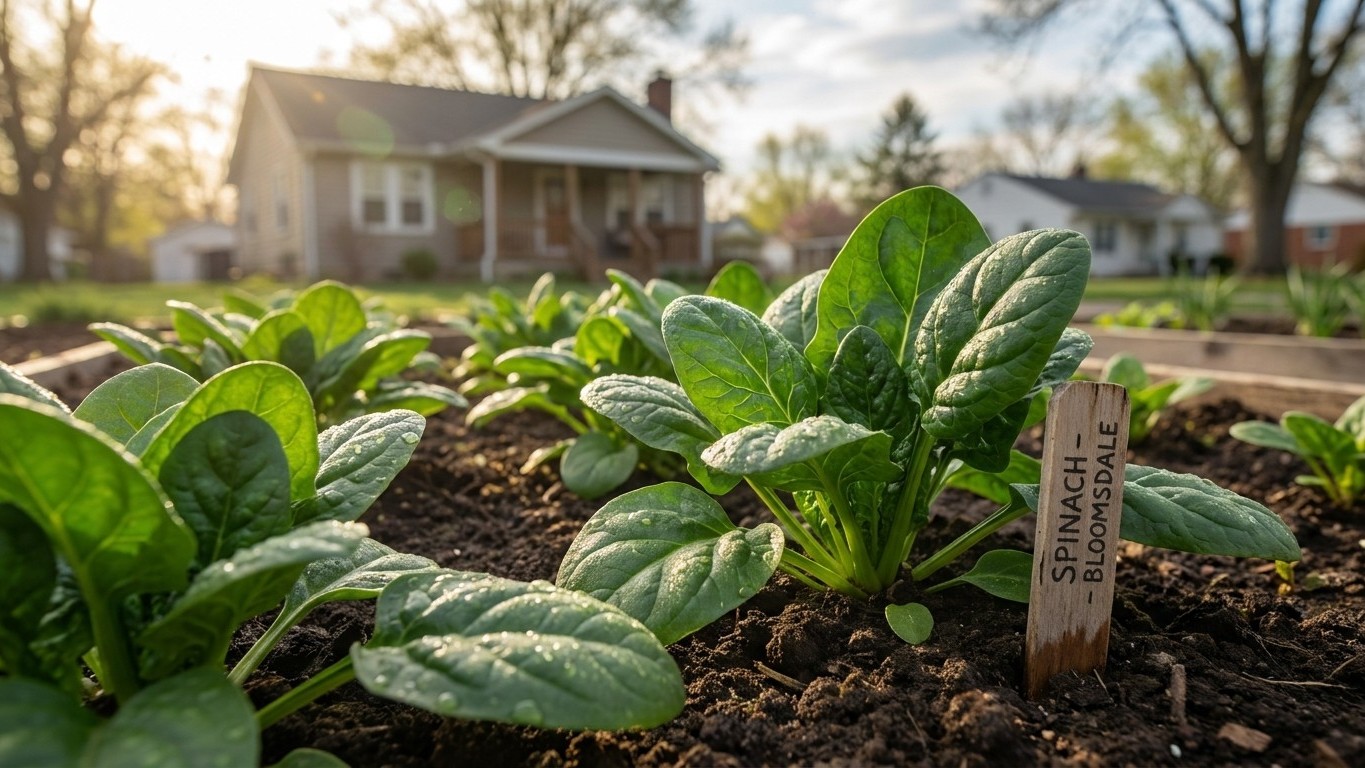

Spinach sown in Michigan in spring typically bolts by early-to-mid June, once day length near the solstice combines with the season’s first real heat. A fall crop, sown as days shorten in late summer, almost never bolts at all. The trigger isn’t the calendar, it’s the light and the thermometer working together, and Michigan’s long summer days make that trigger fire earlier than most gardeners expect, which raises the question Will Spinach Bolt Early in Michigan?
The short answer
At the reference city near Detroit, the longest day of the year delivers 15 hours and 5 minutes of daylight. That’s a lot of light, and it matters more than most people realize for a crop like spinach. Long days push spinach toward flowering, full stop. It doesn’t matter how mild the temperature stays outside if the days keep stretching toward that June peak. So the idea that a cool Michigan summer might buy an extra week or two of harvest doesn’t hold up. The day length does its work on its own schedule, regardless of what the thermometer says.
That’s the part gardeners moving here from farther south sometimes miss. In a shorter-summer climate, the flowering trigger can lag behind the heat. In Michigan, with daylight climbing past 15 hours around the solstice, the light alone is enough to start pushing spinach toward seed stalks even in years with a mild June.
Heat still plays a role, just a smaller one here than it would in, say, the Deep South. Michigan averages only 10.3 days a year at 90 degrees Fahrenheit or hotter, measured at the Detroit reference station. That’s a modest heat load compared to warmer states, and it means Michigan gardeners aren’t fighting brutal early-summer heat waves the way growers farther south are. Spinach grows best where temperatures stay under 75 degrees, and above that ceiling the leaves turn bitter even before the plant fully bolts.
So which one actually ends the spring crop here, day length or heat? Mostly day length, with heat arriving right on cue to finish the job. As June days lengthen toward their peak, average temperatures in southern Michigan also climb toward and past that 75-degree mark, so the two pressures land at almost the same time. Farther north, where the growing season starts later, the same daylight ceiling still applies, since day length at the solstice barely changes across the state’s latitude spread, but the heat arrives a bit later in the calendar.
Seed catalogs list spinach varieties such as Bloomsdale, Melody, Teton, and Olympia, and gardeners often ask whether one of these resists bolting better than another in Michigan’s long summer days. There’s no published maturity or bolt-resistance data tying these varieties to Michigan conditions, so no variety claim here is backed by anything more than the seed packet. Given how unreliable the spring crop can be, many gardeners instead look to When to Sow Autumn Spinach in Michigan as a more dependable strategy.
How long the spring window really is
Working out the real spring window means starting from the frost date and working forward, then checking where that lands against the day-length trigger.
- Start with the last spring frost. In the Detroit area, that’s around April 30. Across most of the Lower Peninsula, it runs early to mid-May, according to MSU Extension.
- Sow spinach seed two to three weeks before that date. For the Detroit area, that puts sowing around April 9 to April 16. Elsewhere in the Lower Peninsula, sowing shifts to roughly late April.
- Early growth happens while the soil and air are still cool, which is exactly the range spinach prefers, well under the 75-degree ceiling that later becomes a problem.
- The favorable stretch holds through most of May, since Michigan’s spring temperatures rarely push past 75 degrees before late in the month.
- By early June, day length is closing in on its June peak of 15 hours and 5 minutes, and average temperatures start brushing against that 75-degree mark. This is where bolting risk rises sharply.
- Counting from a mid-April sowing to an early-to-mid-June bolt point gives roughly seven to nine weeks of usable spring growing time before the crop turns to seed.
That window shrinks or shifts depending on where in Michigan a garden sits. Areas with a later last frost push the sowing date back, which trims the number of usable weeks before the day-length trigger arrives on its own fixed schedule, since the solstice doesn’t move even when the frost date does.
The autumn crop, and when the soil lets you sow
Fall spinach avoids the bolting problem almost entirely, because days are shortening rather than lengthening through late summer and into autumn. But two other obstacles show up instead, and they define the window just as tightly as day length defines spring.
Warm soil delays sowing
Spinach seed germinates poorly once soil temperatures climb above 80 degrees Fahrenheit, according to Utah State University Extension. Michigan’s midsummer soil, warmed by weeks of average temperatures and the occasional stretch near or above 90, routinely sits above that mark through July and much of August. Sowing too early into that warm ground means weak, spotty germination, so the practical fall window doesn’t open until the soil has cooled, typically as August moves toward its final weeks in most of the Lower Peninsula.
Autumn frost sets the finish line
The other boundary is the first fall frost, which lands between October 6 and October 21 in Michigan’s zone 6a areas, per MSU Extension’s garden calendar. Utah State University Extension’s guidance for a fall crop is to sow 50 to 75 days before the date you want to harvest. Counting back from an October 6 target harvest gives a sowing date around mid-to-late July at the 50-day mark, or late July at the 75-day mark. Counting back from an October 21 target pushes sowing into very early September at 50 days, or early August at 75 days.
Overlap those two obstacles and the realistic fall sowing window in most of Michigan sits in later August: late enough that soil has cooled past the 80-degree germination barrier, early enough to reach 50 to 75 days of growth before frost closes things down in early-to-mid October.
Checking this against your own county
Frost dates and soil warm-up shift across Michigan’s Lower and Upper Peninsulas, and the numbers above are anchored to the Detroit-area reference station, not to every county. A garden near Lake Michigan’s shoreline, in the Thumb, or up in the northern Lower Peninsula will see its own last frost, first frost, and soil warm-up curve, sometimes by two or three weeks in either direction.
Michigan State University Extension (canr.msu.edu/outreach/) maintains county-level offices and publishes localized frost-date guidance and garden calendars. Checking there before locking in a sowing date, especially for that narrow late-August fall window, is the most reliable way to translate these statewide numbers into a date that actually fits a specific county’s soil and frost pattern.
Common questions
Does shade or partial sun delay bolting in Michigan?
The bolting trigger is tied to day length and temperature, not directly to how much direct sun a bed gets. Shade doesn’t change how long the day is, so it won’t stop the flowering signal, though it may keep soil slightly cooler for longer, which can help on the heat side of the equation.
Can a second spring sowing extend the harvest?
Sowing again a week or two after the first planting stretches the harvest slightly, but every later sowing still runs into the same day-length ceiling around the June solstice. It buys a few extra harvests of young leaves rather than a longer season overall.
Is fall spinach more reliable than spring spinach in Michigan?
Generally yes, because shortening days remove the main bolting trigger entirely. The tradeoff is a narrower sowing window, since it has to land after soil cools below 80 degrees and still leave 50 to 75 days before the first frost.
Does row cover change any of these dates?
Row cover can moderate soil and air temperature slightly, which may help on the heat side of the spring equation or protect a fall crop from an early frost. It has no effect on day length, so it won’t delay the spring bolting trigger tied to the June solstice.