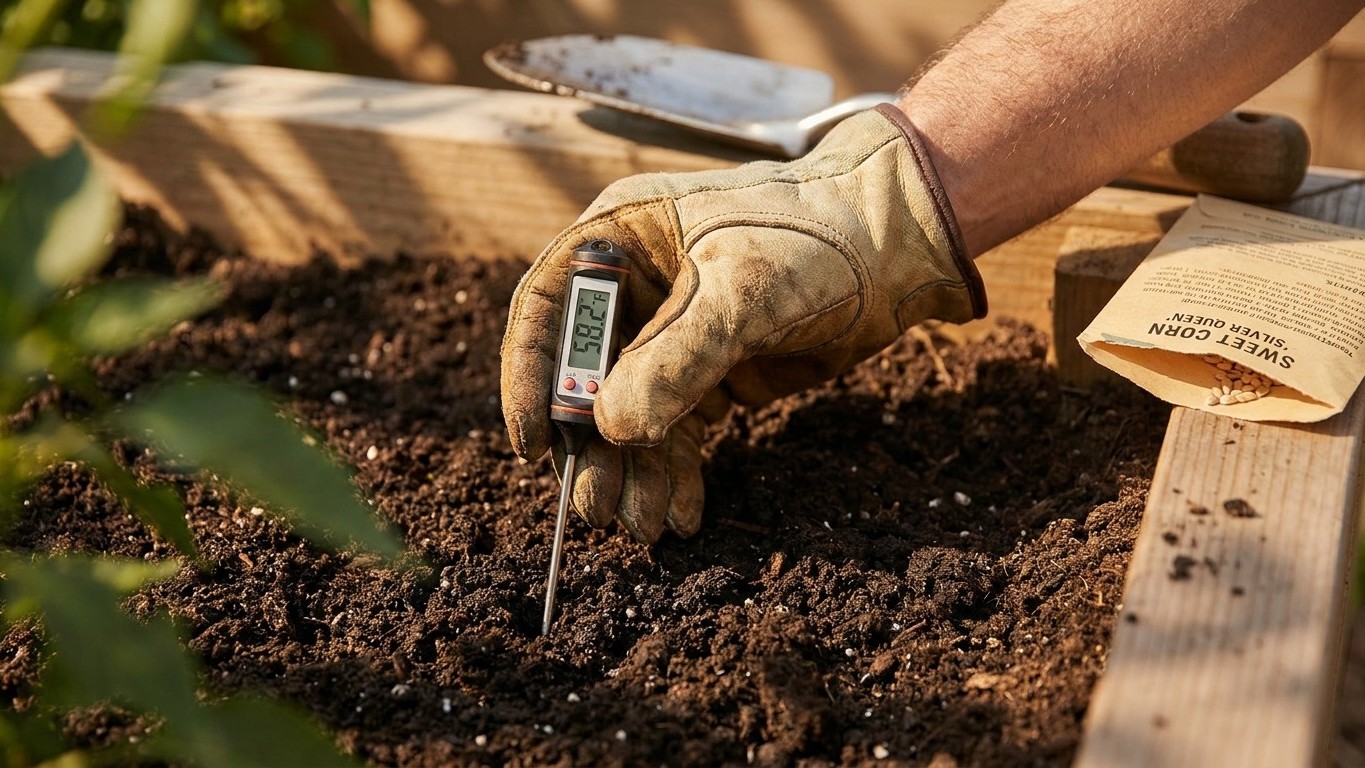

Soil has to clear 60°F before sweet corn seed goes in the ground, and that threshold lands well after the last spring frost, not on the same week. At the reference station used for climate normals here, that frost window runs March 6 to March 22, but real planting typically waits into April once the soil has had time to warm. From there, the 60 to 90 days sweet corn needs fits comfortably before the first fall frost, November 7 to November 22 at that same station.
The short answer
Air temperature and soil temperature move on different clocks, and that gap is exactly what trips people up. A morning can sit safely above freezing for a week straight while the top few inches of garden soil are still cold enough to rot a corn seed before it sprouts. NOAA’s 1991-2020 climate normals put the last spring frost at the reference station (a 30 to 70 percent probability band for 32°F) somewhere between March 6 and March 22. That date matters for tender transplants like tomatoes. For sweet corn, it’s almost beside the point, because the seed itself needs soil above 60°F to germinate reliably, and Mississippi ground doesn’t hold that temperature the same week frost risk clears.
What this means in practice: treat the frost window as the earliest boundary, not the planting date. Soil in a sunny, well-drained bed climbs into the 60s over the weeks that follow the last frost, so most Mississippi gardens land on an April sowing rather than a March one. Heavy clay soil, shaded beds, and low-lying ground all warm slower, which pushes the safe date later still. A simple soil thermometer, pushed two inches down at mid-morning for a few consecutive days, tells you more than any calendar ever will.
Does the season leave room?
Once soil crosses that 60°F line, the real question is whether 60 to 90 days of growing time fit before the first fall frost. At the reference station, that frost arrives between November 7 and November 22. Count forward from an April planting and even the slower end of the range lands the crop in early July, months ahead of any autumn cold. That gap is the reassuring part of gardening in Mississippi: the season here is long enough that a single planting date isn’t the tight squeeze it can be farther north. There’s room to stagger plantings every couple of weeks through late spring and still finish well ahead of frost, which stretches the harvest window instead of dumping the whole crop at once.
The heat load matters too. The reference station averages 71.1 days a year at or above 90°F, and that’s the number that drives water demand and stress during pollination, more than any single “average summer temperature” figure would suggest. Corn silking during the hottest stretch of July can suffer poor kernel fill even when the calendar math looks fine, so timing a planting to avoid the peak heat window is worth as much thought as clearing the soil-temperature threshold in spring.
Does a late variety fit here?
Sweet corn varieties are commonly grouped by days to maturity, and the two extremes are worth checking separately against Mississippi’s frost calendar. The source material behind this guide (Utah State University Extension) doesn’t name specific varieties, and none should be assumed here. What it does give is the maturity range itself, 60 to 90 days from planting, and that range is enough to test the fit.
A 60-day variety
A quick-maturing type planted once soil clears 60°F, likely into April for most Mississippi gardens, would be ready to pick by early-to-mid June. That leaves roughly five months of frost-free growing season still on the table before the November 7 to November 22 fall frost window closes. There’s no tightness here at all. A 60-day variety planted at the normal time, or even planted a second time in early summer for a later harvest, still finishes with margin to spare.
A 90-day variety
Run the same math on the slower end of the range. An April planting reaching maturity in 90 days lands in early July, still four months clear of the earliest fall frost date. Even a second, later sowing of a 90-day type in June would mature by early September, well ahead of frost. In short, the late-maturing end of the sweet corn range does fit Mississippi’s growing season, comfortably. That’s not true everywhere; states with a shorter frost-free window often can’t fit a 90-day type in at all without racing the calendar. Here, the limiting factor isn’t whether the season is long enough. It’s the summer heat load (that 71.1-day average above 90°F) working against pollination if a planting lands squarely in the hottest weeks.
What goes wrong here
- Soil sown too cold. Planting right after the last frost date, rather than waiting for soil to clear 60°F, is the single most common misstep. Seed sits in cold, often wet soil and rots or germinates unevenly, leaving gaps in the row. The fix is patient: check soil temperature directly with a thermometer rather than trusting the frost date alone, and wait for a run of warm days, not just one warm afternoon.
- A variety pushed past what the season allows. This isn’t Mississippi’s main risk, given how much frost-free time the region has, but it still happens with very late plantings. A 90-day variety sown in high summer, aiming for a fall harvest, needs its maturity window checked against the November frost dates for the specific county, not just the reference station. When in doubt, count forward from the actual sowing date, not from an assumed spring planting.
- Sweetness lost to the wrong neighbor. This one has nothing to do with weather. Sweet corn comes in different genetic types (commonly labeled su, se, and sh2), and if two different types tassel at the same time nearby, cross-pollination dulls the sweetness of both. Utah State University Extension’s guidance doesn’t publish a separation distance for this, so no specific number of feet should be treated as a rule here. What does matter is timing: stagger plantings so different types don’t tassel together, and grow sweet corn in blocks of three or more rows rather than a single thin line, since that block shape improves pollination regardless of the timing issue.
Common questions
Can I plant sweet corn in Mississippi in March?
Frost risk may be clearing by mid-to-late March at the reference station, but soil is rarely above 60°F that early. Planting in March usually means cold, slow, or failed germination. Waiting for the soil itself to warm, rather than the calendar date, gives a more reliable stand.
How many sweet corn plantings can I fit in one season?
Given the gap between an April start and a November frost, several staggered plantings two to three weeks apart are realistic for most Mississippi gardens. Just keep different sweet corn types from tasseling at the same time if they’re planted close together.
Does a 90-day variety mature in time here?
Yes, based on the frost dates for the reference station. Even a summer sowing of a 90-day type typically finishes well before the November 7 to November 22 frost window, unlike in regions with a shorter growing season.
Why did my corn taste starchy instead of sweet?
The most likely cause is cross-pollination between two different sweet corn types tasseling at the same time nearby, which dulls sweetness in both. It’s rarely a soil or watering issue when the plants otherwise looked healthy.