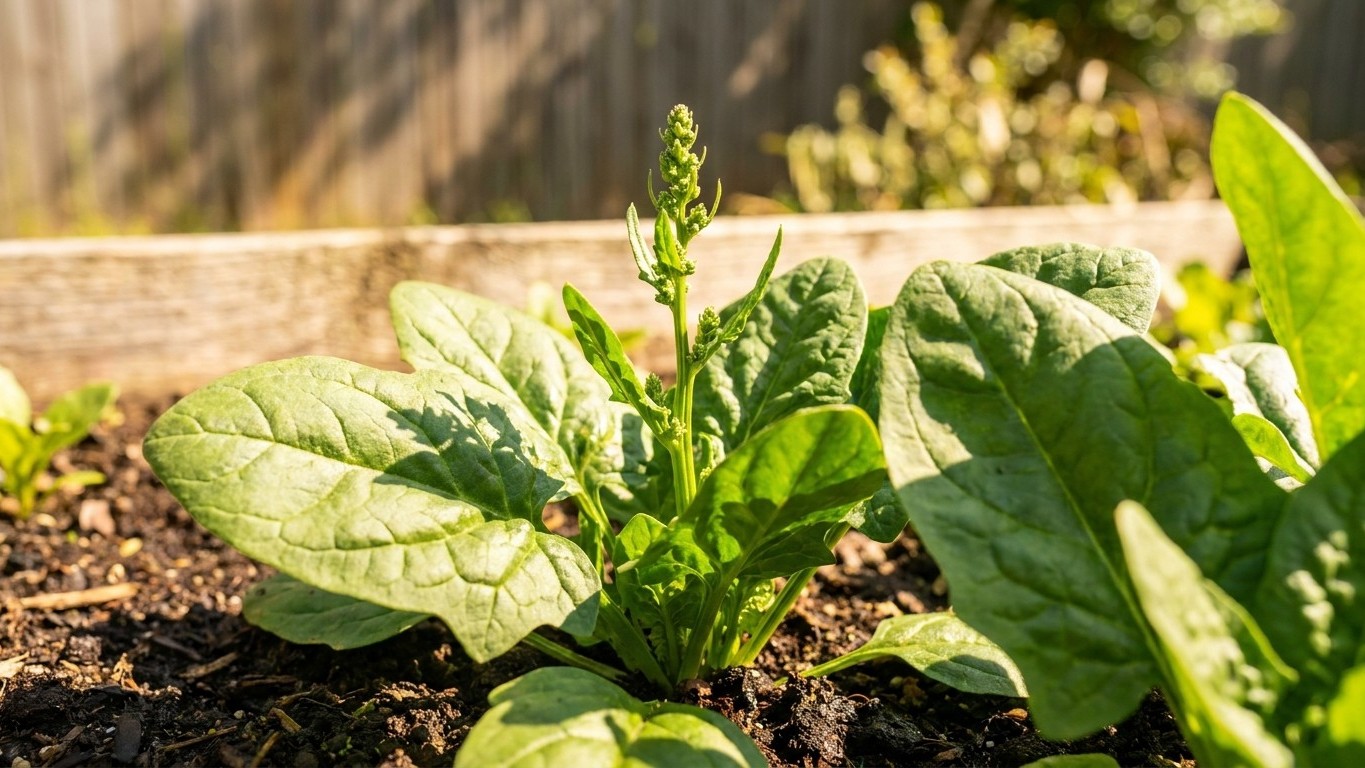

Spinach in Missouri bolts early, and the state’s climate makes that outcome almost unavoidable rather than occasional. Both the long summer daylight and the region’s heat push the plant toward flowering well before most gardeners expect it, which means the real skill here isn’t preventing bolting so much as working around a short, well-defined window in spring and a second, better one in fall.
The short answer
On the longest day of the year, Missouri gets 14 hours and 46 minutes of daylight at the reference city near Kansas City. That number matters more than most gardeners realize, because spinach doesn’t wait for heat to start flowering. It responds to day length directly. Once the days stretch out this far, the plant reads that stretch as a signal to stop making leaves and start making seed, regardless of whether the thermometer is cooperating.
That’s the part people get backwards. A cool, mild summer sounds like it should buy a spinach crop extra time. It doesn’t, not here, because the daylight itself is the trigger. Missouri’s early summer days run long enough that spinach will begin bolting on schedule even in a year with a relatively mild June. The plant isn’t measuring temperature at that point. It’s measuring hours of light, and 14 hours and 46 minutes at the peak is more than enough to flip the switch.
Layered on top of that is the heat. Spinach grows best where temperatures stay under 75 F, and Missouri averages 32.7 days a year at 90 F or hotter at the Kansas City reference station. That’s not a count of warm afternoons here and there. It’s a measure of sustained summer heat load, the kind that pushes soil and air temperatures well past the point where spinach leaves stay tender and where the plant stays vegetative. Once daytime highs settle above that 75 F ceiling, growth slows, quality drops, and the same warmth that stresses the plant also accelerates the bolting that day length already set in motion.
So the honest answer is that both mechanisms are working against a long spinach season in Missouri, not just one. Day length ends the spring crop on its own timetable, and heat makes sure there’s no cool pocket left over to stretch the harvest. The two problems don’t cancel each other out. They stack, which is why spinach here is best treated as a short-season crop grown twice a year, once in spring and once in fall, rather than something you plant once and pick all summer.
How long the spring window really is
Working out the usable spring window means starting from the frost date and working forward until either the heat or the daylight makes further growth pointless. Here’s how that plays out in Missouri.
- The last spring frost at the reference station falls between April 6 and April 20. The downtown Kansas City station tends to run about five days earlier than that, and gardens in southern Missouri are milder still, so the actual date on the ground can shift somewhat depending on exactly where you are in the state.
- Spinach seed should go in the ground two to three weeks before that last frost date, which puts sowing somewhere in the middle of March for most of the state, possibly earlier for southern counties and slightly later for spots that run cooler than the reference station.
- From that sowing date, the plant has roughly six to eight weeks of good growing conditions before the two pressures described above start to close in. That’s not a fixed number so much as an estimate built from how quickly Missouri springs warm up and how fast the days lengthen toward the June peak.
- Because spinach’s ceiling for good growth sits at 75 F, and because Missouri’s spring temperatures climb into that range by mid-to-late May in most years, the practical harvest window ends around then, sometimes sooner if a warm stretch arrives early.
- Day length is climbing the entire time too, so even a spring that stays cooler than average won’t extend the window much. The bolting trigger is working on its own schedule in the background, independent of whether the heat arrives on time.
Put together, that leaves a spring spinach season in Missouri of roughly six to eight weeks from a mid-March sowing to a harvest wrapped up by mid-to-late May. It’s a real window, but it’s a short one, and it closes from both ends at once rather than just fading out gradually.
The autumn crop, and when the soil lets you sow
Fall spinach is where Missouri gardeners usually get a better result, because the day-length pressure is running in reverse by late summer. But the fall crop has its own timing problem, and it’s not the one people expect.
Warm soil delays sowing more than the calendar suggests
Spinach seed germinates poorly once soil temperatures climb above 80 F, and Missouri’s late-summer soil holds onto heat for weeks after air temperatures start to feel like fall is coming. With an average of 32.7 days a year reaching 90 F, the ground in most Missouri counties stays too warm for reliable spinach germination well into late August, sometimes longer in a hot year. That means the fall sowing date isn’t really set by the calendar at all. It’s set by whatever week the soil actually cools down, which can vary from one growing season to the next.
Counting back from the first frost
The first fall frost at the reference station arrives between October 18 and October 29, again running about five days earlier downtown and later than that farther south. Utah State University Extension recommends sowing a fall crop 50 to 75 days before the date you want to harvest, and that guidance is the only figure available here, since no source publishes a specific days-to-maturity number for spinach.
Working backward from a realistic mid-October harvest, a 50-day plan points to sowing in late August, while the 75-day end of that range points to early August. The catch is that early August sowing runs straight into the soil-temperature problem above, so in practice most Missouri gardens end up leaning toward the shorter end of that window, sowing in late August or even early September once the ground has actually cooled, and accepting a harvest that lands closer to the first frost date than to 75 days out. Varieties named in the source material for cool-season planting include Bloomsdale, Melody, Teton, and Olympia, though no performance or timing data is published for any of them specifically.
Common questions
Can I just plant a bolt-resistant spinach variety and skip all this timing?
The available guidance names varieties suited to cool-season growing, including Bloomsdale, Melody, Teton, and Olympia, but no data on bolt resistance or maturity timing is published for any of them. Variety choice may help at the margins, but it doesn’t change the underlying day-length and heat mechanisms driving bolting in Missouri.
Why does a mild summer not save my spring spinach?
Because bolting is triggered by day length as well as by heat. Once Missouri’s daylight reaches its long-day peak of 14 hours and 46 minutes near the June solstice, spinach starts flowering on that signal alone, regardless of whether the temperature stays comfortable.
Is it the heat or the daylight that ends the spring crop first?
Both arrive on similar timing in Missouri. Daytime highs tend to push past the 75 F growth ceiling around the same weeks that day length is climbing toward its peak, so the two pressures close the window from both directions rather than one clearly acting before the other.
Why can’t I just sow the fall crop earlier to get a bigger harvest?
Soil temperatures above 80 F reduce germination, and Missouri soil commonly stays that warm well into late August given the state’s average of 32.7 days a year at 90 F or hotter. Sowing too early simply means poor germination, not a longer season.