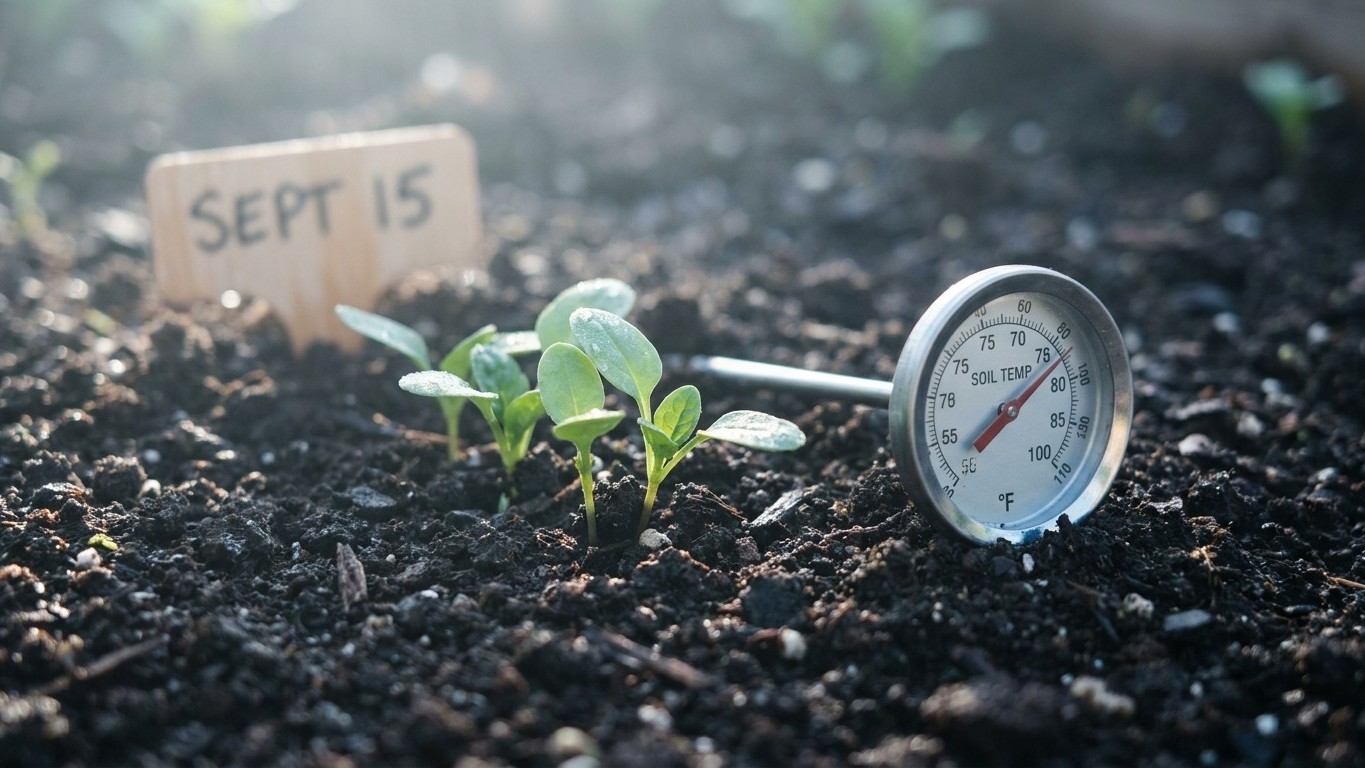

In Missouri, the practical sowing window for fall spinach runs from early August into early September, timed by counting back 50 to 75 days from the first fall frost, which arrives statewide between October 18 and October 29. The catch: soil often stays too warm for spinach seed to germinate well through most of August, so the calendar math and the thermometer don’t always agree. Get the soil right, and there’s still a solid stretch of cool-season growing ahead of the first freeze.
The short answer
On the longest day of the year, Missouri gets 14 hours and 46 minutes of daylight. That number matters more than most gardeners realize, because spinach bolts under long days just as reliably as it bolts under heat. A cooler-than-average summer doesn’t rescue a spinach crop sitting under 14-plus hours of daylight; the plant reads the clock, not the thermometer, and throws a seed stalk regardless of how mild the air feels. So in Missouri, the limit on spinach isn’t one thing. It’s two, working together from opposite directions.
Day length closes the spring door. Heat closes it again, from a different angle, then reopens the whole question for autumn. Spinach grows best where temperatures stay under 75°F, and that ceiling does double duty: cross it and growth turns ragged, leaves turn bitter, and the plant bolts faster than a calendar alone would predict. Missouri crosses that line with room to spare. The reference station averages 32.7 days a year at 90°F or hotter, a heat load that pushes soil and air well past spinach’s comfort zone for a solid stretch of summer.
That combination, lengthening days paired with rising heat, is why Missouri gardeners plant spinach twice instead of once. The spring crop has to finish before day length and heat converge into bolting weather. The fall crop can’t start until the soil cools enough to let seed germinate, and it has to finish before frost shuts things down. Neither window is generous, and neither runs on the same clock as the other.
None of this means spinach needs long summer days to perform, the way a bulb onion does. The relationship runs in reverse: spinach does its best work under short, mild days, and treats long daylight as a stress signal rather than a green light. That’s worth remembering if you’re used to timing onions or other long-day crops in the same garden bed, because the logic flips completely. So which pressure actually decides the picture here, day length or heat? Both, but they take turns. Day length dominates the spring cutoff, since spinach can tolerate a fair bit of heat but not a long enough run of long days. Heat dominates the fall start, since the calendar alone would allow sowing far earlier than warm soil actually permits.
How long the spring window really is
Spinach seed goes into the ground while it’s still cool, and the standard guidance is straightforward: sow two to three weeks ahead of the last expected frost. Applied to Missouri’s own numbers, that produces a narrower window than most people expect.
- Start with the frost date. NOAA’s 1991-2020 climate normals put the last spring freeze at the reference station between April 6 and April 20. Kansas City International Airport (MCI), which sits north of downtown, tends to run a touch later than in-town readings; downtown itself trends about five days earlier, and southern Missouri gardens are milder still.
- Move the sowing date back. Two to three weeks ahead of an April 6-20 frost lands sowing somewhere around mid-to-late March across most of the state, earlier still in southern counties.
- Count forward from there. Cool soil and shorter days in late March and early April favor steady germination and leaf growth, the conditions spinach actually prefers over anything hotter or brighter.
- Watch the ceiling approach. Daylight lengthens quickly through spring, and Missouri’s heat arrives early too. Afternoon temperatures routinely push past the 75°F growth ceiling well before the calendar reaches the solstice’s 14-hour-46-minute peak.
- Add it up. From a mid-to-late March sowing to the point where heat and day length together end good growth, Missouri gardeners are working with roughly six to eight usable weeks, not months, before the spring crop needs to be finished and cleared out.
That’s a tight window by vegetable-garden standards, and it explains why many Missouri gardeners treat spring spinach as a bonus crop rather than the season’s main event, saving the bulk of their harvest for autumn, when the pressure runs in exactly the opposite direction.
The autumn crop, and when the soil lets you sow
Fall spinach doesn’t answer to the same clock as the spring crop. Nothing about day length blocks an autumn planting, since days are shortening rather than lengthening as summer fades, which happens to be the direction spinach prefers. The two real obstacles here are soil temperature at the start of the season and frost at the end of it, and they act on opposite ends of the calendar.
Soil still too warm to germinate
Spinach seed struggles once soil temperatures climb above 80°F, according to Utah State University Extension, and germination rates drop off from there. Missouri soil holds onto summer heat stubbornly. With the reference station averaging 32.7 days a year at 90°F or hotter, most of them clustered in July and August, topsoil often stays too warm for reliable spinach germination well into late summer. Gardeners who sow the moment late summer arrives on the calendar frequently end up with a spotty, disappointing stand. Waiting for a run of cooler nights, watering to pull soil temperature down before sowing, or timing seed into the shaded side of a bed in early evening all help nudge germination odds back in the plant’s favor.
Counting back from the first frost
The other boundary is the first fall frost, which NOAA’s 1991-2020 climate normals place between October 18 and October 29 at the reference station, with the same MCI-versus-downtown and downtown-versus-southern-Missouri pattern shifting the date earlier or later depending on exact location. Utah State’s guidance for a fall crop is to sow 50 to 75 days before the date you want to harvest. Working backward from an October 18-29 target puts sowing somewhere between roughly the first week of August and the second week of September, depending on which end of the frost range applies and how much cushion a gardener wants ahead of the freeze.
That’s the honest range: early enough that soil heat is still the bigger risk, late enough that a slow-to-cool August pushes the safe sowing date toward September instead. Seed racks in Missouri commonly carry spinach varieties such as Bloomsdale, Melody, Teton, and Olympia, but the data behind this guide publishes no days-to-maturity figures for any of them, so treat seed-packet timelines as a supplement to the 50-to-75-day rule, not a replacement for it.
Common questions
Can spinach be sown in the middle of a Missouri summer? Not with good results. Soil above 80°F cuts germination, and Missouri regularly logs weeks of 90°F-plus days each summer, so July and much of August work against the seed before it even sprouts.
Does row cover let fall spinach survive past the first freeze? Spinach is a cool-season plant that generally tolerates some cold, but the climate data used for this guide doesn’t include a specific freeze-damage threshold for spinach, so treat row cover as reasonable insurance rather than a guaranteed fix, and watch the plants rather than a single number.
Why does spring spinach bolt so much faster than fall spinach? Spring sowing runs straight into lengthening days and rising heat at the same time, a double trigger for bolting. Fall sowing moves the opposite way, into shortening days and cooling soil, which is why the autumn crop generally holds longer before flowering becomes an issue.
Does the sowing window shift much across the state? Yes. The frost dates behind this guide come from one reference station, and the same normals note that downtown readings run about five days earlier than the airport station in spring, with southern Missouri milder again. Gardeners well south of the reference station can typically sow a bit later in spring and later still in fall, while those north of it should lean toward the earlier end of every date range here.