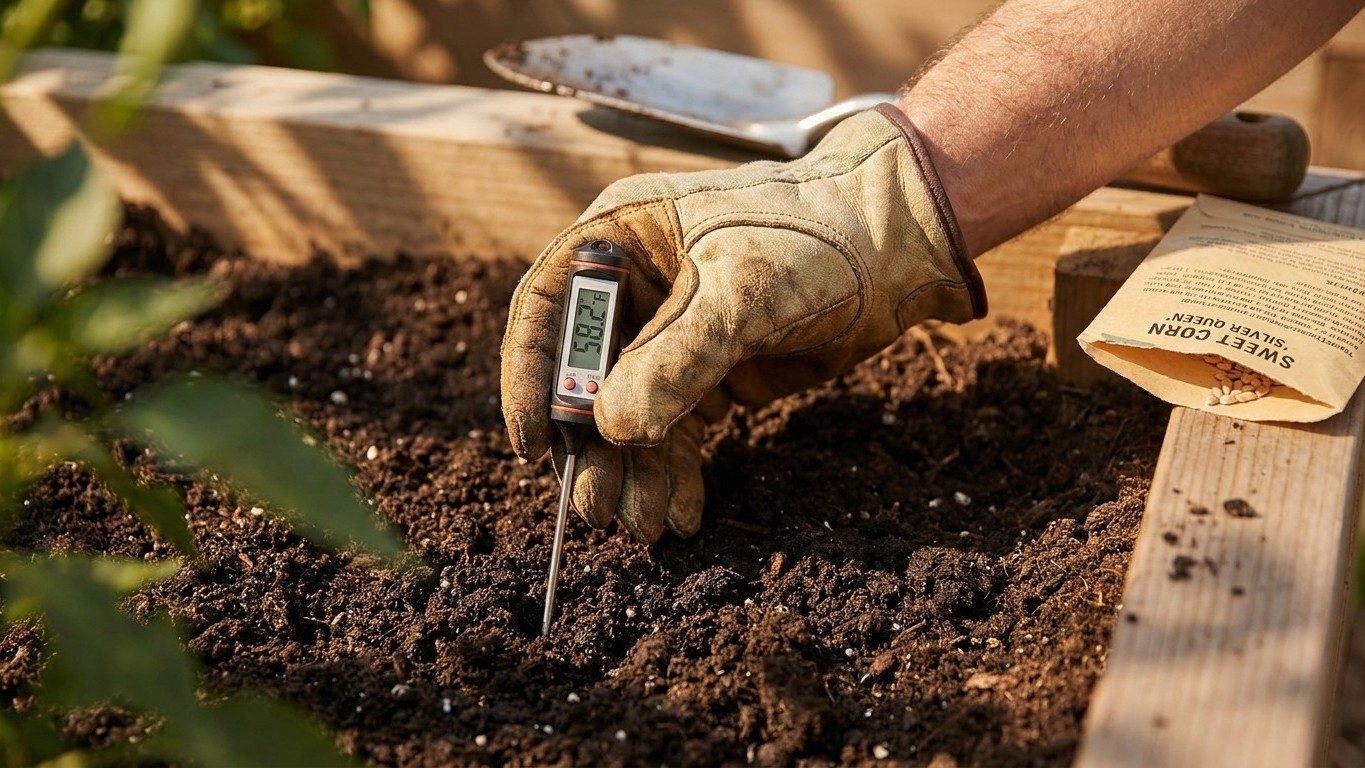

In Moncton and across most of New Brunswick, soil rarely holds a steady 60 F before early-to-mid June, well after the average May 23 last frost. That gap matters more than the frost date itself: sweet corn seed sown into cold ground just sits and rots. Once the soil warms, a 60-day variety fits this season with room to spare. A 90-day type is a much tighter squeeze, and in a cool year it may not ripen before the average October 2 first fall frost.
The short answer
Air and soil don’t warm at the same pace. Soil is slow to release winter’s cold because it holds moisture and has no direct exposure to the wind that flips air temperatures around overnight. That’s why the average last spring frost date for this region, May 23, according to Environment and Climate Change Canada’s Canadian Climate Normals for the Moncton station, tells you almost nothing about when the ground itself is warm enough for corn. The soil needs to sit at or above 60 F, and that threshold typically arrives well after the air has already stopped freezing at night. Treat May 23 as a midpoint, not a guarantee, too: in roughly half of all years on record, that last frost lands later than the average, sometimes by a week or two.
Once you can confirm 60 F soil with a simple probe thermometer pushed a couple inches deep, the math on the rest of the season gets easier. The average first fall frost at the same Moncton station falls on October 2. Counting from May 23 straight through to October 2 gives roughly 132 frost-free days on paper. But sweet corn doesn’t go in the ground on May 23, it goes in once soil is actually warm, which pushes the real planting date into June. That trims the usable window down from 132 days to something closer to 110 to 120, depending on how quickly the ground comes up to temperature in a given year.
Sweet corn needs 60 to 90 days from planting to harvest, according to Utah State University Extension’s guidance on growing sweet corn in the garden. Stack that against a trimmed window of roughly 110 to 120 usable days, and a 60-day variety clears the season with real margin. A 90-day variety uses most of what’s left, and any delay in soil warming, or an early frost that beats the October 2 average, closes that margin fast. There’s also the matter of heat. This station records an average of 0.0 days a year at 90 F or above, per the same ECCC normals. That’s not a detail to skip past: sweet corn’s day-count on a seed packet assumes a certain amount of summer heat driving growth, and a season with essentially no hot days accumulates that growth more slowly than the nominal number suggests.
Does a late variety fit here?
A 60-day variety
This is the comfortable choice for this territory. Plant once soil tests at 60 F, likely sometime in early-to-mid June, and 60 days brings you to harvest by roughly late July or early August. That leaves a full two months of slack before the average October 2 frost, which covers both a slow, cool start to the season and a slightly early autumn. Even accounting for the fact that this station logs no days at 90 F or hotter, a short-season variety doesn’t need much heat to finish on schedule, so it holds up well against a cool Maritime summer.
A 90-day variety
This one runs into trouble. Push planting to mid-June because soil was slow to warm, add 90 days, and harvest lands in mid-September, closer to the average frost date than most gardeners would like. Because this station records zero days a year above 90 F, the heat that would normally speed a long-season variety toward maturity simply isn’t there in typical years, and the real time to harvest often stretches past the nominal 90-day figure printed on the packet. Combine a late soil-warming spring with a slightly early fall frost, and a 90-day variety can be caught short before the ears finish filling out. For most gardens in New Brunswick, a 90-day sweet corn is not a reliable fit, and shorter maturities are the safer bet.
What goes wrong here
- Soil sown too cold. Planting by calendar date instead of soil temperature is the most common mistake here, because the average last frost date of May 23 tempts gardeners to plant right after, while the ground itself is still well below 60 F. Seed sitting in cold, wet soil rots before it germinates. The fix is simple: check soil temperature with a probe thermometer a few inches down, and wait for a steady 60 F rather than trusting a date on a calendar.
- A variety too late for the season. A 90-day sweet corn planted after a slow spring, in a climate with essentially no hot days to speed growth along, can run past its nominal maturity window and meet the average October 2 frost before it’s finished. The remedy is choosing a shorter-season variety for this territory, or accepting the real risk of an unfinished harvest if planting a longer one.
- Sweetness lost to a neighbor, not the climate. This failure has nothing to do with frost dates or soil temperature. Sweet corn types (su, se, and sh2) cross-pollinate freely, and if two different types tassel at the same time nearby, the sugar content of both crops suffers. The fix is timing the plantings so tasseling doesn’t overlap, sticking to one type in a given garden, and planting in blocks of three or more rows rather than a single thin row, which helps pollination stay consistent within a block.
Common questions
Does warming the soil with black plastic help in this climate?
It can speed up how quickly the ground reaches 60 F, which matters more here than in warmer regions, since soil lag behind the air is the main obstacle to an on-time planting. A soil thermometer is still the only way to confirm you’ve actually hit that mark rather than guessing from how warm the air feels.
What if I don’t have a soil thermometer?
An inexpensive probe thermometer, checked a few inches deep in the morning before the sun has warmed the surface, gives a far more reliable reading than counting weeks from the average frost date. Given how much soil temperature can vary year to year in this territory, that small tool matters more than any calendar guess.
Are the days-to-maturity on a seed packet the same as when I should start picking?
No, and mixing these two counts up causes a lot of disappointment. The 60 to 90 days from planting tells you whether the variety fits the season at all. A separate count, roughly 17 to 24 days from when silks first emerge, tells you which week to start checking ears for ripeness. They answer different questions and shouldn’t be merged into one number.
How do I know an ear is actually ready to pick?
Look for three signs together, not just one: silks that have turned dry and brown, husks that are still moist and green, and juice that runs milky (not clear, not thick) when you puncture a kernel with a fingernail. Any single sign alone can mislead you, especially dry silks on their own, which sometimes show up before the ear is truly full.