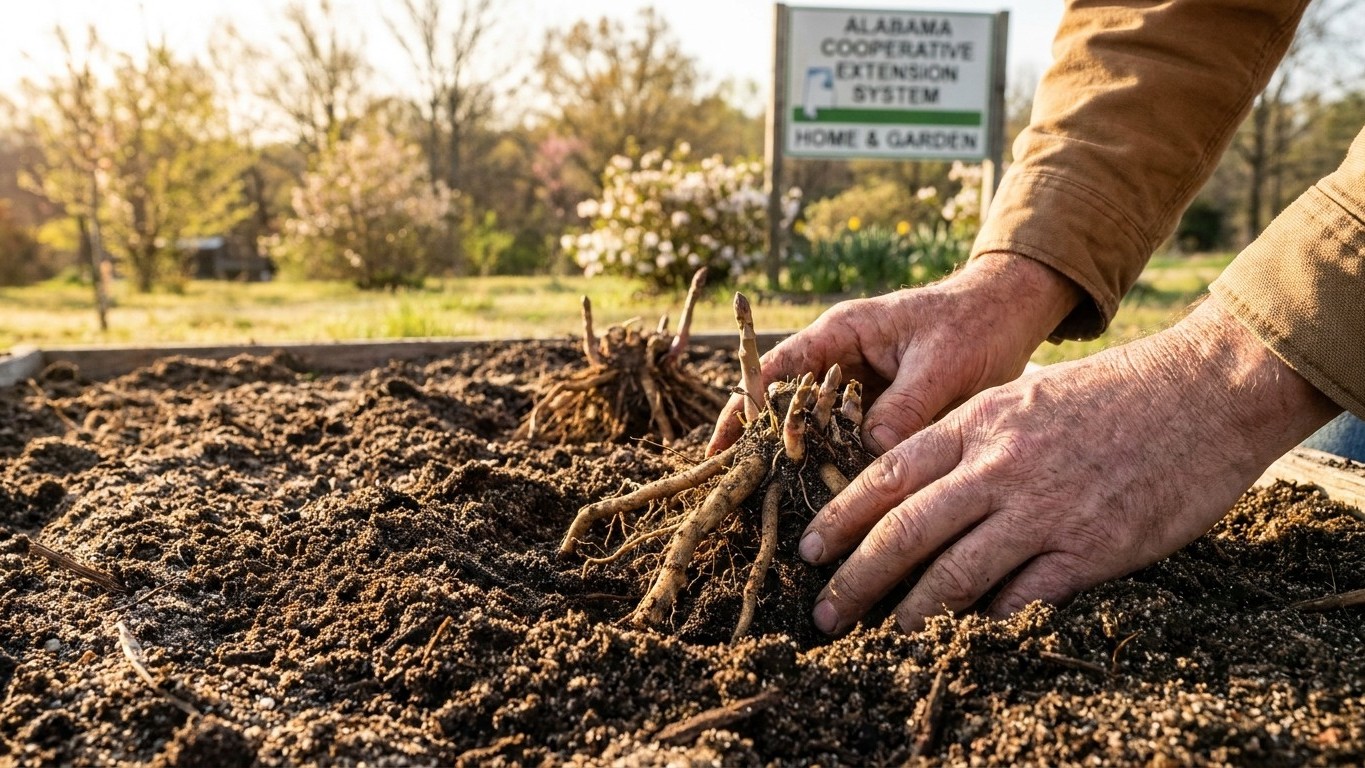

Plant Asparagus Crowns in early spring, timed to the region’s frost window rather than a fixed date, in furrows about 8 inches deep. At the reference weather station used for New Jersey, the last spring frost typically falls between March 29 and April 6, so crowns generally go in once the ground can be worked, right around that stretch. The bigger question isn’t the calendar. It’s whether the ground you’re choosing can hold this crop for the next decade or more.
The short answer
Asparagus asks for one thing above all: soil that drains. That’s the only requirement Utah State University Extension names for this crop, and it matters more here than with almost anything else you’ll grow, because once those crowns go in, they’re staying put for 10 to 15 years. There’s no rotating asparagus to a better bed next season. The spot you pick this spring is the spot you’re committing to through the next decade of gardening.
That makes the soil question worth slowing down for. The soil series USDA lists as representative of New Jersey, the Downer series, is a sandy, well-drained profile: about 79 percent sand, 6 percent clay, and 15 percent silt in the surface layer, with organic matter around 1.2 percent and a surface pH near 6.3, slightly acid. On paper, that’s close to ideal for asparagus. Sandy ground sheds water fast, which is exactly the trait a 15-year perennial root system wants. Standing water around asparagus crowns rots them; loose, sandy ground lets excess moisture pass through instead of pooling.
But that’s a state average, not your yard
The Downer series is what USDA maps as representative of New Jersey overall. It is not a soil test of the bed you’re standing in. River bottoms run heavier and hold water longer. Hill country can carry more clay. And anywhere a builder graded, filled, or compacted the ground, and that includes a lot of suburban New Jersey lots, the native profile may have nothing to do with what’s actually under your lawn now. The only way to know for certain is to dig a hole after a hard rain and watch how long the water sits, or send a sample to a soil test lab.
If what you find is heavy, slow-draining clay, don’t force asparagus into it as-is. Build a raised bed, or work several inches of coarse sand and compost into the planting area before you dig the furrows. Given that a poorly drained bed means fifteen years of struggling plants, that prep work up front is cheap insurance against a much longer disappointment.
Will the summer here water it for you?
Asparagus crowns need 1 to 2 inches of water every other week for their first two seasons in the ground, while roots are establishing. After that, once the plant is mature, that need drops to about 1 to 2 inches every three weeks. New Jersey’s summer rainfall, measured at the reference station used for these figures, comes in at roughly 13.2 inches across June, July, and August combined, a monthly split of 4.34 inches in June, 4.66 in July, and 4.15 in August, the driest of the three. Here’s how that stacks up against what the bed actually needs.
- Year one and two, June and July: The bed wants roughly 2 to 4 inches a month spread across every-other-week soakings. Normal rainfall of 4.34 and 4.66 inches those months looks like enough on paper, but it rarely falls that evenly. A lot of it arrives as a single thunderstorm that runs off a sandy surface almost as fast as it lands, rather than soaking down to where young roots are working.
- Year one and two, August: This is the month to watch. At 4.15 inches, it’s the driest of the summer, and it’s also when evaporation runs hardest on the sandy, fast-draining soil common across the state. Plan to check the soil weekly and add water by hand or by hose if a stretch of a week or more passes without rain.
- Year three onward: Once the bed only needs water every three weeks, the summer’s roughly 13.2 total inches is close to sufficient in an average year, provided it doesn’t arrive as one or two big storms with dry weeks in between. A rain gauge staked in the actual bed is the only way to know if a given week fell short.
The pattern to remember: sandy New Jersey ground doesn’t hold rain the way clay does, so total rainfall numbers can look generous while the root zone still dries out fast between storms. Watering on a schedule tied to what you actually measure in your own bed beats trusting the monthly average.
When to put the crowns in
Crowns go into the ground in early spring, and for New Jersey that generally means timing the job around the region’s last frost, which at the reference station falls somewhere around March 29 to April 6. That’s a mean date from three decades of records, not a guarantee for any single year, and it comes from an airport weather station. Suburban and rural gardens across the state often see a later final frost, sometimes by a week or two, and even more at higher elevation, so treat the date as a starting point and check conditions in your own county before you dig.
Dig furrows about 8 inches deep and set the crowns in place once the soil is workable, roughly around that frost window rather than strictly before or after it. Asparagus crowns are dormant when planted, so a light frost after planting isn’t the threat it would be to tender seedlings. The furrow itself isn’t filled in all at once. Backfill it gradually over the season, adding about 2 inches of soil back over the crowns every other month, rather than covering them completely on planting day.
Named varieties, and what isn’t published
Utah State University Extension names four varieties by their sex, and nothing more. Jersey Giant and Jersey Knight are all-male; UC 157 F1 and Purple Passion are male/female. No flavor comparison, no yield figure, and no reason to prefer one over another is published by that source, so a straightforward choice between them isn’t something this material can settle.
Starting from seed is the alternative to buying crowns, and it’s a slower road: seed-grown plants spend an extra season developing before they reach crown size, pushing the whole timeline out further before any harvest begins. For most home gardeners working toward a bed that produces for a decade or more, crowns remain the faster starting point, and the one this source documents in the most detail.
Whichever route you take, remember the harvest itself doesn’t start until year three, and even then it’s a slow ramp: about 4 weeks of cutting that first harvest year, 6 weeks the year after, and 8 weeks once the bed is fully established. The signal to stop each season isn’t a date on the calendar. It’s the spears themselves: when most of what’s coming up runs thinner than a pencil, that’s the cue to let the plant grow undisturbed for the rest of the season and rebuild its root reserves for next year.
Common questions
Can I harvest any spears the first year after planting?
No. Asparagus isn’t harvested until year three, regardless of how vigorous the ferns look in years one and two. Cutting early weakens the root system the bed depends on for the following decade of production.
What if I dig a test hole and find the water sits for hours?
That’s a sign the spot drains too slowly for a crop that’s staying in the ground for 10 to 15 years. Building a raised bed, or working in several inches of coarse sand and compost before planting, is worth doing now rather than fighting soggy crowns for the next decade.
Does it matter whether I choose an all-male or a male/female variety?
Utah State University Extension names Jersey Giant and Jersey Knight as all-male, and UC 157 F1 and Purple Passion as male/female, but doesn’t publish a reason to prefer one type over the other. No flavor or yield comparison is included in that source.
Is there a winter chilling requirement to worry about before planting?
That figure isn’t published in the source used for this article, and turning a general hardiness zone into a specific chilling number would be a guess rather than a documented fact. What is documented is the planting window itself: early spring, timed around the region’s last frost date.