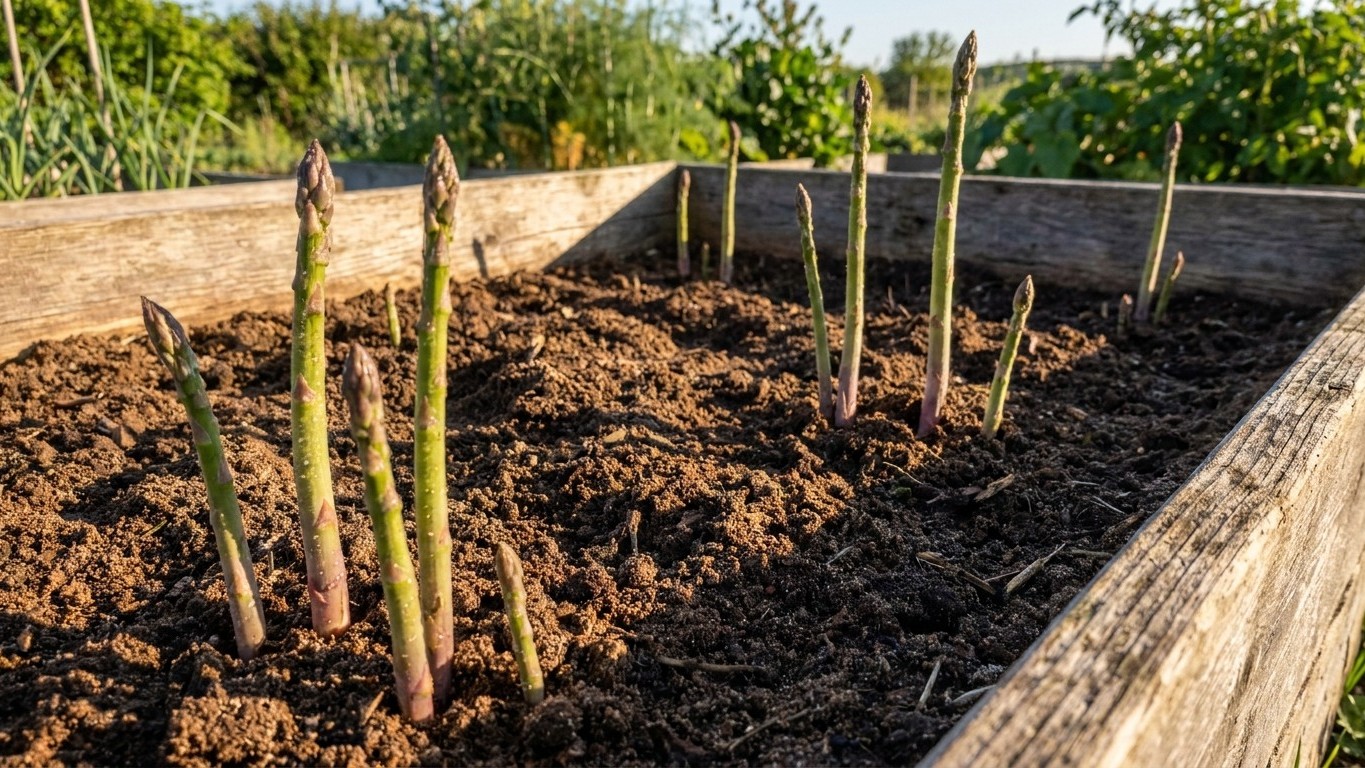

Yes, in most cases, New Jersey’s soil can carry an Asparagus Bed through its full run of ten to fifteen years, because the state’s representative soil already does the one thing this crop asks for: it drains. But “representative” is not “your garden,” and the difference is exactly where a fifteen-year decision can go wrong.
The short answer
Asparagus is unusual among garden vegetables in that it asks almost nothing of the soil except drainage. According to Utah State University Extension, crowns go into the ground once, in early spring, and the bed then produces for ten to fifteen years without needing to be replanted. That single fact changes the entire calculation a gardener makes before turning over the first shovelful. A tomato bed that sits in soggy clay is a nuisance to fix next season. an Asparagus Bed that sits in soggy clay is a nuisance for over a decade, because moving it means starting the whole three-year wait over again.
The soil USDA records as representative of New Jersey is the Downer series, an Ultisol: an old, heavily weathered and leached soil that runs naturally acid and low in nutrients. Its surface horizon measures out at 79 percent sand, 6 percent clay and 15 percent silt, with organic matter around 1.2 percent and a surface pH near 6.3. That much sand does one job extremely well: it drains. Water moves through a profile that light without much clay to hold it back, which is precisely the property asparagus needs most. On paper, then, the soil the state is known for is a reasonable match for a bed meant to sit in one spot for fifteen years.
The caution matters more here than in almost any other crop decision. The Downer series is what USDA maps as representative across the state, not a measurement taken in any one backyard. A New Jersey property near a floodplain, a lot that a builder has scraped and filled, or ground sitting over a denser subsoil layer can behave nothing like the sandy profile above. Before committing a corner of the yard to fifteen years of asparagus, dig a test hole after a rain: if water still stands in it after an hour, the ground does not drain the way this crop wants, no matter what the county’s dominant soil series says. A raised bed, or a mounded row built up with added sand and compost, solves that problem without waiting to find out the hard way in year eight.
Neither soil pH nor a winter chilling requirement for asparagus is published in the source used here, so none is offered as a target. What is published is the harvest timeline, and it deserves to be said plainly rather than softened: no spears come out of a new bed in year one or year two, no matter how vigorous the fern growth looks. Cutting starts in year three, and even then it is limited, typically around four weeks, before the grower lets the plant rebuild its root reserves. That window widens gradually in the following seasons, moving toward six weeks and later toward eight. The rule for when to stop cutting in any given year isn’t a date on a calendar. It’s a size: once most of the spears coming up are thinner than a pencil, the harvest stops and the plant is left alone to grow into fern for the rest of the season.
Will the summer here water it for you?
An established asparagus planting has a fairly specific thirst: one to two inches of water every other week for the first two years while the crowns are building their root system, then a lighter schedule of one to two inches every three weeks once the planting matures. New Jersey’s summer rainfall, and the gaps in it, decide how much of that a gardener needs to make up with a hose.
- What the sky delivers. The reference station’s normals put summer rainfall at about 13.2 inches across June, July and August, out of 46.6 inches for the year. Broken down by month, that’s 4.34 inches in June, 4.66 in July, and 4.15 in August, which stands as the driest of the three summer months.
- What the young bed needs. In the first two summers, a bed asking for one to two inches every other week adds up to roughly six to thirteen inches over a thirteen-week summer stretch, depending on which end of that range the weather calls for. Set against 13.2 inches of rainfall, the season’s total looks like it could, on average, come close to covering the requirement.
- Why the average is misleading. Rain in a New Jersey summer rarely arrives as a gentle, evenly spaced inch every other week. It tends to come as a handful of thunderstorms separated by dry stretches, and on a sandy, fast-draining profile like the state’s representative soil, a heavy downpour moves through the root zone quickly rather than lingering the way it would on clay. That combination, quick sandy drainage plus clumped rainfall, means the total for the season can look adequate on paper while the bed still goes thirsty for a week or two at a stretch.
- Where the gap shows up worst. August, the driest of the three summer months at 4.15 inches, is also often the stretch when evaporation runs highest. A gardener who skips checking soil moisture in August because “it rained plenty in June” is the one most likely to end up with an underwatered bed exactly when the crowns need reserves for the following spring’s growth.
- The only reliable fix. A rain gauge set in the actual bed, checked weekly through the growing season, is what tells a gardener whether the sky covered that week’s one to two inches or whether a hose needs to fill the difference. Normals describe what a region can usually expect; they don’t describe what fell on a particular row two weeks ago.
When to put the crowns in
Crowns go into the ground in early spring, and for New Jersey that means timing the work around a last spring frost that, at the reference station, falls somewhere around March 29 to April 6. That figure is a mean drawn from freeze-probability data at one airport station, not a promise for every county, and it’s worth treating it that way: suburban and rural gardens commonly see their last frost land later than an airport reading, sometimes by a week or two, and more than that at higher elevation. The safest approach is to watch the local extension office’s frost guidance for the specific county rather than planting strictly by the reference date.
Crowns are set into furrows dug about eight inches deep. Rather than filling that furrow all at once, the soil goes back in gradually across the season, roughly two inches every other month, as the emerging shoots grow tall enough to be covered without smothering them. That slow backfill is part of why the first two years of a bed take patience: the row looks unfinished and shallow for months while the crowns establish themselves underground.
Seed is the alternative route to starting a bed, though it adds time before the planting reaches the stage a purchased crown starts at. A gardener choosing seed is committing to raising seedlings well ahead of the frost window and transplanting them once the danger of frost has passed, effectively adding a year onto the front end of the fifteen-year clock before the bed behaves like a crown-started planting of the same age. For most home gardeners weighing the difference between waiting one extra year for seed-grown plants or starting with crowns already a year old, crowns remain the more direct path into production.
Variety choice at planting time comes down to a short published list, and the only distinction that source draws between them is sex, not flavor or yield. Jersey Giant and Jersey Knight are all-male varieties; UC 157 F1 and Purple Passion are male-and-female types. No comparative performance, taste, or yield claim is published for any of the four, so choosing among them is less a matter of picking a “better” variety and more a matter of which one a supplier happens to carry.
Common questions
Can an Asparagus Bed be moved once it’s planted?
Nothing in the sourced guidance suggests transplanting an established bed. Since crowns take three years before any harvest at all, moving an established planting effectively resets that clock, which is why choosing a well-drained spot before planting matters more than for most vegetables.
Does New Jersey’s soil need lime or fertilizer before planting?
Neither soil pH nor a fertility target for asparagus is published in the source used for this article, so no specific number is given here. A soil test through the local cooperative extension office is the way to get an actual reading for a specific plot rather than relying on the state’s representative pH figure.
What happens if the summer stays dry for several weeks straight?
The bed’s stated need, one to two inches every other week for the first two years and every three weeks afterward, doesn’t pause for a dry spell. A stretch without rain longer than that window is the signal to water manually rather than assume the next storm will catch the planting up.
Is it too late to plant if the last frost date has already passed?
Early spring is the described planting window, and the frost dates given here are averages rather than fixed cutoffs, so a planting a week or two after the mean last-frost date is not unusual, particularly since suburban gardens often see frost risk linger past an airport station’s reading anyway.