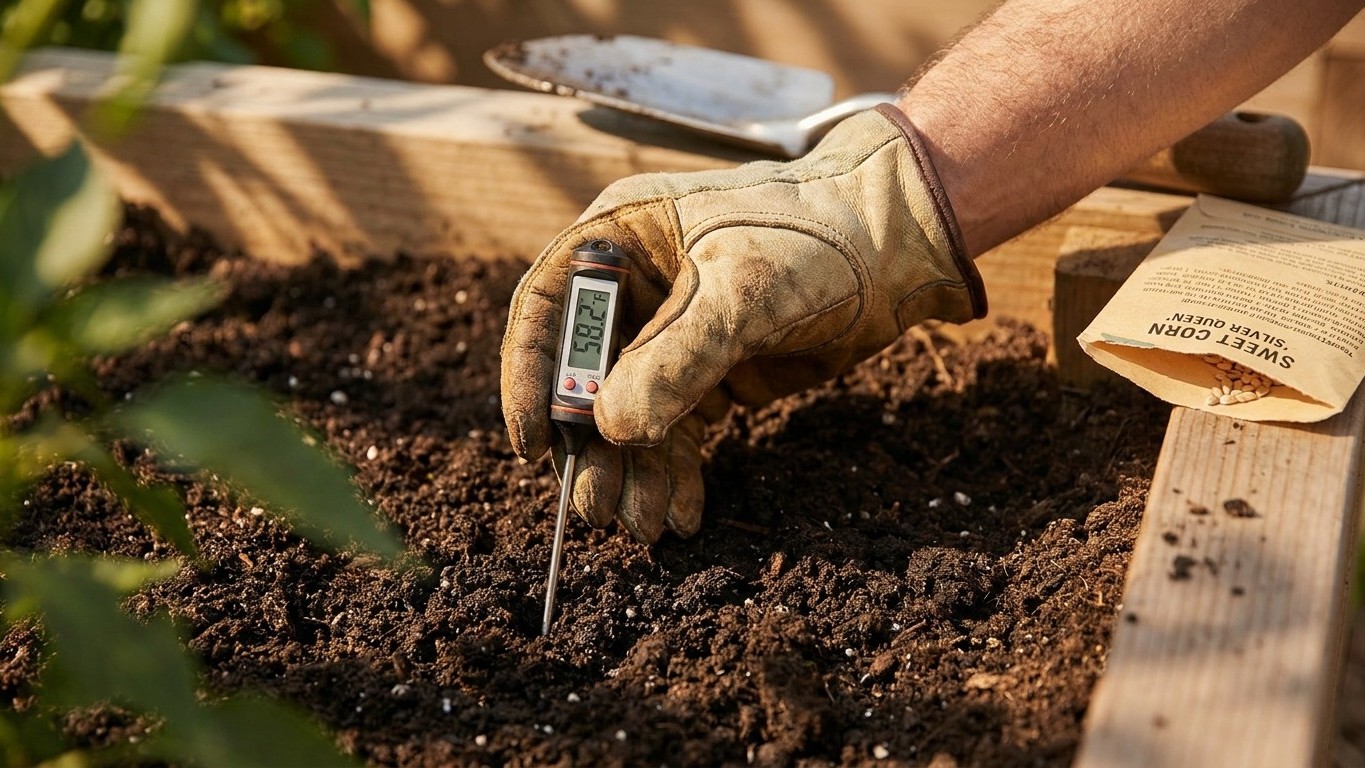

In New York City, sweet corn goes into the ground once soil temperatures climb past 60°F, a mark reached later than the region’s last spring frost. That frost typically clears the city between March 23 and April 3, but soil takes extra time to catch up. Once it does, both 60-day and 90-day varieties have ample room to mature before the first fall frost, which arrives between November 14 and November 27. The timing math works out comfortably in this climate zone.
The short answer
Here’s the part gardeners tend to skip: the last frost date and the “safe to plant” date for sweet corn are not the same day. Air temperature can climb above freezing weeks before soil does. Dirt is slow to warm. It holds winter’s cold longer than the air above it, so even after New York City’s frost risk clears in late March or early April, the ground itself is still too cold for corn seed to germinate reliably. Sweet corn needs soil above 60°F to sprout without rotting, and that threshold lands well after the frost-free date, not on it.
This gap matters because it’s the actual planting signal, not the frost date printed on seed packets or garden calendars. A gardener who drops seed into the ground the week after the last frost, assuming the job is done, is very likely planting into soil that’s still too cool. The seed sits, takes on water, and rots before it ever pushes a shoot up. Waiting for the soil itself to cross 60°F, checked with a simple soil thermometer a few inches down, is the more reliable move.
Once that threshold is met, the second question is whether there’s enough season left. Sweet corn needs 60 to 90 days from planting to harvest, depending on the variety. New York City’s growing season, measured from the last spring frost window (March 23 to April 3) to the first fall frost window (November 14 to November 27), runs roughly seven and a half months. Even after subtracting the extra weeks it takes soil to warm past 60°F, there’s still a long stretch of frost-free time left before autumn’s first freeze shows up. That’s enough room for a 60-day variety with margin to spare, and enough for a 90-day variety too, as the next section works out in more detail.
Summer heat is part of this picture as well. New York City averages 12.2 days a year at 90°F or higher, a load that drives up water demand and can stress corn during pollination if the crop dries out during a hot stretch. It’s not a planting-date issue, but it’s a reason not to let watering slide once the stalks are tasseling.
Does a late variety fit here?
A 60-day variety
A short-season sweet corn variety is the easy case in this climate. Plant it once soil has crossed 60°F, and it matures in about two months. Given that New York City’s frost-free stretch runs from early April into mid-to-late November, a 60-day corn planted even somewhat late in the spring still finishes with weeks to spare before the first fall frost. This is also the variety type that gives room for a second, staggered planting later in the season, since it clears out of the garden quickly and doesn’t tie up bed space for long.
A 90-day variety
The longer-season variety is the one worth checking carefully, and here it fits. Even allowing for the extra weeks soil needs to warm past 60°F after the last frost date, a 90-day corn planted in late spring still has roughly four to five months of frost-free growing time ahead of it before the first fall frost arrives between November 14 and November 27. Ninety days is about three months, so the margin holds. This isn’t the case everywhere in New York; upstate regions and the Adirondacks see both an earlier first fall frost and a later last spring frost, which squeezes that window considerably. In New York City’s milder, urban-influenced climate, though, a 90-day variety has enough season to reach full maturity without racing the clock. The one caution is not to delay planting further than necessary. A 90-day corn started very late in June or beyond starts eating into that margin fast, especially if a cool, wet stretch slows early growth.
What goes wrong here
- Soil sown too cold. Planting right after the last frost date, before soil has actually crossed 60°F, is the most common mistake in this climate. Seed sits in cold, often wet ground and rots instead of germinating. The fix is simple: check soil temperature directly with a thermometer a few inches down, rather than counting days from the frost date, and hold off until it reads above 60°F.
- A variety pushed too late for the season. A 90-day corn fits New York City’s window, but only if it goes in without excessive delay. Waiting too long into summer to start a longer-season variety, whether from a late spring or a second successive planting, can leave it short of time before the first fall frost between November 14 and November 27. If a planting date is running late, switching to a 60-day variety keeps the harvest on schedule.
- Sweetness lost to nearby tasseling, and it has nothing to do with weather. Standard (su), sugar-enhanced (se), and supersweet (sh2) sweet corn types cross-pollinate if they tassel at the same time, and the result is starchy, disappointing ears instead of sweet ones. This is a timing and planning problem, not a climate one. The fix is to avoid planting different types so that their tasseling windows overlap, and to grow each variety in blocks of three or more rows rather than single rows, which improves pollination within the block itself. Staggering planting dates by variety, so tasseling happens at different times, is the practical way to keep types from crossing.
Common questions
Can I plant sweet corn right after the last frost date in New York City?
Not reliably. The last frost date (March 23 to April 3) marks when freezing air temperatures become unlikely, but soil needs to separately climb above 60°F before corn seed will germinate without rotting. Check soil temperature directly rather than counting days from the frost date.
How do I know when to harvest, once the corn is planted?
Days-to-maturity from planting (60 to 90 days) tells you whether the season fits, but it’s not the harvest signal itself. Once silks appear, ears are typically ready roughly 17 to 24 days later. The actual test for ripeness is three signs together: dry, brown silks, husks that are still moist and green, and milky (not clear, not doughy) juice from a punctured kernel.
Is a 90-day sweet corn variety too risky to grow in New York City?
Given the city’s frost-free window, roughly early April through mid-to-late November, a 90-day variety has enough time to mature if it’s planted without much delay once soil crosses 60°F. The margin shrinks fast upstate or in the Adirondacks, where frost arrives earlier in fall and lingers later in spring.
How far apart do different sweet corn types need to be planted to stay sweet?
There’s no published distance for this. What determines whether types cross is timing: su, se, and sh2 varieties lose their sweetness if they tassel at the same time. Stagger planting dates so tasseling doesn’t overlap, and grow each type in its own block of three or more rows rather than single scattered rows.