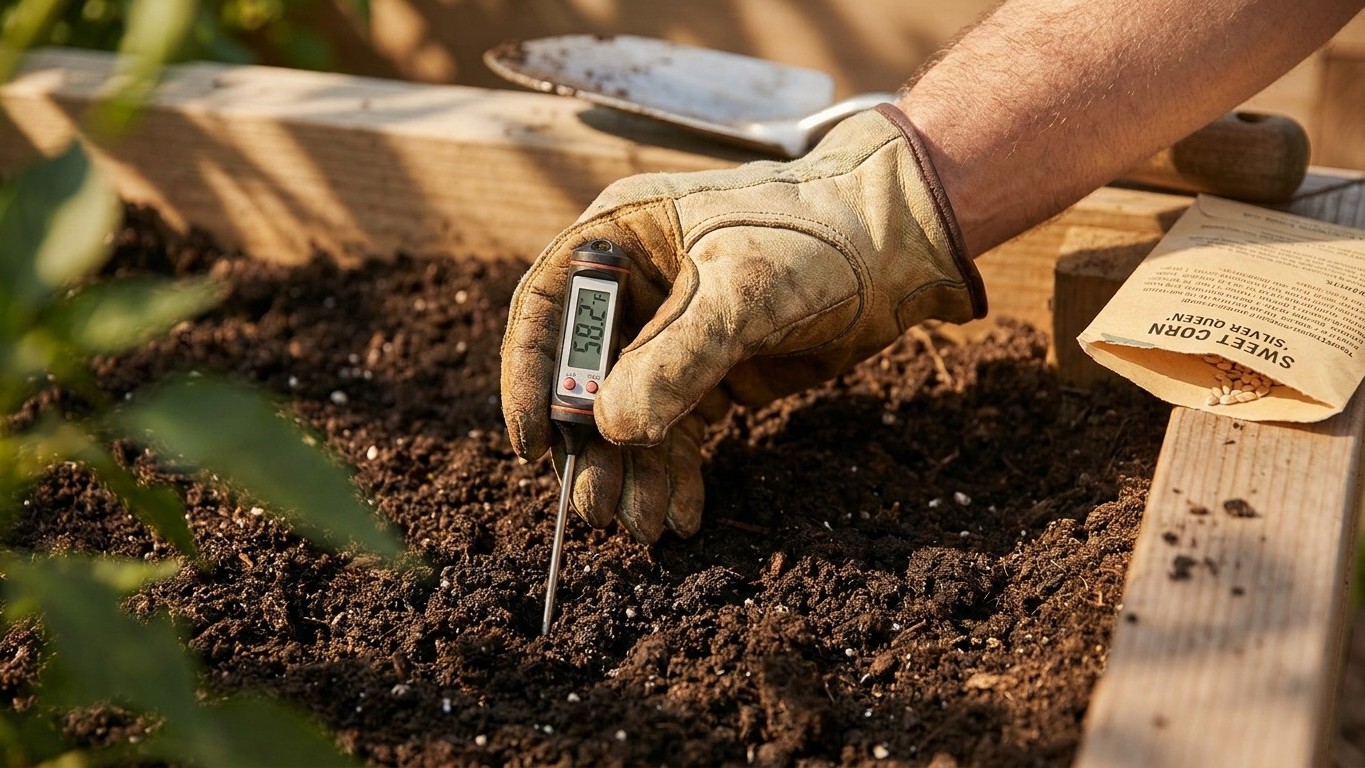

The straight answer: sweet corn in the Northwest Territories should go in the ground only after the soil itself has warmed past 60 F, not on the calendar date of the last frost. Given the average frost dates here (May 25 in spring, September 18 in fall) and zero days a year above 90 F, the safe planting window sits well into June, and only fast-maturing varieties have a realistic shot at ripening before autumn.
The short answer
Soil temperature, not air temperature, is what starts the clock for sweet corn. Utah State University Extension puts the threshold at 60 F soil before you plant, and that threshold has nothing to do with whether frost has already passed. In the Northwest Territories, where the average last spring frost falls around May 25, the ground itself is almost never at 60 F by that date. Soil warms slower than air, especially this far north, so the real planting window opens later, likely well into June for most gardens here. Anyone who drops seed into cold soil right after the last frost date is planting into ground the corn simply can’t use yet.
That lag matters more here than in most of the country. With zero average days a year climbing above 90 F, this territory accumulates heat slowly. Corn doesn’t just need warm soil to germinate, it needs sustained warmth through the season to push through its 60 to 90 day maturity window. A cool summer with no real heat spikes stretches that window out rather than compressing it, which is the opposite of what a short-season gardener wants.
Run the numbers on the other end of the season. The average first fall frost lands around September 18. That date is a mean, not a guarantee, so in roughly half of years frost arrives earlier than that, and in half it arrives later. Treat September 18 as the midpoint of a range, not a date you can plant around with confidence. Once soil finally reaches 60 F, likely sometime in June, and you count forward from there to a September 18 frost, the usable growing stretch is somewhere in the neighborhood of 90 days at best, and possibly less if the soil is slow to warm or the fall frost arrives early.
That math leaves almost no cushion for a variety on the long end of the 60 to 90 day range. It leaves real room, though not unlimited room, for a variety on the short end. The takeaway for this territory: wait for warm soil rather than a warm calendar, and lean toward the fastest-maturing option you can find rather than gambling on extra sweetness from a slower type.
Does a late variety fit here?
The 60 to 90 day figure from Utah State University Extension is a range, not a single number, and where a given variety falls in that range determines whether it has any business being planted in this territory at all.
A 60-day variety
Start with soil finally hitting 60 F, which realistically happens sometime in June rather than in May. Count 60 days forward and you land somewhere in August, comfortably ahead of the average September 18 first fall frost. Even allowing for a slow start, a cool stretch mid-season, or a fall frost that arrives earlier than average, a 60-day variety carries a real margin of safety. This is the end of the range that actually fits the Northwest Territories growing season without asking for a lucky year.
A 90-day variety
Now run the same math with 90 days instead of 60. Starting from soil at 60 F in June and counting 90 days forward pushes harvest into mid-to-late September, right up against or past the average first fall frost date of September 18. Remember that date is a mean: in half of years frost comes later, which might just barely bail out a 90-day crop, but in the other half it comes earlier, which means the corn simply doesn’t finish. There’s no cushion built into that math, and zero average days above 90 F means there’s little chance of a hot stretch accelerating maturity to make up the difference. A 90-day variety does not fit this territory’s window with any reliability. Gardeners set on trying one should treat it as an experiment with a real chance of failure, not a dependable crop plan.
What goes wrong here
- Soil sown too cold. Planting on the last frost date (around May 25 on average) rather than waiting for the soil itself to reach 60 F is the most common mistake. Cold, wet soil rots seed or produces weak, uneven germination. The remedy is simple: check soil temperature directly rather than trusting the frost date, and hold off until it’s consistently above 60 F, even if that means waiting well into June.
- A variety too late for the season. Choosing a 90-day type because it promises better flavor or yield ignores the arithmetic above. With the growing window this tight, a late variety risks an unripe crop caught by the average September 18 frost, or worse, an early frost that lands before that mean date. The remedy is to favor varieties at the 60-day end of the range and accept that this territory doesn’t have room for slower corn.
- Sweetness lost because two types tasseled together. This one has nothing to do with climate. Utah State University Extension notes that su, se, and sh2 sweet corn types lose their sweetness if they tassel at the same time, since cross-pollination between types dilutes flavor. The source gives no isolation distance in feet or rows, only the condition itself: the types must not be shedding pollen simultaneously. The remedy is to separate plantings by timing rather than distance, staggering sowing dates or choosing only one type for a given garden, and to plant in blocks of three or more rows rather than single lines, which is the shape Utah State University Extension recommends for reliable pollination within a single type.
Common questions
Can I just plant on the last frost date to be safe?
No. The last frost date and the soil reaching 60 F are two different events, and the soil lags well behind. Planting on May 25, the average last frost date, almost always means planting into soil that’s still too cold for sweet corn to germinate reliably.
Is the September 18 fall frost date a hard deadline?
It’s an average, which means in about half of years frost arrives after that date and in about half it arrives before. Plan your harvest as though it could land earlier than September 18, since treating the average as a guarantee is exactly the risk that catches a 90-day variety out.
Why does a 60-day variety make more sense here than a 90-day one?
Because the realistic window between warm soil (likely sometime in June) and the average first fall frost (September 18) leaves little more than about 90 days at best, and often less. A 60-day variety fits inside that window with margin to spare; a 90-day variety asks for a longer season than this territory reliably provides.
How far apart do different sweet corn types need to be planted?
That specific distance isn’t published by the source behind this guidance. What is established is the condition to avoid: su, se, and sh2 types must not tassel at the same time, or the sweetness of the crop suffers. Manage that through staggered timing or by growing a single type, rather than relying on a spacing figure that isn’t documented here.