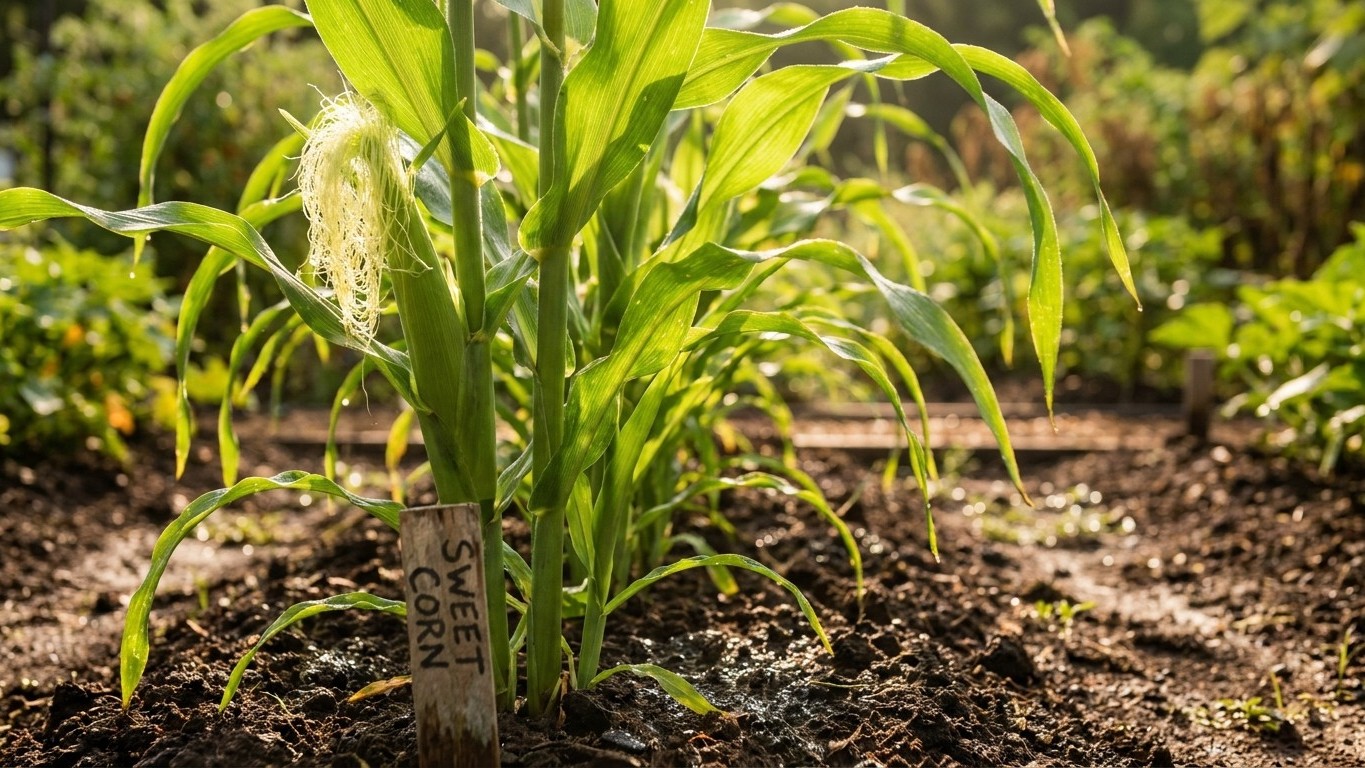

Sweet corn’s odds in the Northwest Territories are poor, and the reason isn’t the cold snaps of early spring. It’s the compressed stretch between soil warm enough to plant and the first frost that ends the season. Around Yellowknife, that stretch runs tight even for the fastest varieties, and it runs out entirely for slower ones.
The short answer
Sweet corn seed doesn’t care about air temperature so much as what’s happening a few inches underground. Utah State University Extension puts the threshold at soil above 60 F before planting makes sense at all. That’s the number that matters here, and it lands well after the last spring frost, not on the same day as it.
At Yellowknife A, the average last spring frost falls on May 25. That date comes from Environment and Climate Change Canada’s Canadian Climate Normals, based on records from 1981 to 2010, and it’s a mean, not a guarantee. In one year out of two, frost shows up later than May 25. Treat that date as the midpoint of a range, not a line you can plant against safely.
Soil doesn’t flip to 60 F the moment the air stops freezing overnight. It warms slower, especially this far north where the ground has spent months locked under snow and where daylight hours, while long in midsummer, arrive gradually in spring. No station-level soil-temperature record for Yellowknife is published in the data behind this article, so no specific calendar date can be given for when the ground actually clears 60 F. What can be said plainly is that it happens later than May 25, likely by a matter of weeks rather than days, which pushes safe planting into June before the clock on maturity even starts.
That clock, once it starts, needs 60 to 90 days to run its course, again per Utah State University Extension. The first fall frost at Yellowknife A averages September 18, also an ECCC normal from the 1981-2010 period, and again a midpoint rather than a safe cutoff. Count forward from a June planting date and the arithmetic gets uncomfortable fast. If soil hits 60 F in early June, a 60-day variety maturing in early August leaves a comfortable cushion before the average frost. A 90-day variety maturing in early September is cutting it close against a date that, half the time, arrives even earlier than average.
Add to that the region’s summer heat. Yellowknife averages 0.0 days a year at 90 F or hotter, according to the same ECCC normals. Sweet corn is a warm-season crop that grows fastest with real heat load behind it. Without those hot days, the “days to maturity” printed on a seed packet, numbers generated in warmer test plots, tend to run long here. A crop rated at 90 days in a temperate zone may need more like 100 days’ worth of calendar time to actually finish in a climate this cool, because growth slows on cooler days even when frost isn’t the threat.
Put together: the window exists, but it favors fast varieties only, and it offers little room for error on either end.
Does a late variety fit here?
A 60-day variety
A variety rated at roughly 60 days from planting is the one type of sweet corn that has a realistic shot in this territory. Assume soil reaches 60 F sometime in early-to-mid June, a reasonable read given how far behind the May 25 frost date soil warming tends to lag in a subarctic climate. Sixty days from a mid-June planting lands the ears ready in mid-August, more than a month ahead of the September 18 average first frost. That cushion matters because the frost date is a mean, not a promise, and a fast variety gives room to absorb a year when autumn arrives early or when cool weeks slow growth below the seed packet’s optimistic count. It also gives room to delay planting slightly if a cold spring pushes soil warming later than usual, without running out of season entirely.
A 90-day variety
A variety rated at 90 days does not fit comfortably here, and it’s worth saying that plainly rather than hedging. Ninety days from a mid-June planting reaches maturity around mid-September, essentially on top of the average first fall frost of September 18. That leaves no buffer for a late-arriving spring, no buffer for a cool summer slowing growth beyond the rated maturity window, and no buffer for the simple fact that frost dates are averages, meaning the actual frost arrives earlier than September 18 in roughly half of all years. Add the near-total absence of 90 F days to drive fast growth, and a 90-day variety is more likely to be caught by frost with ears still immature than to reach harvest. For growers set on trying anyway, the only real strategy is treating any date beyond roughly 70 to 75 days as a gamble rather than a plan, and accepting that a hard freeze could end the season before the ears fill out.
What goes wrong here
- Soil sown too cold. Planting sweet corn seed into ground that hasn’t yet reached 60 F, tempting in a short season where every week feels precious, invites poor germination and seed rot rather than an earlier harvest. The remedy is patience: wait for the soil itself to warm, using a simple soil thermometer rather than the calendar or the air temperature as the guide, even if that means planting weeks after the last spring frost has already passed.
- A variety too late for the season. Choosing a 90-day type because it’s what’s available, or because it promises bigger ears, sets up a race against the September 18 average frost that the corn is likely to lose. The remedy is matching variety to window before buying seed at all, favoring the fastest maturing type on hand and treating anything rated much beyond 70 or so days as poorly suited to this climate.
- Sweetness lost because two types tasselled together. This one has nothing to do with frost or soil temperature. Utah State University Extension notes that su, se and sh2 sweet corn types lose their distinct sweetness if they tassel and cross-pollinate at the same time. No isolation distance is published by that source, so the fix isn’t a measurement in feet, it’s timing and layout: stagger plantings so the varieties don’t tassel in the same window, or keep different types in separate blocks planted with enough of a gap in timing that pollen from one isn’t drifting onto the silks of another. Sweet corn should be planted in blocks of three or more rows rather than single rows regardless, since block planting improves pollination for any single variety grown alone.
Common questions
Can sweet corn be planted right after the last frost in the Northwest Territories?
Not by soil temperature alone. The last frost averages May 25 at Yellowknife A, but soil needs to reach 60 F before planting makes sense, and that threshold is reached later than the frost date, not on it. Planting too early into cold soil risks seed rot rather than a head start.
How is ripeness actually checked once corn is growing?
Three signs need to line up together: dry brown silks, husks that are still moist and green, and milky juice from a kernel that’s been punctured. Any one sign alone isn’t enough to call it ready.
Does the 60-to-90-day maturity window mean the same thing as time from silk emergence?
No, and mixing the two up leads to picking too early or too late. The 60-to-90-day count runs from planting and answers whether the crop fits the season at all. A separate, much shorter count, roughly 17 to 24 days from when silks first appear, answers which week to actually pick. They measure different stages and shouldn’t be merged into one number.
Is there a way to grow sweet corn here without the marginal timing risk?
Not by variety choice alone, since the fastest available types are still working with a short window. Some growers manage the risk with transplants started indoors to get a head start before soil outdoors reaches 60 F, though that shifts the challenge rather than removing it, and the crop still needs the outdoor season to finish once transplanted.